
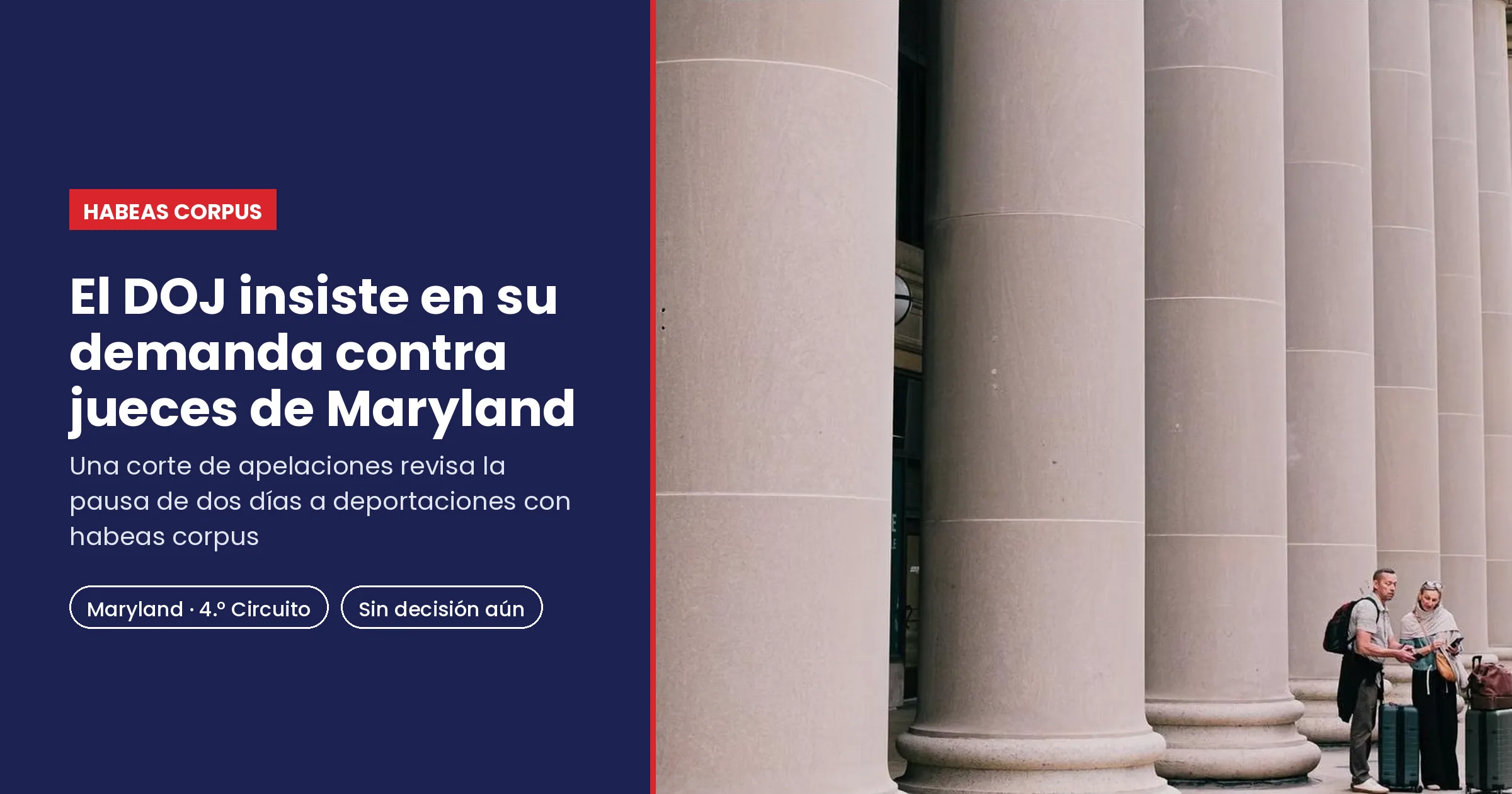
The DOJ lawsuit against Maryland judges is back in court, this time before the U.S. Court of Appeals for the Fourth Circuit. At Campos Law Firm, we closely monitor developments in U.S. immigration policy to protect our clients’ rights and future. On Friday, October 30, 2026, according to Reuters, the U.S. Department of Justice (DOJ) asked that court to revive a lawsuit a judge had dismissed in 2025.
The court heard arguments and has not issued a decision. This is also not a nationwide change to deportation timelines. Here is what we know, what we don’t, and what you can do.
What Did the Maryland Judges Order?
In May 2025, George L. Russell III, chief judge of the U.S. District Court for the District of Maryland, issued a standing order for detained immigrants who file habeas corpus petitions in that district. The order bars the government from deporting them or changing their status until 4:00 p.m. on the second business day after the petition is filed.
Russell explained that the court was receiving many after-hours petitions, leading to rushed hearings and little information about where detainees were. The pause is meant to let the case reach a judge, let the person talk to a lawyer, and give the government a chance to respond. On December 1, 2025, the court revised it: detainees must now certify that they are held in Maryland and need emergency relief, and a judge can lift the pause if the government shows “good cause.”
What Is the DOJ Lawsuit Against Maryland Judges About?
In June 2025, the DOJ sued all 15 federal judges in Maryland, the clerk, and the court itself in United States v. Russell. It argued that a blanket order cannot halt deportations without looking at each case. On August 26, 2025, Judge Thomas Cullen of Virginia, assigned because the Maryland judges could not rule on their own case, dismissed the suit.
Cullen found that the government lacked standing to sue and that the judges were immune. He wrote that the Executive had pulled an entire court into “potentially calamitous” litigation and that the normal path was to appeal the order. In January 2026, the DOJ tried to end its own appeal, arguing the December order made it moot, but on February 10 the Fourth Circuit ruled that the case was still alive.
What Is Habeas Corpus, and Why Does Timing Matter?
Habeas corpus is a petition asking a federal court to review whether a detention is lawful. In immigration cases, it is mainly used to challenge detention by U.S. Immigration and Customs Enforcement (ICE), for example when someone has been held for a long time without a bond hearing. It is not an appeal of a removal order, which usually follows a different path.
The problem is the clock. If a person is deported before a judge reads the petition, the court may be left with no practical way to protect them, and bringing someone back is hard even when an error is proven. That is why a few hours or two days can decide whether a case is heard at all.
Limits on habeas are also before the Supreme Court. As we explained in our article on Mahmoud Khalil’s habeas corpus case, another appeals court restricted in 2026 when judges can review immigration detention.
What Changes for You?
For now, nothing outside Maryland. The two-business-day pause applies only to habeas petitions filed in the U.S. District Court for the District of Maryland, and it remains in effect in its December 2025 form while the Fourth Circuit decides. If the appeals court sided with the government, the lawsuit would go back to the district court; it would not automatically end the order.
If a relative is detained by ICE, in any state:
- Find them: use the ICE Online Detainee Locator with their name and country, or their Alien Registration Number (A-Number).
- Keep their documents handy: A-Number, date of entry, Immigration Court notices, and any prior orders.
- Do not sign without advice: voluntary departure or a stipulated removal can close off options.
- Act fast: a habeas petition or a request for a stay of removal must be filed before the person is transferred or deported.
Protect Your Immigration Status with Campos Law Firm
When a deportation is imminent, every hour counts, and the options depend on where the person is held and the stage of the case. Our immigration attorneys assess whether a habeas corpus petition, a stay of removal, or another path applies, without unrealistic promises.
Do not leave your immigration status to chance. Call us today at +1 (844) 922-6767 to schedule a free, confidential consultation in English or Spanish. Campos Law Firm: Legal Solutions in All Areas of Law.
With information from NBC News, the Associated Press, The Daily Record and The Daily Record on the Fourth Circuit.