

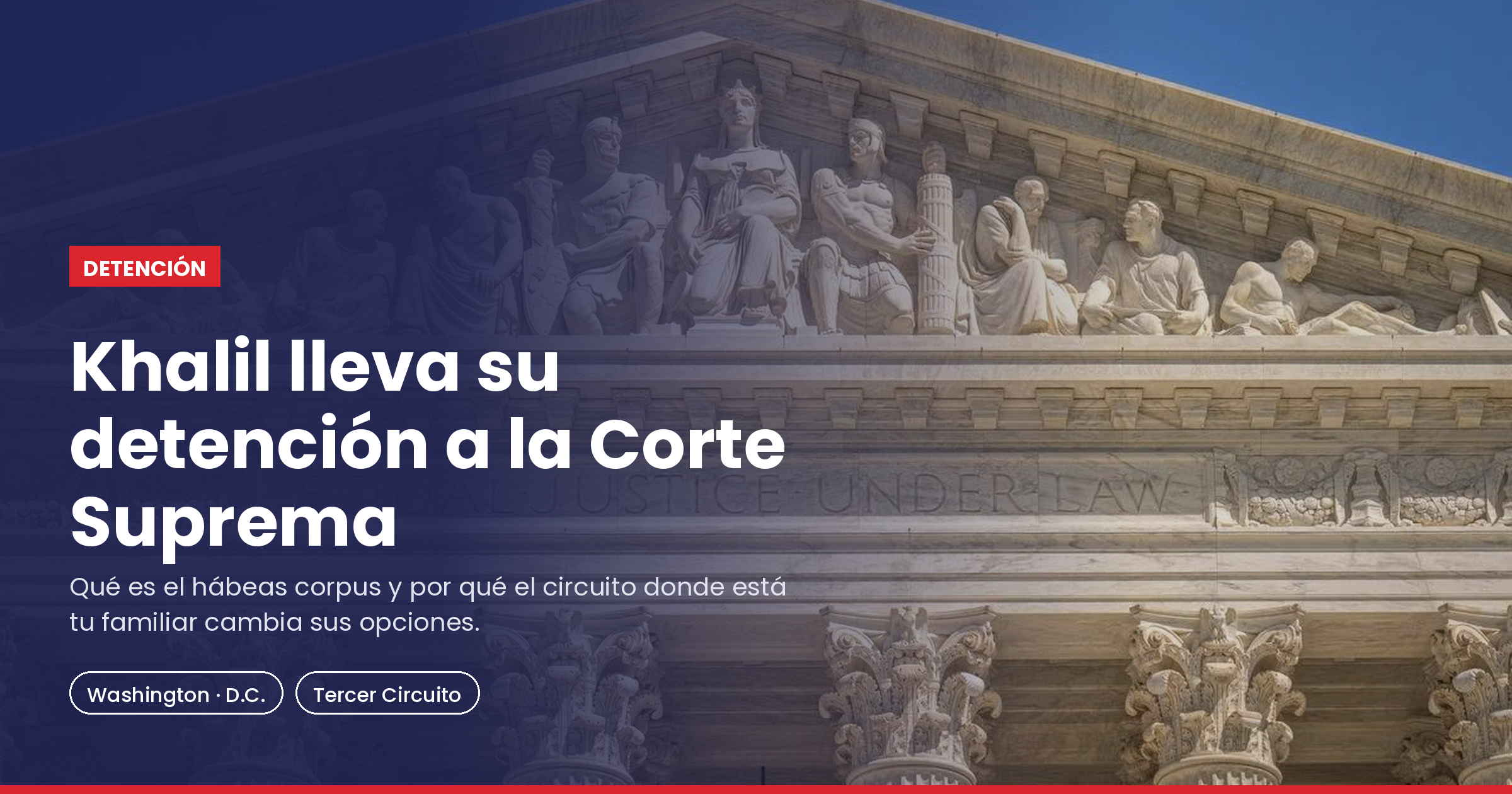
At Campos Law Firm, we closely monitor developments in U.S. immigration policy to protect our clients’ rights and future. On October 19, 2026, Mahmoud Khalil, a lawful permanent resident and former Columbia University graduate student, asked the Supreme Court to review a Third Circuit ruling that bars federal judges from promptly reviewing whether an immigration detention is lawful.
The legal question affects any family with a loved one held by Immigration and Customs Enforcement (ICE). Below, we explain what is known, what is not, and what you can do.
What did Mahmoud Khalil ask the Supreme Court to decide?
Khalil was arrested on March 8, 2025, in New York and moved to New Jersey and then to Louisiana. The government deems him removable under a foreign-policy ground, citing his role in the 2024 pro-Palestinian protests at Columbia. He spent 104 days in custody until a federal judge in New Jersey ordered his release on bail on June 20, 2025, after finding the government had acted unconstitutionally.
On January 15, 2026, a divided Third Circuit panel vacated that release. According to the Associated Press, the court held that federal judges lack jurisdiction to review whether a detention is lawful until the immigration courts have fully decided the case. On May 22, the full circuit declined to rehear the decision by a 6-5 vote.
The petition asks the Supreme Court to decide whether the Immigration and Nationality Act really strips federal judges of the power to review, through habeas corpus, a detention alleged to be retaliation for protected speech, and, if so, whether that restriction violates the Constitution. The Department of Homeland Security (DHS) responded that a visa or green card “is a privilege” and urged him to self-deport.
The Third Circuit put its ruling on hold while the Supreme Court decides, so Khalil remains free. The Supreme Court has not yet agreed to hear the case; if it does, arguments would likely be heard in 2027.
What is habeas corpus, and why does it matter if a relative is detained?
Habeas corpus is the remedy that lets anyone deprived of liberty ask a federal judge to examine whether their detention is lawful. It is recognized in federal law (28 U.S.C. § 2241) and protected by the Constitution. In immigration matters, it is the tool attorneys use when ICE holds someone for months without bond or a hearing.
The practical difference is time. A case before the Immigration Court, followed by an appeal to the Board of Immigration Appeals (BIA) and then to a federal court, can take months or years with the person detained. Habeas corpus asks a judge to review the detention now, not at the end.
What the Third Circuit decided is that, for claims like Khalil’s, that fast door is closed: detention must first be challenged inside the immigration system, which answers to the executive branch. His attorneys argue that path offers no real review of “now or never” claims.
Why does the judicial circuit where your relative is held matter?
The United States is divided into federal circuits, and each one sets the rule for the states it covers. Today that rule is not the same nationwide: the Fourth Circuit, based in Richmond, Virginia, upheld in 2026 the release of Georgetown scholar Badar Khan Suri and held that federal judges can review an allegedly retaliatory detention through habeas corpus. The government has already asked the Supreme Court to overturn that ruling, which conflicts with the Third Circuit’s.
For a family, this means that where ICE takes the detainee can change the legal tools available. Khalil was arrested in New York, but his habeas case was heard in New Jersey and his removal case in Louisiana, within the Fifth Circuit, where he is appealing the removal order the BIA upheld in April 2026. Rapid transfers between states are not accidental, and an attorney must react within hours, not weeks.
This case joins the dispute over the no-bond detention policy the Supreme Court is weighing: separate matters with the same core question, how long a detention can last without an independent judge reviewing it.
What can you do if a family member is detained by ICE?
- Locate them immediately: use the ICE Online Detainee Locator with their name, date of birth, and country, or their A-number. Note which state, because that defines the circuit.
- Act before a transfer: an attorney can file habeas in the district where the person is at that moment. Once they are moved to another state, the jurisdiction and the rules can change.
- Gather their file: status documents, A-number, Immigration Court notices, criminal records, and proof of ties (work, family, time in the country).
- Do not sign, and do not let them sign, anything without advice: a voluntary departure or a stipulated removal order can close options.
- Consult our immigration attorneys: the right strategy depends on the circuit, the ground for detention, and the deadlines.
Protect Your Rights with Campos Law Firm
Khalil’s petition is not yet a victory or a defeat: it is an open question about how long a detained person can wait before an independent judge hears them. In the meantime, the rule that applies to your relative depends on where they are held and on how quickly their defense acts. Attorney Alejandra Campos stresses that, in a detention, the first days are decisive.
Do not leave your immigration status to chance. Call us today at +1 (844) 922-6767 to schedule a free, confidential consultation in English or Spanish. Campos Law Firm: Legal Solutions in All Areas of Law.
With information from AP, Al Jazeera, and the petition filed with the Supreme Court.