

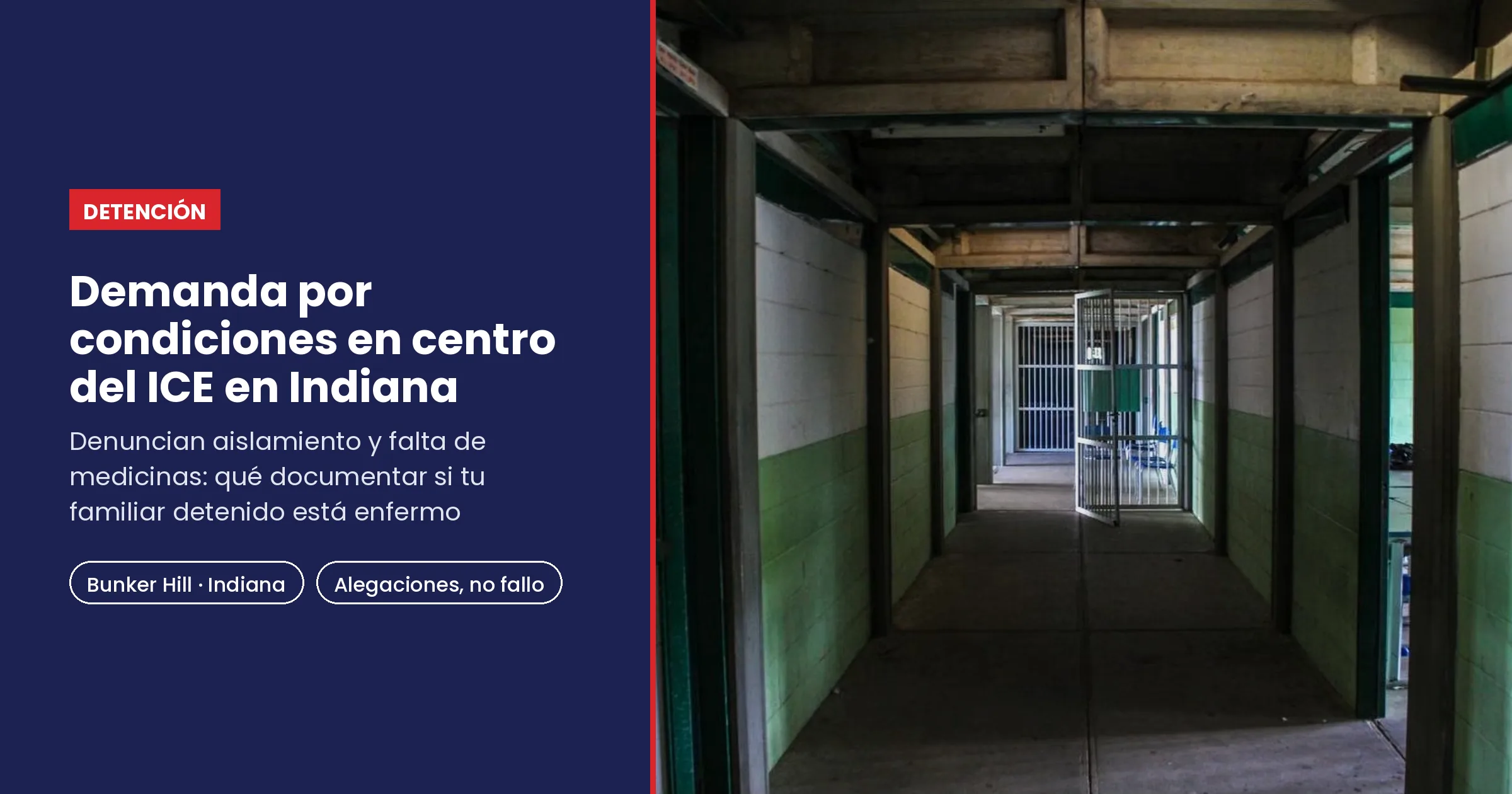
ICE detention conditions in Indiana reached federal court on October 29, 2026, when three detained people filed a class action alleging prolonged solitary confinement, missed medication, and abuse. At Campos Law Firm, we closely monitor developments in U.S. immigration policy to protect our clients’ rights and future. If a family member with a chronic illness is in Immigration and Customs Enforcement (ICE) custody, this news matters to you.
One point should be clear from the start: these are allegations that a judge still has to examine, not proven facts. Here is what we know, what we do not know yet, and what you can do.
What Does the Lawsuit Over ICE Detention Conditions Allege?
The lawsuit was filed in the U.S. District Court for the Northern District of Indiana, in South Bend, according to public radio station WFYI and WBEZ. It is brought by the ACLU of Indiana and the ACLU of Illinois together with the National Immigrant Justice Center and the MacArthur Justice Center, and it seeks to represent everyone ICE holds at the Miami Correctional Facility.
That facility is not in Florida. It is a maximum-security state prison in Bunker Hill, north of Kokomo, in Miami County, Indiana. It has held ICE detainees since October 2025 under a two-year contract with the Department of Homeland Security (DHS), and federal officials informally call it the “Speedway Slammer.”
Among the lawsuit’s allegations:
- Solitary confinement: detainees locked alone 23 to 24 hours a day “with little or no justification,” according to WRTV.
- Medication: a transgender woman from Guatemala with epilepsy allegedly went months without consistent medication and has several seizures a week; other detainees allegedly waited months for HIV medication.
- Conditions and treatment: cells flooded with sewage, inadequate food, racial slurs, and excessive force.
- Deaths: at least two people have died in custody at the facility since 2025, and the complaint describes a suicide attempt.
How Has the Government Responded, and What Does the Lawsuit Seek?
DHS, ICE, and the Indiana Department of Correction did not immediately respond to requests for comment from The Associated Press and other outlets. According to WBEZ, DHS has called claims that detainees are mistreated or denied adequate medical care false.
The lawsuit asks the court to declare that medical care and conditions at the facility violate due process under the Fifth and Fourteenth Amendments, and to order immediate changes. Its core argument is that ICE detainees are civil detainees, not people serving criminal sentences, and should not be treated punitively. It is not the first case: in July, the ACLU of Indiana sued on behalf of another detainee with epilepsy who says he missed his medication and suffered a severe seizure.
We covered it on the Campos Law Firm Instagram:
What Should You Document If a Detained Loved One Has Medical Needs?
You do not need to wait for a lawsuit to play out to protect your loved one. A well-organized record helps an attorney request care, file complaints, or assess whether there is a basis to seek release. Attorney Alejandra Campos, founder of Campos Law Firm, recommends starting with the basics: confirm the facility, record the medical needs, and keep every communication.
- Exact location: search the ICE Online Detainee Locator (locator.ice.gov) using the person’s Alien Registration Number (A-Number), and write down the facility name, address, and the date of every transfer.
- Medical history: gather diagnoses, prescriptions, doses, and the name of the treating doctor before detention. Ask the doctor for a letter explaining why treatment cannot be interrupted.
- Symptom and request log: record the date of each medical episode, each request for care your loved one made, and the response. Ask them to keep copies of written requests.
- Communications: keep records of calls, messages, and emails with the facility, the deportation officer, and the consulate.
- Complaint channels: the ICE Detention Reporting and Information Line (1-888-351-4024) takes reports of abuse, serious unresolved problems, and serious mental health conditions.
Never post your loved one’s medical or personal details on social media without first talking to their attorney.
What Legal Options Exist?
It depends on the case and the jurisdiction; not every case has the same remedy. Depending on the facts, an attorney may evaluate requesting bond or humanitarian parole, filing formal complaints with DHS, or, in some cases, going to federal court. A class action like the one in Indiana does not automatically release anyone or change each person’s removal case.
If your loved one is held in Indiana, Campos Law Firm has an office in South Bend, the same city where the lawsuit was filed. You can also read our coverage of a death in ICE custody in Georgia.
Protect Your Rights with Campos Law Firm
When a sick family member is detained, every day counts, and having the right information is your best tool. We do not make unrealistic promises: we provide serious legal representation backed by preparation and integrity. Our team of immigration attorneys can help you locate your loved one, organize their medical records, and evaluate the options in their case.
Do not leave your immigration status to chance. Call us today at +1 (844) 922-6767 to schedule a free, confidential consultation in English or Spanish. Campos Law Firm: Legal Solutions in All Areas of Law.
With information from The Associated Press, WFYI, WBEZ, WRTV, the ACLU of Indiana, and ICE.