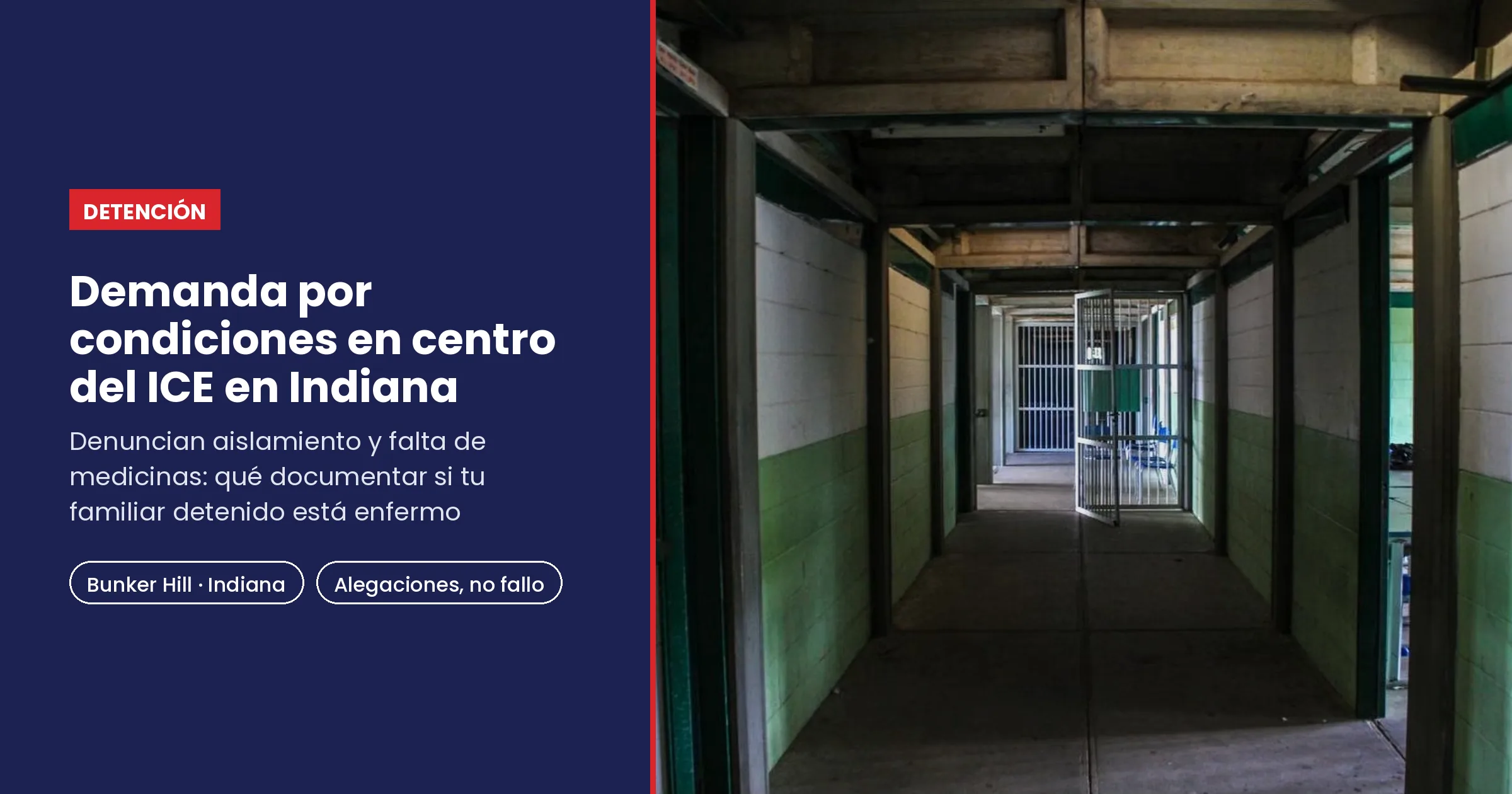


Another death in ICE custody has raised alarms in Georgia. At Campos Law Firm, we closely monitor developments in U.S. immigration policy to protect our clients’ rights and future. On October 24, 2026, Immigration and Customs Enforcement (ICE) confirmed that Luis Sandoval, a 48-year-old Salvadoran man, died in the early hours of Friday, October 23, at the Folkston ICE Processing Center in southeast Georgia.
It is painful news, and for anyone with a loved one in detention it is also a source of anguish. Below, we explain what is known, what is not, and what you can do if a family member is in ICE custody.
What happened at the Folkston detention center?
According to ICE’s statement, cited by The Atlanta Journal-Constitution and The Current, facility staff found Sandoval unresponsive in his unit at 1:46 a.m., attempted to revive him, and called Charlton County paramedics, who pronounced him dead at 2:28 a.m. ICE says the official cause of death is under investigation pending an autopsy. According to reports, the Georgia Bureau of Investigation (GBI) opened an inquiry at the request of the local sheriff’s office; we did not find a GBI statement confirming it.
ICE says Sandoval was arrested by its Newark, New Jersey, office on October 2, was served a Notice to Appear (NTA), and was transferred to Folkston on October 8, where he was awaiting his first hearing before an immigration judge. The agency labels him a “criminal alien” and lists prior convictions; those records have not been independently verified by the press, and they do not change the government’s legal duty to protect the life and health of anyone it detains.
What are detainees alleging, and what do authorities say?
The death came in the middle of a hunger strike that began on October 6, after 45 men published a letter about conditions at the facility. Detention Watch Network and Senators Raphael Warnock and Jon Ossoff put participation at up to 500 people at its peak; ICE said on October 16 that 13 remained. Our earlier article on hunger strikes at ICE detention centers explains how this protest started.
Detainees and their families allege a lack of medical care, spoiled food, solitary confinement as punishment, and threats of force-feeding. These are allegations ICE has not acknowledged; the agency says it is “committed to ensuring that all those in custody reside in safe, secure, and humane environments.” It is not known whether Sandoval took part in the strike. On October 22, Warnock and Ossoff asked the Department of Homeland Security (DHS), its Inspector General, and GEO Group, the company that runs the facility, for an immediate investigation and an unannounced inspection.
The context is serious: according to The Guardian and the Atlanta Journal-Constitution, Sandoval’s is roughly the 60th death in ICE custody since January 2025, and fiscal year 2026 closed with the highest annual toll the agency has ever recorded. In Georgia, it is the fifth death in custody since the start of Trump’s second term.
What should the family of a detained person do?
First, locate them. The ICE Online Detainee Locator (locator.ice.gov) lets you search by A-number (nine digits) and country of birth, or by full name and country of birth; it shows adults only, and the information can be up to eight hours old. If the person does not appear, call the ICE Detention Reporting and Information Line at 1-888-351-4024 (Monday through Friday, 8 a.m. to 8 p.m. Eastern, with Spanish-speaking operators).
Second, document everything. Write down the A-number, the facility, the names of officers, and every call you receive, with date and time. Keep copies of their immigration documents, prescriptions, and diagnoses: if your family member has high blood pressure, diabetes, a psychiatric condition, or any ongoing treatment, notify the facility and their attorney in writing from day one. Attorney Alejandra Campos, founder of Campos Law Firm, notes that a medical condition documented early can be decisive in a request for release.
How do you report mistreatment or lack of medical care?
- Inside the facility: your family member can file a written grievance; ask them to keep a copy or note the date.
- ICE line (1-888-351-4024): for serious or unresolved problems in detention, including reports of physical abuse or denial of medical care.
- DHS Inspector General (1-800-323-8603): takes complaints of civil rights abuses and allows anonymous reports.
- With your attorney: every grievance, medical record, and transfer becomes part of the strategy for bond, parole, or a habeas corpus petition. Do not wait for things to get worse.
- If a death occurs: ICE publicly announces deaths in custody and notifies the family and the consulate; the family has the right to request the autopsy and medical records through an attorney.
Protect Your Rights with Campos Law Firm
Luis Sandoval’s death remains under investigation, and until there are results no one can say with certainty what happened. What we do know is that a detained person depends entirely on the system for their health and safety, and that family and counsel are, in practice, their only outside watchdogs.
If you have a family member detained by ICE, in Georgia or any other state, Campos Law Firm is here to help you locate them, review their options for release, and demand the medical care they are entitled to. Do not leave their future to chance. Call us today at +1 (844) 922-6767 to schedule a free, confidential consultation in English or Spanish. Campos Law Firm: Legal Solutions in All Areas of Law.
With information from The Guardian, The Atlanta Journal-Constitution, The Current, and ICE.