
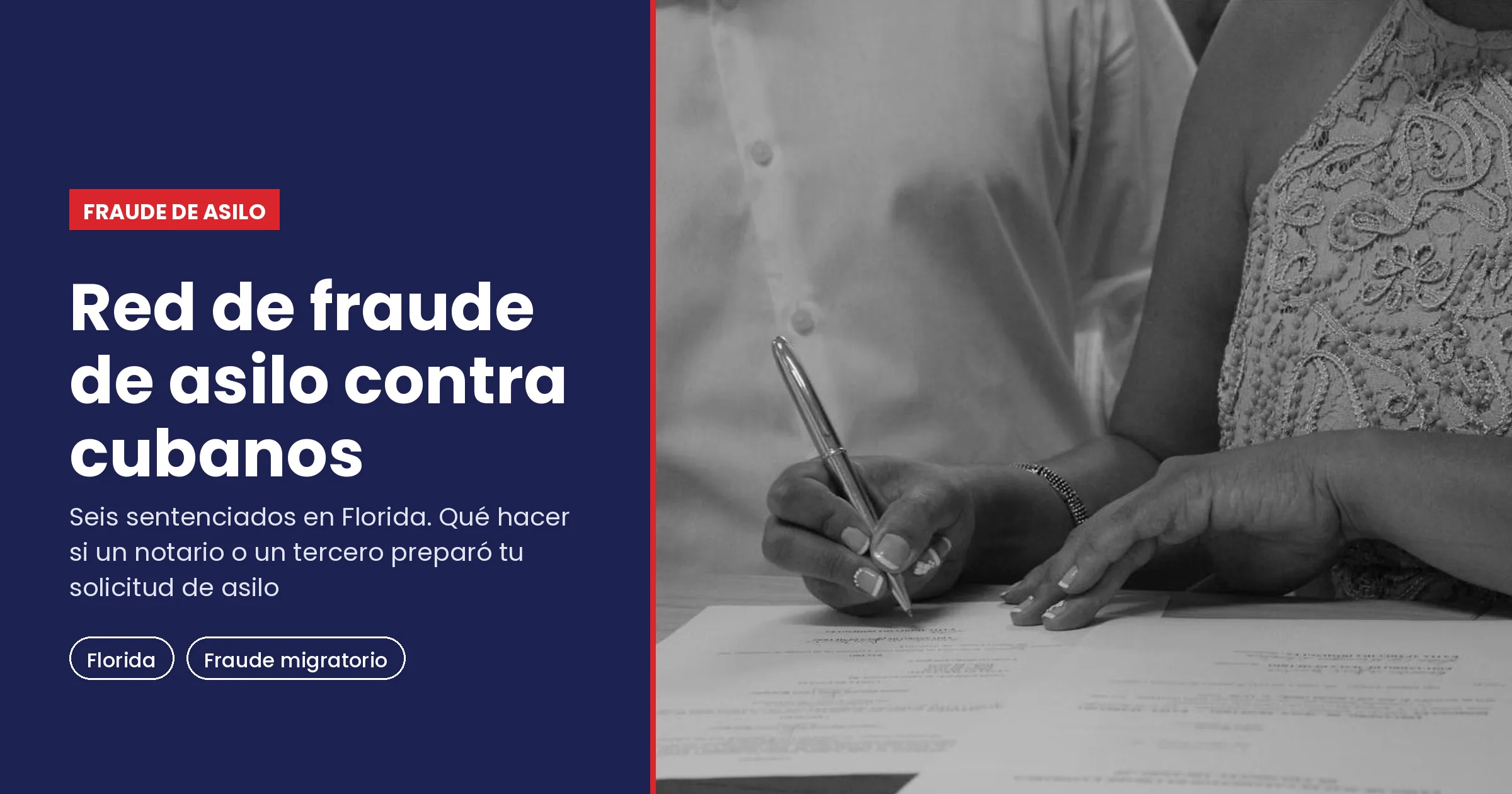
Asylum fraud aimed at Cuban migrants made headlines again on October 29, 2026, when a federal court in Tampa, Florida, sentenced six members of a network that combined migrant smuggling, fraudulent asylum filings, and money laundering, as announced by the Justice Department (DOJ).
At Campos Law Firm, we closely monitor developments in U.S. immigration policy to protect our clients’ rights and future. If an agency, a “notario,” or an acquaintance prepared your asylum application, it is natural to feel uneasy about this news. Below, we explain what is known, what is not, and what you can do.
What do we know about the asylum fraud sentences?
According to the DOJ and reporting by the Miami Herald, the ring was linked to more than 1,700 fraudulent asylum applications and laundered more than $22 million between 2021 and 2025. It charged $1,500 to $40,000 per person, and its customers were Cuban. All six defendants had pleaded guilty to conspiracy charges.
Liannys Yaiselys Vega-Perez, described as the manager of the Tampa-based immigration services business Asesoria y Servicios Migratorios, received the longest sentence: four years in prison. Layra Libertad Treto Santos, an employee who also filed false asylum claims, received 30 months. Luis Emmanuel Escalona-Marrero, Miguel Martinez Vasconcelos, Walbis Pozo-Dutel, and Emanuel Martinez Gonzalez each received two years.
This is the same case the DOJ brought against 12 people in September 2025. Another defendant, Erik Ventura-Castro, was sentenced to 30 months in July, and Lazaro Alain Cabrera-Rodriguez, convicted by a jury in September, is set to be sentenced on December 17. According to press reports, two more defendants remain at large.
How did the ring use asylum applications?
The pattern prosecutors describe is the one applicants should worry about most. In its indictment, the DOJ says the company filed boilerplate asylum claims without clients’ knowledge or consent and blocked them from accessing their own U.S. Citizenship and Immigration Services (USCIS) online accounts.
In addition, according to the Miami Herald, Vega-Perez was neither a licensed attorney nor an accredited representative. In other words, many people paid for a service without knowing an asylum application had been filed in their name, or what its statement said. The ring advertised on social media, Instagram, and WhatsApp groups.
It is a risk similar to the one we described when the DOJ charged six people in a Massachusetts marriage fraud ring: whoever promises “fast papers” rarely answers for the consequences.
If a third party prepared your application, are you guilty?
Not automatically. The sentences target those who organized and profited from the scheme, and every person connected to it must be assessed individually. Defendants still awaiting trial or sentencing keep their rights, and the agency’s clients are not, for that reason alone, guilty of a crime.
That said, an application containing false information can still hurt your case, even if you did not write it. Immigration law imposes serious consequences on anyone who knowingly files a frivolous asylum application or willfully misrepresents facts to obtain a benefit. “Knowingly” is the key word: showing that you did not know what was filed, and correcting it in time, can make a difference.
How can you review and correct your asylum application?
- Request a copy of your file: you can ask USCIS for your records through a Freedom of Information Act (FOIA) request. If your case is in immigration court, your attorney can review the record with the Executive Office for Immigration Review (EOIR).
- Regain access to your account: check your receipt notices and make sure the mailing address and email on file are yours, not the agency’s.
- Compare the statement with your real story: dates, places, reasons for persecution, and family members. Any discrepancy should be documented.
- Correct it before the interview or hearing: with legal guidance, errors can be clarified at the start of the asylum interview or through an amendment before the judge, depending on the stage of your case.
- Keep proof of payments and messages: receipts, Zelle transfers, WhatsApp chats, and the names of the people who helped you. They show that you acted in good faith.
- Do not go back to the same agency: and do not sign anything new without understanding it. In the U.S., a “notario” is not a lawyer; only attorneys and DOJ-accredited representatives can give you immigration legal advice.
If a federal or USCIS investigator contacts you about a case like this, speak with a lawyer before giving any statement. In those situations, our immigration attorneys can review your file and, if needed, coordinate with our criminal defense team.
Protect Your Immigration Status with Campos Law Firm
Being targeted by a fraudulent preparer does not have to define your future, but ignoring the problem can make it worse. Reviewing your asylum application now, before an interview or a hearing, is the best way to protect your case. Campos Law Firm is here to help you.
Do not leave your immigration status to chance. Call us today at +1 (844) 922-6767 to schedule a free, confidential consultation in English or Spanish. Campos Law Firm: Legal Solutions in All Areas of Law.
With information from Latin Times, the Miami Herald, the U.S. Justice Department and Telemundo 51.