
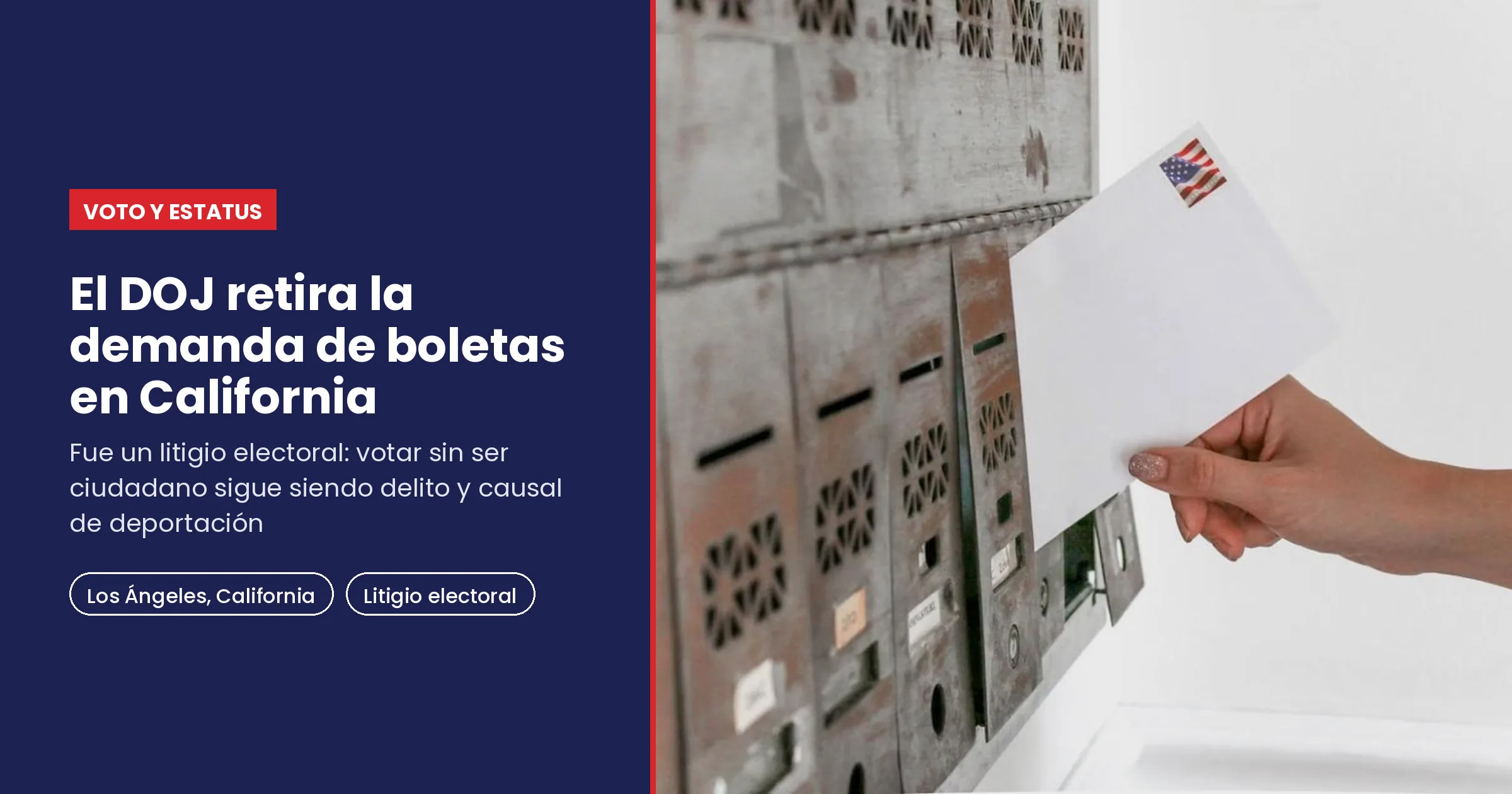
The California ballot lawsuit that the federal government filed against the state and Los Angeles County came to an end on Friday, November 6, 2026, when the Department of Justice (DOJ) moved to drop it. At Campos Law Firm, we closely monitor developments in U.S. immigration policy to protect our clients’ rights and future. The case is over, but voting as a noncitizen is still a federal crime and a ground for deportation.
Here is what we know, what we do not know yet, and what you can do.
What Happened to the California Ballot Lawsuit?
According to the Associated Press and Democracy Docket, DOJ filed a notice of voluntary dismissal in the U.S. District Court for the Central District of California, where Judge David O. Carter was handling the case. The suit, United States v. State of California, was filed on October 15 and sought to set aside mail ballots from about 20,000 people registered to vote whom the government considered “likely” noncitizens.
DOJ’s reason was practical: by the November 13 hearing, the ballots would already be mixed in with all other votes. “There is then no way to get the challenged ballots segregated,” its attorneys wrote, calling the case moot. DOJ added that it is “evaluating how to best ensure that American votes are protected,” without announcing any new action.
Why Did the Government Lose in Every Court?
On October 28, Judge Carter denied the emergency order. He wrote that the list, built with a U.S. Citizenship and Immigration Services (USCIS) matching protocol, “raises significant concerns,” and that “once a vote is segregated, lasting harm has occurred.” Los Angeles County found people in a small sample of the list with records showing they were born in the U.S., which the government disputed.
On October 30, the Ninth Circuit Court of Appeals upheld that decision 2-1. Judge Mark J. Bennett wrote that “there is no feasible way to identify and segregate the ballots of specific individuals.” On November 2, the Supreme Court denied the government’s emergency request in a one-sentence order, with no noted dissents.
This case is part of a broader push on noncitizen voting, which we covered in our articles on the “noncitizen” ballots in California and Washington and on the judge who blocked noncitizen voter lists.
Does the End of the Lawsuit Change Immigration Law?
No. This lawsuit was election litigation about how ballots are counted, not a change in who may vote or in immigration consequences. Here is what stays the same:
- Voting in federal elections as a noncitizen is a crime: federal law punishes it with a fine and up to one year in prison, and falsely claiming citizenship to register can bring harsher penalties.
- It is a ground for deportation: the Immigration and Nationality Act allows the removal of anyone who voted in violation of the law, including permanent residents.
- It can block your citizenship or green card: Form N-400 asks whether you have ever registered or voted, and unlawful voting is also a ground of inadmissibility.
- Investigations continue: according to the AP, at least three Los Angeles election officials were subpoenaed to appear before a grand jury, and federal prosecutors there have charged several people with alleged illegal registration or voting. All are presumed innocent unless convicted.
The law includes a narrow exception for people who reasonably believed they were citizens, for example because their parents are citizens and they lived in the U.S. since childhood. It is a technical defense that requires evidence and legal advice.
What Can You Do If You Registered by Mistake?
Many people were registered without meaning to be, for example when getting a driver’s license. If that is your situation or a relative’s:
- Do not vote if you are not a citizen: even if a mail ballot arrives, do not use it.
- Do not cancel your registration on your own without advice: the cancellation form may ask you to state why, and that statement can be used later.
- Gather documents: keep any DMV or election office records that show how the registration happened.
- Check before applying for citizenship: answer the N-400 truthfully; lying is worse than the original problem. Read our guide on noncitizen voting charges and what to check before the N-400.
- If you get a subpoena or a federal agent contacts you: do not give a statement without an attorney present.
Protect Your Immigration Status with Campos Law Firm
A mistaken voter registration may look like a minor paperwork issue, but it can affect your residency, your citizenship, and your ability to stay in the country. We do not make unrealistic promises: we provide serious legal representation backed by preparation and integrity. Our team of immigration attorneys can review your history and, if there is a criminal investigation, coordinate with our criminal defense attorneys.
Do not leave your immigration status to chance. Call us today at +1 (844) 922-6767 to schedule a free, confidential consultation in English or Spanish. Campos Law Firm: Legal Solutions in All Areas of Law.
With information from the Associated Press, Democracy Docket, WUNC/NPR, CNN and Los Angeles Magazine.