
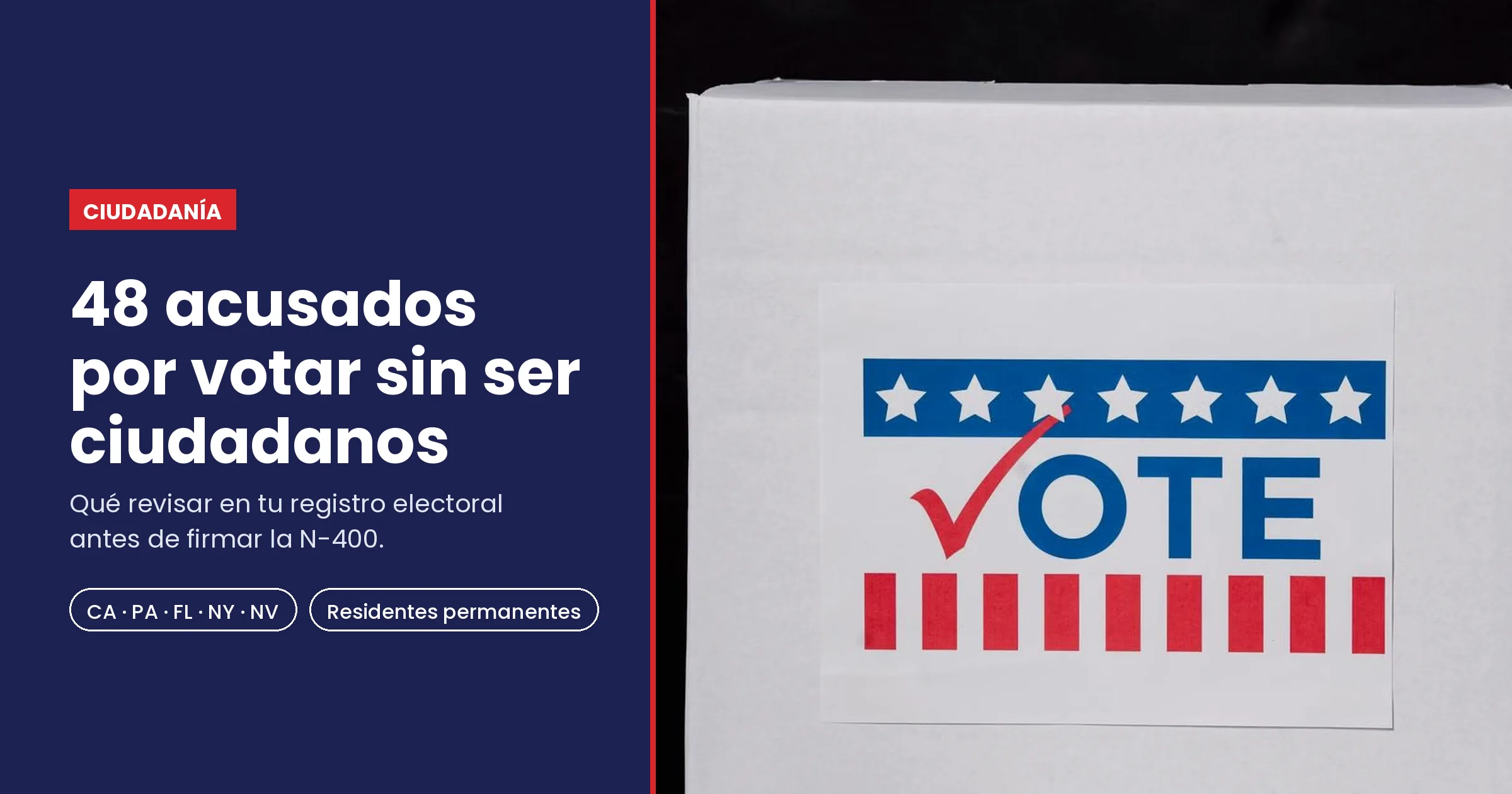
Noncitizen voting is at the center of a new wave of federal charges. At Campos Law Firm, we closely monitor developments in U.S. immigration policy to protect our clients’ rights and future. On October 26, 2026, the Justice Department announced charges against 48 noncitizens in California, Pennsylvania, Florida, New York, and Nevada for registering to vote, voting in federal elections, or falsely claiming to be U.S. citizens. According to the government’s own releases, most of them are lawful permanent residents.
These are accusations, not convictions: every defendant is presumed innocent. But the message for anyone with a green card who plans to naturalize is clear. Below, we explain what is known, what is not, and what you can do.
What happened in California, Pennsylvania, New York, Florida, and Nevada?
The wave began on October 19, when California’s four U.S. Attorney’s Offices announced charges against 28 lawful permanent residents under what they called “Operation Protect the Vote”; 11 were arrested that day. Prosecutors allege the defendants registered to vote by claiming citizenship and later, on their naturalization applications, stated they had never claimed to be citizens, registered, or voted. Acting Deputy Attorney General Trent McCotter said that “every illegal vote cancels out the vote of a lawful American citizen.”
On October 23, new “voting by an alien” charges followed in Nevada, New York, and Pennsylvania. In Pennsylvania, nine people, nearly all green card holders, were charged with voting in 2022 or 2024; in Nevada, one permanent resident, with voting in the 2024 presidential election. On October 26, the Justice Department consolidated everything into a single announcement: 48 defendants across nine federal districts.
As the Associated Press reports, the administration ties these prosecutions to its lawsuit asking California to set aside roughly 20,000 mail ballots from people it considers “likely” noncitizens ahead of the November 3 election. California officials reject that list as unsupported by evidence, and a Votebeat analysis notes that, in Pennsylvania, fraudulent ballots identified since 2015 are a tiny fraction of the total.
What are the noncitizen voting charges, and what penalties do they carry?
According to the official releases, the most common charges are:
- Voting by an alien in a federal election: a misdemeanor punishable by up to one year in federal prison.
- False claim of U.S. citizenship to register or vote: a felony.
- False statements on a naturalization application and unlawful procurement of naturalization: felonies punishable by up to five years in prison, according to prosecutors in California.
In many of the California cases, the accusation goes beyond the vote itself: prosecutors allege that the answers on the defendants’ citizenship applications (Form N-400) did not match the state’s voter rolls. That is the central lesson.
Why is Form N-400 the most sensitive step?
The naturalization application asks, under oath, whether you have ever claimed to be a U.S. citizen, whether you have ever registered to vote, and whether you have ever voted in any federal, state, or local election. Answering “no” when the records say otherwise turns a past mistake into a potential new crime. And the mistake is more common than it seems: some green card holders do not remember checking a box at the DMV, or were registered at the suggestion of a clerk. That is why our immigration attorneys insist on reviewing the record before you sign.
The immigration consequences exist even without a criminal case. The Immigration and Nationality Act (INA) makes anyone who falsely claims citizenship to obtain a benefit inadmissible (section 212(a)(6)(C)(ii)), a ground with almost no waiver, and makes anyone who voted in violation of the law deportable (section 237(a)(6)). There is a narrow exception for those with citizen parents who resided in the U.S. before age 16 and reasonably believed they were citizens.
In addition, U.S. Citizenship and Immigration Services (USCIS) may deny naturalization for lack of “good moral character” if the registration or vote was knowing. Its Policy Manual, updated in 2021, clarifies that an unintentional registration prompted by a confusing form should not, on its own, disqualify an applicant.
What can you do if you hold a green card and plan to naturalize?
- Check your voter history before filing Form N-400: you can ask your county election office whether you appear as a registered voter and request proof of any cancellation.
- Do not answer “no” on autopilot: if you were ever registered, even by mistake, that question deserves an explanation prepared with an attorney, not a denial.
- If you discover a registration you do not remember: request removal from the rolls in writing and keep the confirmation and any DMV paperwork; that paper trail can be decisive.
- If you already filed an N-400 with an inaccurate answer: do not wait for the interview; a timely correction, with legal advice, carries very different weight than a contradiction uncovered by the officer.
- If federal agents contacted you: do not make a statement without a lawyer. Our criminal defense attorneys work alongside our immigration team because a criminal statement can determine your immigration future.
Protect Your Immigration Status with Campos Law Firm
A green card does not give you the right to vote in federal elections, but it does not make you a suspect either. An old registration you never used and a ballot cast knowingly are very different situations before USCIS and before a prosecutor; what changes the outcome is reviewing the record early.
If you are a lawful permanent resident, plan to apply for citizenship, and are not sure what your records say, Campos Law Firm is here to help you. Do not leave your immigration status to chance. Call us today at +1 (844) 922-6767 to schedule a free, confidential consultation in English or Spanish. Campos Law Firm: Legal Solutions in All Areas of Law.
With information from the U.S. Justice Department, AP, Votebeat and FOX5 Las Vegas.