
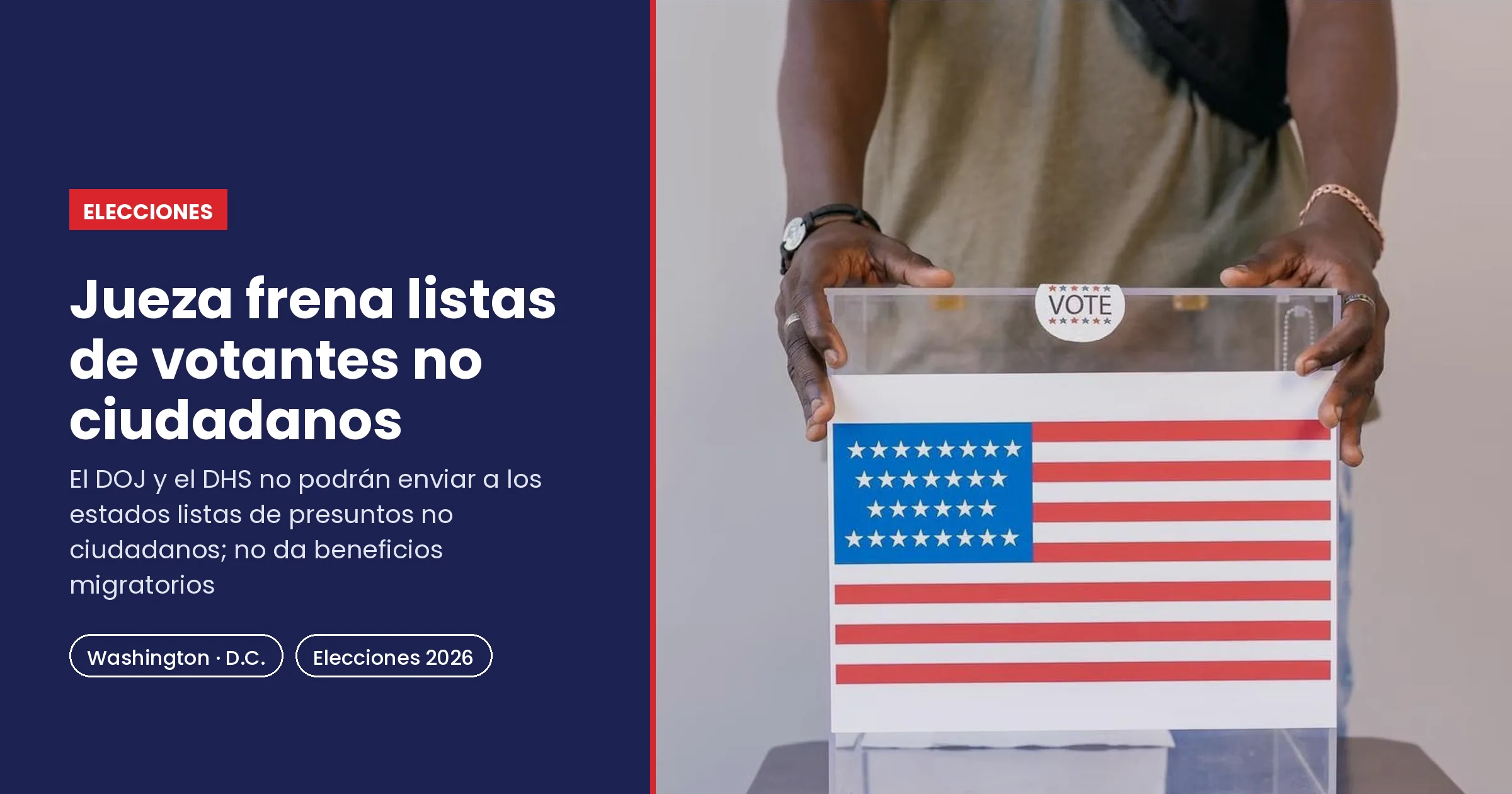
Noncitizen voter lists that the federal government had been sending to states were halted by a court order on the eve of the November 3, 2026 midterm elections. At Campos Law Firm, we closely monitor developments in U.S. immigration policy to protect our clients’ rights and future. On November 2, U.S. District Judge Tanya Chutkan temporarily barred the Department of Justice (DOJ) and the Department of Homeland Security (DHS) from sharing those lists with election officials.
One point up front: the order protects eligible citizens from being wrongly flagged, and it grants no immigration benefit. Here is what we know, what we do not know yet, and what you can do.
What Did the Judge Decide About Noncitizen Voter Lists?
Judge Chutkan, of the U.S. District Court for the District of Columbia, granted a preliminary injunction in a lawsuit filed on October 15 by the League of Women Voters, together with the League of United Latin American Citizens (LULAC) and the Electronic Privacy Information Center (EPIC), according to Raw Story. Her 30-page decision bars DOJ and DHS from sending state and local officials lists of registered voters whom the government considers confirmed or suspected noncitizens.
According to Reuters, the order also stops the government from pressuring states to set those voters’ ballots aside. The judge left two things out, according to Newsweek: individual citizenship checks through the SAVE system and prosecutions of federal crimes. The government had 24 hours to report how it would comply. The injunction is temporary while the case continues, and the government can appeal.
Why Did the Judge Doubt the Reliability of the Data?
The judge found that the plaintiffs are likely to win. According to The Epoch Times, she concluded that the bulk release of personal data likely violates the Privacy Act and that the government never published the notice that law requires for a new database. She also wrote that the criminal statute on noncitizen voting “contains no language authorizing the broad program of bulk transmission,” according to Raw Story.
On data quality, the ruling notes that DOJ gave Los Angeles County a thumb drive with more than 20,000 names of “likely” noncitizens, and only 7,035 of them had addresses in the county, according to Raw Story. It is the same dispute we covered in our article on “noncitizen” ballots in California and Washington. The government says it is simply enforcing federal election law and argued that the plaintiffs lack standing.
Is This the Only Court Decision This Week?
No. Also on November 2, Chief Judge James Boasberg turned down a request from Democratic Party committees to stop letters threatening election officials with prosecution, finding that those plaintiffs lacked standing, according to Democracy Docket. That same day, the Supreme Court denied the government’s emergency request to force California to set aside about 20,000 ballots, according to Fox News.
These are separate cases, with different plaintiffs and different scope. What they share is that none of them decides whether a specific person voted illegally, and none changes anyone’s immigration status.
Does the Order Give You Any Immigration Benefit?
No. The order limits how the government shares data with states; it does not change who can vote. Only U.S. citizens can vote in federal elections. Voting as a noncitizen is a federal crime and, along with falsely claiming citizenship, is a ground of deportability under the Immigration and Nationality Act (INA 237(a)(6) and 237(a)(3)(D)); it can also block naturalization for lack of “good moral character.”
- If you are not a citizen: do not register or vote, even if someone tells you “it’s fine” or that a form allows it.
- If you registered by mistake: for example, when you got a driver’s license. Talk to an attorney before you request cancellation or answer any letter, so it is properly documented.
- If you are a naturalized citizen and you are flagged: keep your naturalization certificate handy and contact your county election office; a database match proves nothing.
- If you plan to apply for citizenship: Form N-400 asks whether you have ever registered or voted. Read what we explained about the 48 people charged with noncitizen voting before you file.
Protect Your Immigration Status with Campos Law Firm
A flawed list does not make you a suspect, but a voter registration that is not properly explained can complicate your green card or your citizenship case. We do not make unrealistic promises: we provide serious legal representation backed by preparation and integrity. Our immigration attorneys review your history before any filing, and if the matter turns into charges, our criminal defense attorneys work alongside the immigration team.
Do not leave your immigration status to chance. Call us today at +1 (844) 922-6767 to schedule a free, confidential consultation in English or Spanish. Campos Law Firm: Legal Solutions in All Areas of Law.
With information from Reuters, Newsweek, The Epoch Times, Raw Story, Democracy Docket, and Fox News.