
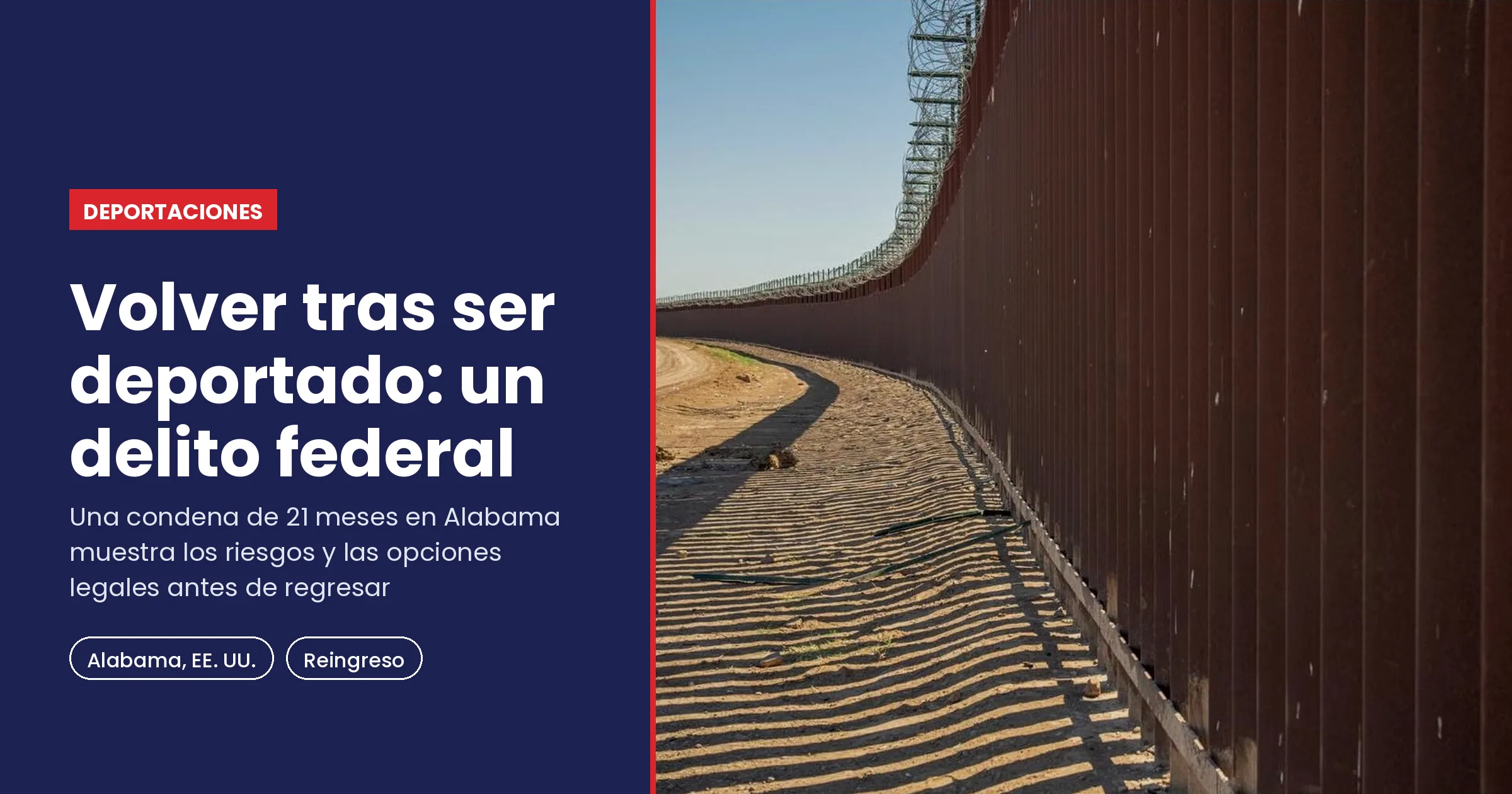
Illegal reentry after deportation is a federal crime, and a recent case in Alabama puts it back in the spotlight. At Campos Law Firm, we closely monitor developments in U.S. immigration policy to protect our clients’ rights and future. This sentence does not change any immigration law or requirement, but it shows what is at stake for anyone thinking about returning without permission.
Here is what we know, what the law says, and what options exist.
What Happened in the Alabama Case?
According to the Department of Justice (DOJ), U.S. District Judge Anna M. Manasco sentenced Federico Sanchez Alvarado, a 29-year-old Mexican citizen, to 21 months in prison after he pleaded guilty to reentry after deportation and to possession of a firearm by a person without lawful status. The press release was published on Monday, November 9, 2026, under the DOJ initiative “Operation Take Back America.”
According to the DOJ, he was ordered removed on February 10, 2016, and deported on August 16 of that year. On October 17, 2025, Pelham police responded to a shots-fired call and found him at a residence where officers recovered a pistol reported stolen. Homeland Security Investigations (HSI) and the Pelham Police Department investigated.
Why Is Illegal Reentry After Deportation a Federal Crime?
Federal law (8 U.S.C. § 1326) punishes anyone who was deported and then enters, attempts to enter, or is found in the U.S. without the government’s permission. It is a criminal offense, not just an immigration violation, and it is prosecuted in federal criminal court, not immigration court.
The maximum penalties depend on the person’s record:
- Basic case: up to 2 years in prison, a fine, or both.
- With prior convictions: up to 10 years if the deportation followed a felony or three or more misdemeanors involving drugs or crimes against the person.
- With an aggravated felony: up to 20 years.
These are statutory maximums; the actual sentence depends on the federal guidelines, the facts, and the defense. In this case there was also a firearm charge. That is why these cases call for a criminal defense attorney and an immigration attorney working together.
What Are the Immigration Consequences of Coming Back Without Permission?
Beyond prison, returning without authorization usually closes doors that might otherwise be open:
- Reinstatement of the prior order: the government can reactivate the earlier removal order without a new hearing before an immigration judge, and the law bars nearly all forms of relief. Even so, a person who fears persecution or torture can request a reasonable fear interview and, if eligible, withholding of removal or protection under the Convention Against Torture, which we explained in our article on withholding of removal and deportations to Africa.
- Reentry bars: after a deportation, a person cannot return for 5, 10, or 20 years depending on the case, or ever if they have an aggravated felony.
- The “permanent” bar: someone who was deported (or accrued more than one year of unlawful presence) and then reenters without inspection becomes permanently inadmissible. They can only seek permission after spending at least 10 years outside the U.S.
- Barriers to legal status: reentry usually blocks adjustment of status inside the country, even with a U.S. citizen spouse or child.
What Legal Options Exist Before You Try to Return?
If you were deported and have reasons to come back, such as family, work, or an approved petition, the path is to ask for permission before you travel. There are no guarantees, but there are options:
- Form I-212 (permission to reapply for admission): U.S. Citizenship and Immigration Services (USCIS) uses it to grant consent to people who are inadmissible because of a prior removal. Favorable and unfavorable factors are weighed, and it is filed with records of every removal order.
- Additional waivers: depending on the case, other waivers may be needed, for example for unlawful presence (Form I-601) or for criminal history. An I-212 alone is not always enough.
- Review the original order: some orders were issued without proper notice or contain errors. An attorney can assess whether there is a basis to reopen or challenge it, although deadlines are strict.
- Do not return without permission: crossing without authorization makes every option worse and can turn an immigration problem into a criminal case.
Protect Your Immigration Status with Campos Law Firm
A deportation is not always the end of the story, but every decision that follows matters. We do not make unrealistic promises: we provide serious legal representation backed by preparation and integrity. Our team of immigration attorneys can review your history and, if there is a criminal charge, coordinate with our criminal defense attorneys.
Do not leave your immigration status to chance. Call us today at +1 (844) 922-6767 to schedule a free, confidential consultation in English or Spanish. Campos Law Firm: Legal Solutions in All Areas of Law.
With information from the U.S. Department of Justice, the U.S. Code (8 U.S.C. § 1326), the U.S. Code (8 U.S.C. § 1182) and USCIS.