
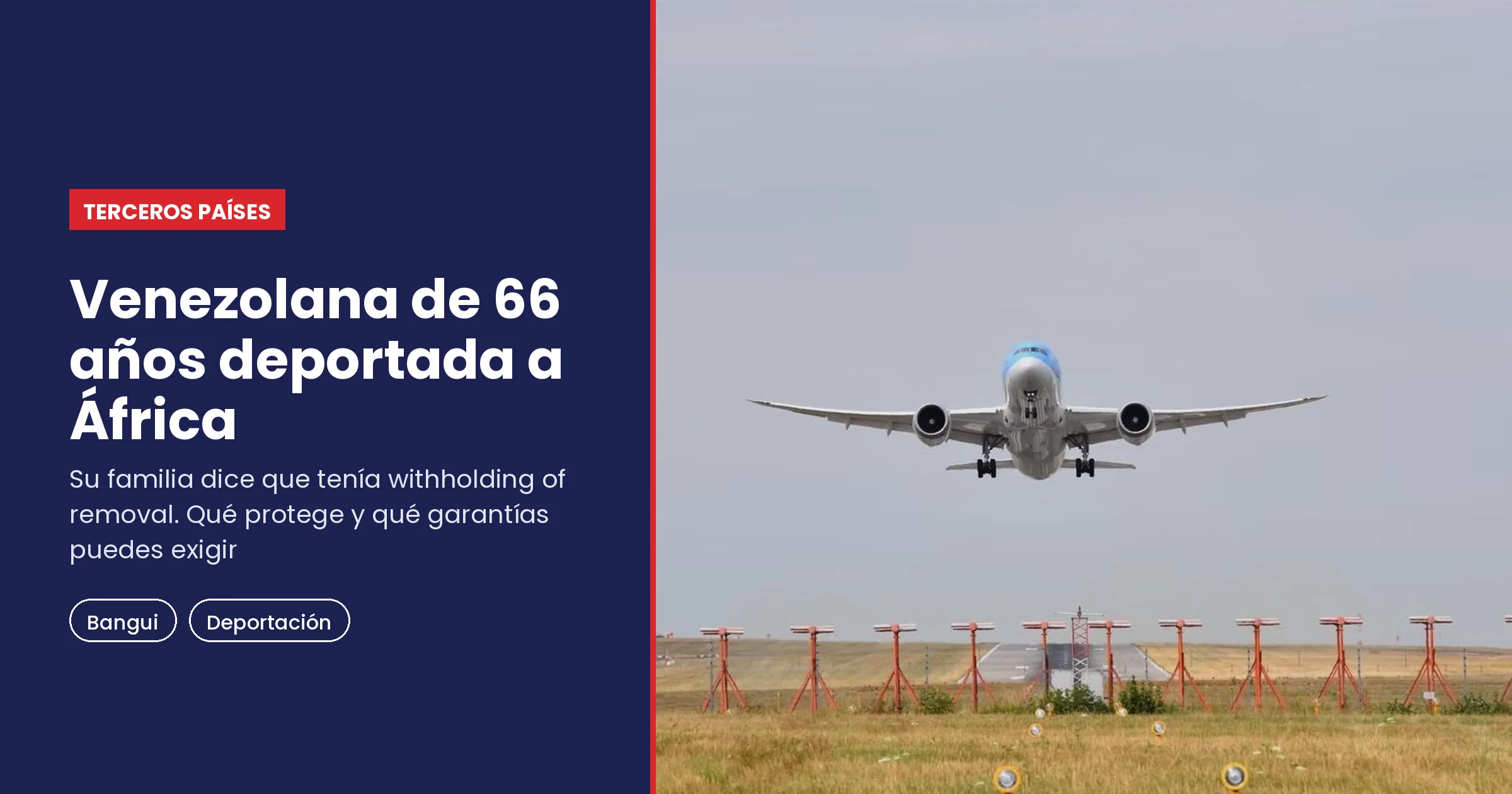
Withholding of removal is at the center of a case that has alarmed many families: Marilú Paredes, a 66-year-old Venezuelan, was sent from the United States to Bangui, capital of the Central African Republic, according to her family and reports published on October 29, 2026, by the outlets El Pitazo and Panas en Utah.
At Campos Law Firm, we closely monitor developments in U.S. immigration policy to protect our clients’ rights and future. This case is especially worrying for people who are protected from deportation to their home country. Below, we explain what is known, what is not, and what you can do.
What happened to Marilú Paredes, according to her family?
According to her family, Immigration and Customs Enforcement (ICE) agents detained Paredes during a mandatory immigration check-in in Louisiana. Panas en Utah reports that she traveled with nine other women, eight Cubans and one Peruvian, who believed they were being moved to another detention center in Miami. The flight reportedly stopped in Senegal, Mali, and Uganda before reaching Bangui in late October.
Her family also says ICE kept her passport, which would make it harder for her to leave the African country. According to Panas en Utah, her husband of more than four decades remains in the U.S. and is recovering from serious surgery. Both outlets describe her as the first Venezuelan deported by the U.S. to Africa.
It is important to stress that these claims come from her family and from press reports. We have not been able to independently verify her immigration file, and as of publication there was no official ICE response about her transfer.
What is withholding of removal, and what does it not cover?
Withholding of removal is a protection granted by an immigration judge when a person shows they would more likely than not be persecuted in a specific country. Unlike asylum, it does not lead to a green card, does not allow you to petition for family members, and only bars deportation to the country named in the order.
That is the key point in this case. Withholding of removal does not automatically prevent the government from sending someone to a third country, and her family says Paredes had exactly that protection as to Venezuela. In its October 8 report, Human Rights Watch documented that many people expelled to Africa had withholding of removal or protection under the Convention Against Torture (CAT).
We covered the scope of that report in our article on the 536 deportations to Africa documented by Human Rights Watch.
What does the law say about third-country deportations today?
The policy rests on a March 2025 Department of Homeland Security (DHS) guidance. If the U.S. receives “diplomatic assurances” from the destination country, a person can be removed with no further process; if not, ICE must notify the person of the destination and, if they express fear, offer a screening. A July 2025 memo generally set a minimum notice of 24 hours, or six hours in exigent circumstances.
A federal court in Massachusetts vacated that guidance on February 25, 2026, but on September 29, 2026, the Supreme Court stayed that ruling and agreed to hear DHS v. D.V.D., with arguments set for December. In the meantime, third-country removals continue. According to HRW, about 92 people were flown to the Central African Republic alone on three flights between June and August.
What safeguards can you insist on if you have protection?
The fact that third-country removal is allowed does not mean you have no rights. There are safeguards worth knowing and asserting with legal help:
- Notice of the destination: ask to be told in writing which country they intend to send you to, and keep any document you receive.
- Expressing fear: if you fear persecution or torture in that third country, say so clearly and ask for a fear interview; that statement can trigger a screening.
- Access to your lawyer: ask to contact your attorney before any transfer, and memorize their phone number.
- Your documents: request a copy of your removal order and of the decision granting you protection, and ask about your passport.
- Emergency remedies: depending on the case, there may be a motion to reopen, a request for a stay of removal, or a habeas corpus petition in federal court.
A judge has already ordered the return of a man sent to another African country, as we reported in the case of the Egyptian man deported to Equatorial Guinea, although every case depends on its facts. If you have an upcoming ICE check-in, our immigration attorneys can review your order before you report.
Protect Your Immigration Status with Campos Law Firm
If you have withholding of removal or CAT protection, preparing your case before an ICE check-in can make a difference. Gather your documents, leave instructions with your family, and get advice before it becomes urgent. Campos Law Firm is here to help you.
Do not leave your immigration status to chance. Call us today at +1 (844) 922-6767 to schedule a free, confidential consultation in English or Spanish. Campos Law Firm: Legal Solutions in All Areas of Law.
With information from Panas en Utah, El Pitazo, Human Rights Watch and the Supreme Court.