

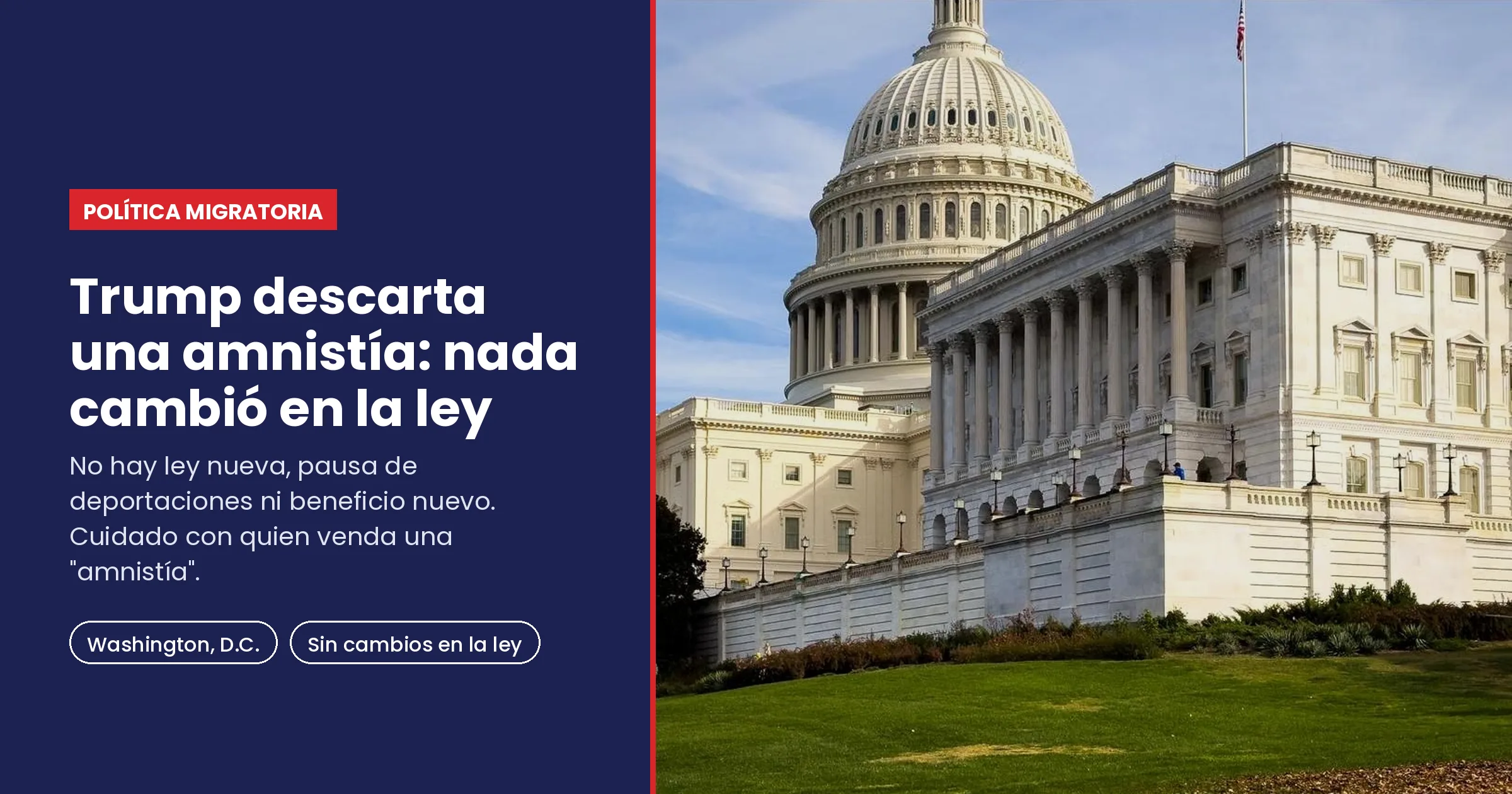
Talk of a Trump amnesty, which many families began discussing after the president’s 60 Minutes interview, was ruled out by the president himself on Monday, November 9, 2026. At Campos Law Firm, we closely monitor developments in U.S. immigration policy to protect our clients’ rights and future. The bottom line: as of today, there is no new law, no general pause on deportations and no new benefit.
Here is what we know, what we do not, and what you can do.
What Did Trump Say About Amnesty on November 9?
In the interview that aired on Sunday, November 8, Trump acknowledged his deportation policy may have been too tough and said he was open to doing something on immigration with Democrats. We covered it in detail in our article on Trump’s 60 Minutes interview. The next day, the message was different.
Speaking to reporters at the White House on Monday, November 9, Trump called his deportation policy “very strong” and rejected any deal that would include amnesty for people in the country without legal status. “There won’t be amnesty,” he said, adding, “My policy hasn’t changed,” according to the Associated Press (AP). He also said the focus will remain on “the worst of the worst.”
Are There Negotiations With Democrats?
No formal negotiation has been announced. On the same Monday, Homeland Security Secretary Markwayne Mullin told reporters on the sidelines of a conference near Washington that he has been getting calls from Democrats he worked with in Congress and that he has let the president know. But he added: “We haven’t had any conversation just on policy,” according to AP.
Mullin went further, saying “amnesty’s never going to be a solution” and “we’re never gonna allow amnesty to happen.” On recipients of Deferred Action for Childhood Arrivals (DACA), he said any move to give them legal status would be “up to Congress.” As of today, no source has reported a concrete proposal agreed upon by the White House and Democrats.
We covered it on the Campos Law Firm Instagram:
Statement, Negotiation, Amnesty and Reform: What Is the Difference?
These four ideas get blended together in headlines, but they have very different effects on your case:
- Political statement: what a president or official says in an interview or to the press. It may signal intentions, but it does not change the law or stop a case in immigration court.
- Negotiation: talks between the White House and lawmakers. Until there is an approved text, it creates no rights for anyone.
- Amnesty or legalization: a program that would let certain people without status obtain legal status. It only exists if Congress passes a law creating it, with its own requirements, deadlines and forms.
- Enacted reform: a bill that passes the House and the Senate and is signed by the president. Agencies then have to publish rules to carry it out, which usually takes months.
Right now we are at the first stage: public statements, informal contacts according to Mullin, and no agreed bill.
What Has NOT Changed for You?
The same rules that applied before the interview are still in place. There is no general pause on deportations: Immigration and Customs Enforcement (ICE) continues its operations, and deportation orders already issued remain valid. There is also no form, sign-up process or deadline to request an “amnesty.”
This is exactly where scams appear. The Federal Trade Commission (FTC) warns that notarios in the U.S. are not attorneys and cannot give legal advice, that U.S. Citizenship and Immigration Services (USCIS) forms are free, and that no one can guarantee a green card or offer early access to a program. Be careful if someone offers you:
- A spot in “Trump’s amnesty”: that program does not exist; any fee for it is a red flag.
- A “special list” or guaranteed slot: no one has privileged access to benefits the law has not created.
- Blank forms or forms with false information to sign: they can seriously damage your case, even years later.
What Can You Do Now?
- Stay on track with your current case: attend your immigration court hearings and ICE check-ins; missing one can lead to a deportation order in absentia.
- Review the options that already exist: asylum, cancellation of removal, a U visa, Temporary Protected Status (TPS) or a family petition may apply depending on your history.
- Keep your evidence: records of your years in the country, employment and taxes may help in a current case or if a program is ever approved.
- Check before you pay: work only with licensed attorneys or accredited representatives, and report fake consultants at ReportFraud.ftc.gov.
Protect Your Immigration Status with Campos Law Firm
When the message changes from one day to the next, having the right information is your best tool. Our team of immigration attorneys can honestly review your case, tell you what options you have today and let you know if Congress approves a real change. We do not make unrealistic promises.
Do not leave your immigration status to chance. Call us today at +1 (844) 922-6767 to schedule a free, confidential consultation in English or Spanish. Campos Law Firm: Legal Solutions in All Areas of Law.
With information from the news agency Associated Press, the outlet Türkiye Today and the U.S. Federal Trade Commission.