
Noncitizen ballots are now the subject of federal court fights in California and Washington. At Campos Law Firm, we closely monitor developments in U.S. immigration policy to protect our clients’ rights and future. Between October 21 and October 26, 2026, four decisions put immigrants at the center of the election debate: lists of alleged “noncitizens” on the voter rolls of California and Washington, and a federal order limiting how the Department of Homeland Security (DHS) may investigate them.
If you are a lawful permanent resident or in the middle of your naturalization process, this concerns you. Below, we explain what is known, what is not, and what you can do.
What is happening with noncitizen ballots in California and Washington?
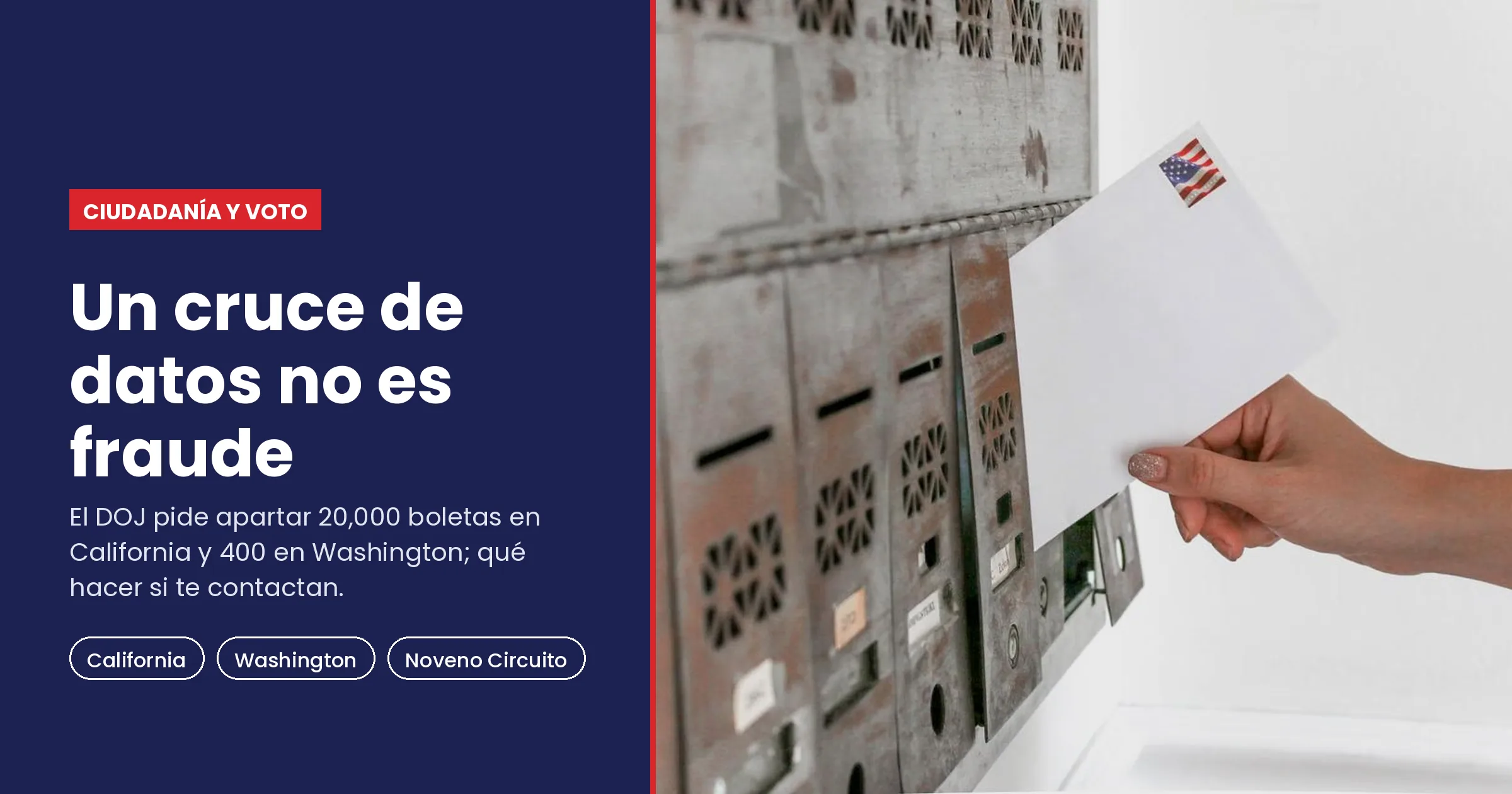
On October 15, the Justice Department (DOJ) sued California election officials after giving them 48 hours to review a list of more than 20,000 voters it deems “likely” noncitizens, and asked that their mail ballots be set aside uncounted. U.S. District Judge David O. Carter scheduled a hearing for October 27; the government filed an emergency appeal, and on October 25 two of the three Ninth Circuit judges appeared skeptical, according to Reuters.
On October 26, that panel declined 2-1 to step in, finding it lacked jurisdiction at this stage and that the government’s claimed emergency was, “at least in part, a self-constructed one,” according to CBS News. The case returns to the district court. Los Angeles County reported that in a sample of 200 records from the list, 112 were canceled or inactive registrations and more than a quarter listed a U.S. birthplace.
That same day, federal prosecutors asked Washington State to set aside the ballots of more than 400 voters they believe are noncitizens, most of them green card holders registered through the Motor Voter program, according to USA Today. Secretary of State Steve Hobbs said his office would review the request under the law and that the timing, a week before the November 3 election, “is no doubt intended to cast unfounded suspicion on the results.”
What did the judge say about the DHS investigations?
On October 21, U.S. District Judge Araceli Martínez-Olguín in Oakland, California, restricted a DHS program that sent agents to interview people flagged as possible noncitizens in nine states: California, Connecticut, Georgia, Missouri, Nevada, New York, Pennsylvania, Washington, and Wisconsin.
The order bars DHS from relying solely on database matches for field operations targeting people it knows, or should reasonably suspect, are U.S. citizens. The judge wrote that “even under the best conditions, there is a high likelihood of error” because “there is no federal database containing citizenship status.” The order was put on hold until October 23 to allow an appeal; DHS responded that it has “no plans to question or investigate people we believe to be U.S. citizens.”
Is a database match proof of fraud?
No. This is the distinction that matters most. Data matching compares voter rolls with immigration records, commercial files, and Social Security data, and it fails because of duplicate names, data-entry errors, or because the person naturalized later. Election officials in California and Washington say the lists include U.S.-born citizens and inactive registrations.
Nor should you confuse an administrative list of suspicions, individual proof that someone is not a citizen, and a criminal conviction. On October 26, the DOJ announced charges against 48 noncitizens for alleged election crimes in five states; those are accusations, and every defendant is presumed innocent. Attorney Alejandra Campos, founder of Campos Law Firm, stresses that no headline replaces a review of your own file.
That said, the law is clear: a noncitizen may not vote in federal elections, and unlawful voting or a false claim to citizenship are grounds of deportability (INA 237(a)(6) and 237(a)(3)(D)) and potential bars to the “good moral character” required for naturalization, according to the USCIS Policy Manual.
What should you do if you get a letter or a visit about your voter registration?
- Stay calm and do not sign anything on the spot: you have the right to consult an attorney before answering questions about your citizenship or registration.
- Keep everything: the letter, the envelope with the date, and the name and agency of whoever contacted you. If it was a visit, write down the date, time, and what you were asked.
- Find out whether you are actually registered: many people end up on the rolls through a driver’s license transaction they did not understand. According to USCIS, a registration made without knowingly claiming citizenship is generally not an unlawful act, but document it and request cancellation.
- If you are a green card holder and ever voted, tell your lawyer: Form N-400 expressly asks whether you have ever registered or voted; an inaccurate answer makes the problem worse.
None of this changes the requirements for naturalization: continuous residence, physical presence, good moral character, English, and civics remain the same. What increases is the scrutiny of your voting history at the interview, so before filing your N-400, review with an attorney whether you ever appeared on a voter roll and how to explain it with evidence.
Protect Your Immigration Status with Campos Law Firm
A database match does not make you a fraud suspect, but ignoring a letter or answering without counsel can cost you your green card or your citizenship. Our immigration attorneys review your voting history and prepare your naturalization; if the matter turns into charges, our criminal defense attorneys work in coordination with the immigration team.
Do not leave your immigration status to chance. Call us today at +1 (844) 922-6767 to schedule a free, confidential consultation in English or Spanish. Campos Law Firm: Legal Solutions in All Areas of Law.
With information from the Associated Press, The Washington Post, CBS News, Fortune, and USA Today.