
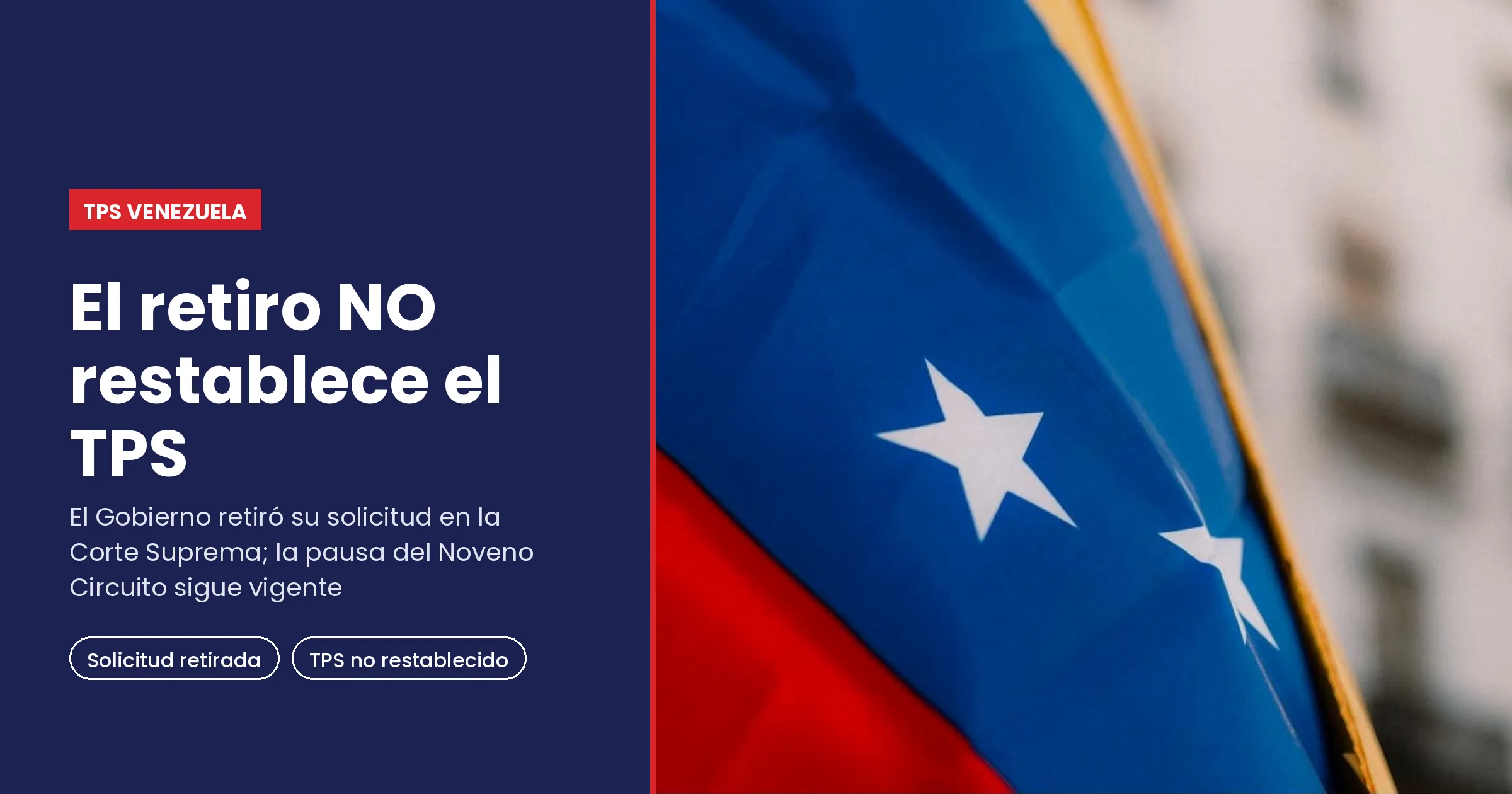
The Venezuelan TPS Supreme Court withdrawal, filed by the government on November 19, 2026, does not restore TPS. At Campos Law Firm, we closely monitor developments in U.S. immigration policy to protect our clients’ rights and future. If you saw on social media that “TPS is back” or that your work permit was renewed, that is not the case: the order that would have restored it remains on hold.
Important note: as of November 20, we found no new, verifiable instruction from U.S. Citizenship and Immigration Services (USCIS). Its Venezuela TPS page and its newsroom returned access errors, so we could not confirm whether it has posted anything. What we know comes from court documents and news reports, not from USCIS.
Here is what we know, what we do not, and what you can do.
What the Venezuelan TPS Supreme Court Withdrawal Means
On November 18, the government asked the Supreme Court to halt U.S. District Judge Edward Chen’s order setting aside the termination of Temporary Protected Status (TPS) for Venezuela, as we explained in our article on that request. One day later, on November 19, Solicitor General D. John Sauer sent a letter to the Clerk of the Court, Scott S. Harris, withdrawing that application (No. 26A714, Mullin v. National TPS Alliance).
The Supreme Court docket lists the letter that same day, followed by the entry “Application withdrawn.” The Court did not decide anything on the merits.
Why Was It Withdrawn, and Why Is TPS Still Not Back?
According to the letter, the reason is an order the Ninth Circuit issued on November 18 in case No. 25-5724. That appeals court extended its administrative stay of Judge Chen’s order until seven days after it publishes its judgment in the appeal. With that pause in place, the government already has what it was seeking from the Supreme Court, at least for now.
That is why the withdrawal changes nothing for beneficiaries. Judge Chen’s order remains frozen, TPS has not been restored, and there is no fixed date on which it could return. It depends on when and how the Ninth Circuit rules.
The government has also kept its options open. In its letter, it says that if the Ninth Circuit rules against it, it intends to “immediately return” to the Supreme Court for additional relief. The same letter repeats its arguments about the impact of restoring TPS, such as the release of about 1,800 detained Venezuelans; these are the government’s claims, not proven facts.
What Comes Next at the Ninth Circuit?
The case returned to that court after the Supreme Court, on October 5, 2026, vacated the Ninth Circuit’s earlier decision and asked it to reconsider in light of Mullin v. Doe. According to SCOTUSblog, in that June 2026 ruling the Supreme Court held that courts generally cannot review the Homeland Security Secretary’s decisions to designate or terminate TPS for a country.
The Ninth Circuit must now decide the appeal with that precedent in mind. There are three possible scenarios, none of them confirmed:
- The Ninth Circuit rules for the government: Judge Chen’s order would no longer have effect, and TPS would not return through this case.
- The Ninth Circuit rules for the beneficiaries: the pause would end seven days after its judgment, but the government has already said it would go back to the Supreme Court.
- The process drags on: until there is a judgment, the pause stays in place and TPS remains unrestored.
What Can You Do Now If You Had Venezuelan TPS?
Keep the background in mind: the 2021 designation ended, and the last court-protected documents under the 2023 designation expired on October 2, 2026. Here is what matters most today:
- Do not assume your work permit was renewed: there is no automatic extension of your Employment Authorization Document (EAD) because of this withdrawal or the pause. If you have work authorization through another route, such as a pending asylum case, confirm it with an attorney.
- Have an attorney review your case: each person has a different mix of TPS history, pending applications, and possible removal orders.
- Keep your documents: approval notice (I-797), EAD, I-94, re-registration receipts, and any notice from ICE or the Immigration Court.
- Watch out for scams: no one can “reactivate” your TPS today. Be wary of anyone charging for a process that does not exist or promising an immediate work permit.
- Follow official sources: the Ninth Circuit docket, the USCIS TPS page when it is available, and reliable news outlets, not screenshots on social media.
The previous stage of the litigation is covered in our article on the 14-day pause.
Protect Your Immigration Status with Campos Law Firm
Venezuelan TPS now hinges on an appeal with no decision date. We do not make unrealistic promises: we provide serious legal representation backed by preparation and integrity. Attorney Alejandra Campos, a Venezuelan lawyer and the firm’s founder, and our team of immigration attorneys can review your documents and your options.
Do not leave your immigration status to chance. Call us today at +1 (844) 922-6767 to schedule a free, confidential consultation in English or Spanish. Campos Law Firm: Legal Solutions in All Areas of Law.
With information from the Solicitor General’s letter, the U.S. Supreme Court docket, SCOTUSblog, the Associated Press and Reuters.