
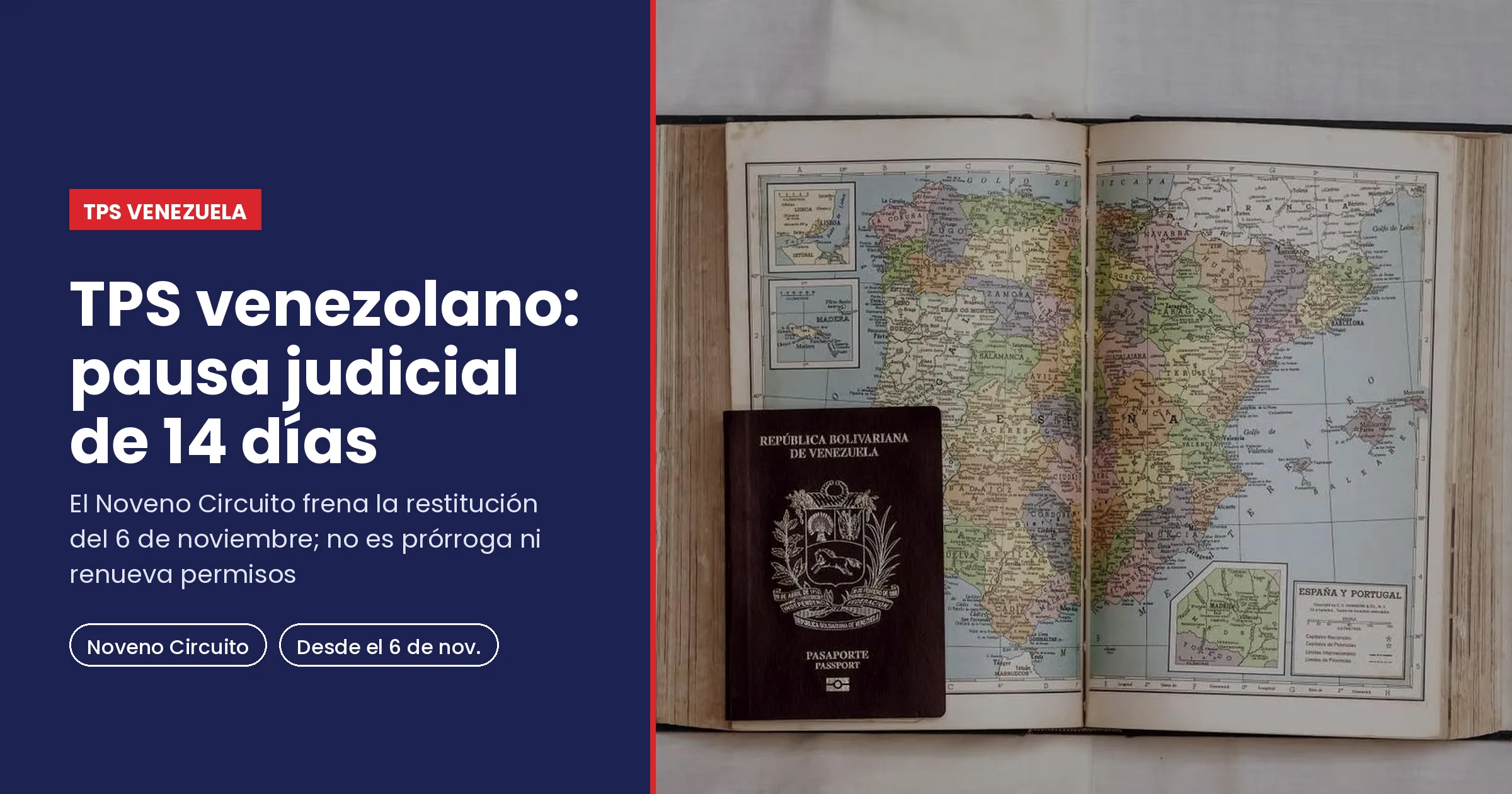
The Venezuelan TPS stay granted on November 3, 2026, means protection will not be restored on November 6, as seemed possible a week ago: the U.S. Court of Appeals for the Ninth Circuit gave the government a 14-day administrative pause. At Campos Law Firm, we closely monitor developments in U.S. immigration policy to protect our clients’ rights and future. This decision is not a TPS extension and does not renew work permits: it only freezes the situation for a few more days.
Here is what changed, what did not, and what you can do.
What Did the Ninth Circuit Decide in the Venezuelan TPS Stay Order?
In National TPS Alliance v. Mullin (No. 25-5724), the same three-judge Ninth Circuit panel granted the government’s request for a 14-day administrative stay, according to the order entered as docket 97 and reporting by Bloomberg Law. The pause begins when the Supreme Court issues its mandate, expected on Friday, November 6.
While it lasts, the order by U.S. District Judge Edward Chen in San Francisco, which had set aside the termination of Temporary Protected Status (TPS) for Venezuela, remains on hold. The order does not set a calendar end date; counting 14 days from November 6, the pause would end around November 20, as some outlets have calculated.
Why Did the October 30 Expectation Change?
On October 30, we reported that the Ninth Circuit had cleared the path for a possible November 6 restoration of Venezuelan TPS. That day, the panel denied the government both a stay pending appeal and an administrative stay of at least 21 days. Because the Supreme Court’s stay was set to end on November 6, Judge Chen’s order could have taken effect again that day.
On November 3, the same panel changed course and granted a shorter, 14-day pause. The published orders do not explain the reason for the change. In short, the sequence is:
- October 30: the Ninth Circuit denies the stay and the 21-day pause.
- November 3: the same court grants a 14-day administrative stay.
- November 6: the Supreme Court’s mandate is expected to issue; the 14-day pause begins instead of restoration.
We covered it on the Campos Law Firm Instagram:
What Does This Pause Mean, and What Is Still Undecided?
An administrative stay is a short pause that gives a court time to consider a request; it does not decide who is right. The government’s main request, a stay lasting through the entire appeal, is still pending. The court also asked both sides for supplemental briefs, due within seven days, on the effect of the Supreme Court’s Mullin v. Doe ruling, which limits judicial review of these Department of Homeland Security (DHS) decisions.
That is why it helps to be clear about what this order does not do:
- It does not extend TPS: Venezuelan TPS remains inactive while the pause lasts.
- It does not renew your work permit: an expired Employment Authorization Document (EAD) does not become valid again because of this order.
- It is not a USCIS instruction: U.S. Citizenship and Immigration Services (USCIS) has not published guidance on this decision.
- It does not end the case: after the pause, the Ninth Circuit can extend it or deny it, or the case can go back to the Supreme Court.
What Can You Do in the Meantime?
- Organize your TPS documents: keep your approval notice (I-797), your EAD, your I-94, and your re-registration receipts, and identify whether your case falls under the 2021 or the 2023 designation.
- Do not work on an expired permit on your own: wait for official USCIS instructions and get advice before giving documents to your employer.
- Be wary of anyone who charges you to “reactivate” your TPS: no such process exists today.
- Review other options: a pending asylum case, a family petition, or a defense in Immigration Court do not depend on TPS.
- Get advice before traveling or signing: do not leave the country or sign ICE documents without first talking to an attorney.
Protect Your Immigration Status with Campos Law Firm
Venezuelan TPS can change again within days, and each designation and each document has different dates. We do not make unrealistic promises: we provide serious legal representation backed by preparation and integrity. Attorney Alejandra Campos, a Venezuelan lawyer and the firm’s founder, and our team of immigration attorneys can review your case and explain what this pause means for you.
Do not leave your immigration status to chance. Call us today at +1 (844) 922-6767 to schedule a free, confidential consultation in English or Spanish. Campos Law Firm: Legal Solutions in All Areas of Law.
With information from Bloomberg Law, the legal website Juricue, the newspaper El Cronista, the law firm WR Immigration and USCIS.