
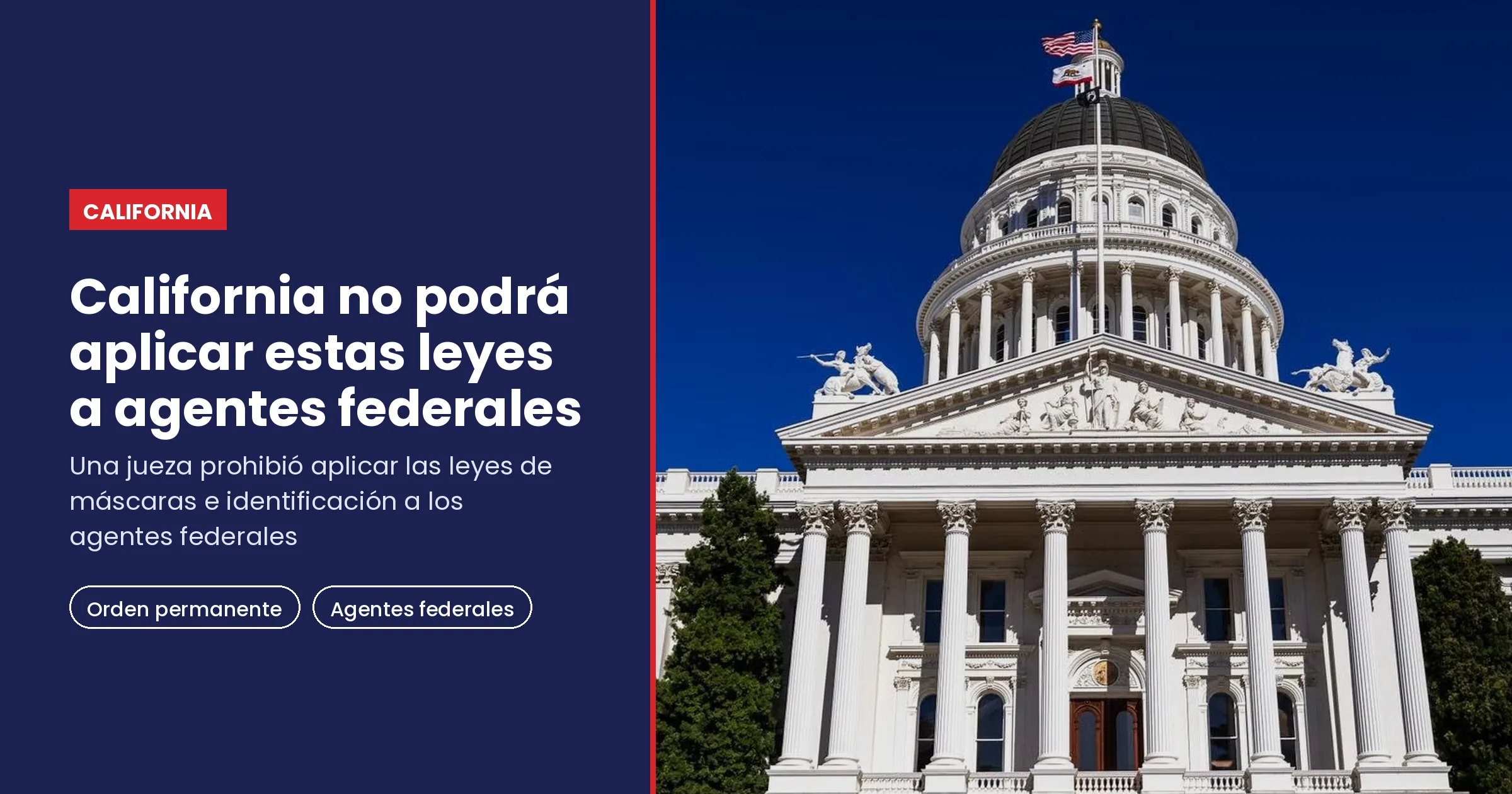
The California federal agents injunction, announced by the Justice Department (DOJ) on November 19, 2026, bars the state from applying its mask and identification laws to federal officers. At Campos Law Firm, we closely monitor developments in U.S. immigration policy to protect our clients’ rights and future. In practice, ICE and other federal agents can keep operating in California with their faces covered and without the identification those laws required.
But the order has a specific scope, and your rights when facing an agent do not change. Here is what we know, what we do not, and what you can do.
What Did the Judge Decide About California’s Laws?
U.S. District Judge Christina A. Snyder of the Central District of California signed the order on Tuesday, November 17, in United States v. State of California (2:25-cv-10999), according to the DOJ and news reports. The federal government had sued the state, Governor Gavin Newsom, and Attorney General Rob Bonta on November 17, 2025.
The order permanently bars enforcement of four state law provisions (Government Code Sections 7288 and 7289 and Penal Code Sections 185.5 and 13654) against the U.S. government, its officers, and its agencies. Those sections come from two laws Newsom signed in September 2025:
- SB 627, the “No Secret Police Act”: it barred federal and local officers from covering their faces during operations, with exceptions such as undercover work or medical masks.
- SB 805, the “No Vigilantes Act”: it required non-uniformed officers to display their agency and their name or badge number.
The judge also dismissed the case with prejudice.
Why Did It End in a California Federal Agents Injunction?
California had been losing the case in stages. On February 9, 2026, Judge Snyder blocked the mask ban because, in her analysis, it discriminated against the federal government: it did not apply to state police such as the California Highway Patrol.
The Ninth Circuit then blocked the identification rule during the appeal and, on October 14, 2026, a three-judge panel unanimously held that it violates the Constitution’s Supremacy Clause. After that ruling, the parties filed a joint stipulation, and California agreed to end the case without further appeals. According to The Sacramento Bee, state lawyers noted for the record that they continue to dispute the federal government’s claims.
States “do not have the authority to regulate the Federal Government,” Associate Attorney General Stanley E. Woodward Jr. said in the press release. That is the DOJ’s position. As of publication, we found no new statement from Newsom or Bonta on the final order; in February, Bonta had argued that “transparency and accountability are the foundation of good law enforcement.”
What Changes, and What Does Not, for You in California?
What changes is specific: California cannot penalize a federal agent for wearing a mask or for not displaying a name or badge number under those four sections. It is a debate similar to the one in Maryland, where the Justice Department sued the state over its law banning masks for officers.
What does not change matters just as much:
- Other California laws are not affected: the order is limited to those four sections. It does not touch, for example, state rules limiting local police cooperation with ICE.
- The Constitution has not changed: your rights with any agent, masked or not, remain the same.
- Some questions remain open: according to The Sacramento Bee, it is unclear how the order affects a 2026 law (SB 1004) that asks state and local police to adopt mask policies.
What Can You Do If You Encounter Federal Agents?
An agent with a covered face has no more power over you. If you encounter agents on the street, at work, or at home:
- Ask for identification: you can ask for their name and agency. They may not answer.
- Remain silent: you do not have to answer questions about where you were born or your immigration status.
- Do not sign anything: do not sign documents you do not understand without first talking to an attorney.
- Ask for a lawyer: if you are detained, ask to speak with your attorney.
- Do not open the door without a judicial warrant: to enter your home without your consent, agents generally need a warrant signed by a judge, not just an ICE form.
- Document what happens: write down the time, place, vehicles, and anything visible on the uniform. You can record from a safe distance without interfering. Do not run, do not resist, and do not show false documents.
Protect Your Rights with Campos Law Firm
Knowing how to act with an agent can make a difference in an immigration case. We do not make unrealistic promises: we provide serious legal representation backed by preparation and integrity. If a family member was detained in California or another state, our team of immigration attorneys can help you locate them and review their options.
Do not leave your immigration status to chance. Call us today at +1 (844) 922-6767 to schedule a free, confidential consultation in English or Spanish. Campos Law Firm: Legal Solutions in All Areas of Law.
With information from the U.S. Department of Justice, The Sacramento Bee, the Civil Rights Litigation Clearinghouse, the ABA Journal and the California Attorney General’s Office.