
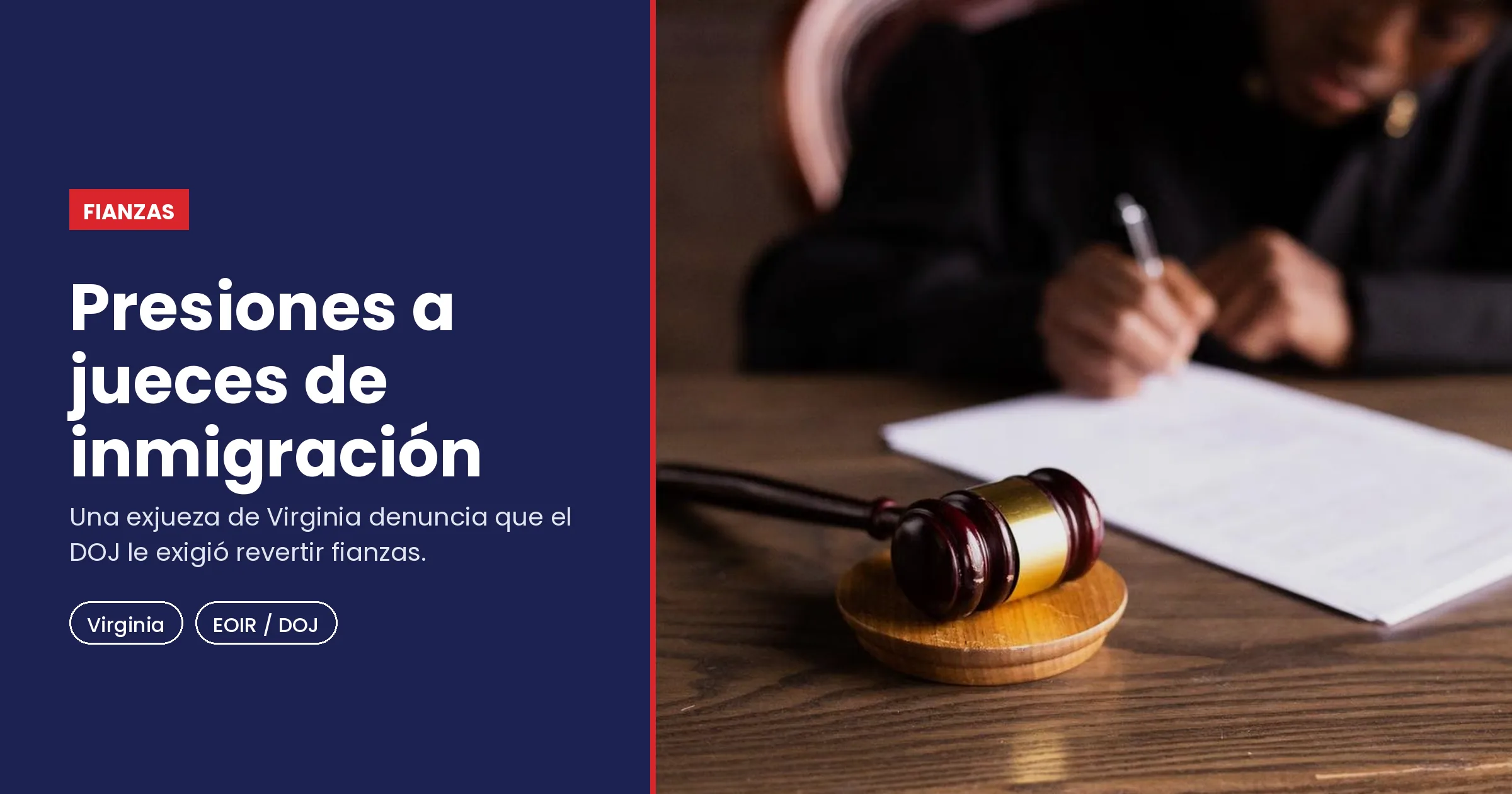
An immigration judge’s account is raising new questions about how bond decisions are made. At Campos Law Firm, we closely monitor developments in U.S. immigration policy to protect our clients’ rights and future. On October 25, 2026, The Washington Post published an investigation into Karen Donoso Stevens, a former judge at the Annandale Immigration Court in Virginia, who says Justice Department supervisors pressured her to reverse bond decisions in favor of detained immigrants and that, months later, she was fired without explanation.
These are the former judge’s allegations and documents reviewed by the newspaper, not a court finding. But the case raises a question that affects anyone detained by ICE: who decides your bond, and how independent are they? Below, we explain what is known, what is not, and what you can do.
What does former judge Karen Donoso Stevens allege?
According to The Washington Post, in September 2025 the judge granted bond to four people who had entered the country without inspection as minors. A supervisor allegedly told her that “higher-ups” wanted her to vacate those decisions on her own motion, without a government appeal; according to notes she took at the time, she reluctantly complied. In November 2025, the head of the immigration court system, Teresa L. Riley, emailed her demanding an explanation for six other bond grants issued after federal court orders.
In January 2026, another supervisor reminded her that a court-ordered bond hearing did not require her to grant release. On January 14 she was pulled from detained cases mid-hearing; on May 21, 2026, she was fired, nine months before becoming eligible for a pension. She has appealed and, per the Post, is one of at least a dozen former immigration judges arguing their dismissals were unlawful.
The Executive Office for Immigration Review (EOIR) referred to “a disgruntled former employee’s allegations” and said the Justice Department’s approach “is to impartially adjudicate cases… in accordance with the law and evidence.” The Post also reports that the administration fired about 100 of the country’s roughly 700 immigration judges during its first year.
Why isn’t Immigration Court an independent court?
Many people assume an immigration judge is like a federal judge. They are not. Immigration courts belong to EOIR, an office within the Justice Department, and the judges are department employees under the Attorney General, without the life tenure that protects federal judges. The Board of Immigration Appeals (BIA), which reviews their decisions, is also part of DOJ.
In other words, the agency that accuses (DHS, through ICE) and the one that judges (DOJ) both sit in the executive branch. An EOIR memo from August 2025 states that no one may “direct any adjudicator to rule in a particular way,” but warns that “statistically improbable outcome metrics” may warrant close examination. Donoso Stevens’ allegations raise the question of whether that line was crossed; that has not been established.
What does this mean for your bond hearing?
At a bond hearing, the detained person must show that they are not a danger to the community or a flight risk; the judge decides whether release is appropriate and sets an amount. But the ground shifted in September 2025: in Matter of Yajure Hurtado, the BIA concluded that many people who entered without inspection are subject to mandatory detention and cannot ask an immigration judge for bond at all.
Nine federal courts of appeals have rejected that reading, two have upheld it, and the Supreme Court has agreed to resolve the question. Meanwhile, on October 23, 2026, the Fifth Circuit (Texas, Louisiana, and Mississippi) ruled 10-7 that the Constitution, on its own, does not require bond hearings for detained immigrants. In practice, your right to a hearing today depends on where you are held, how you entered, and your record. As Attorney Alejandra Campos, founder of Campos Law Firm, stresses, no news story replaces a review of your file.
What can you do if bond is denied or revoked?
- Ask for the decision in writing: the judge’s bond memorandum explaining the denial is the foundation of any appeal.
- Appeal to the BIA within 30 days: a bond decision is appealed separately from the removal case, using Form EOIR-26, and the deadline is strict. The government can also appeal a bond that was granted, which is why it pays to be prepared from the start.
- Consider habeas corpus: if the Immigration Court says it has no authority to grant you bond, or if you have been detained for months without review, an attorney can ask a federal judge to order a hearing or your release. That path has worked in the circuits that reject the BIA’s interpretation.
- Do not decide out of fear: accepting voluntary departure or a removal order to “get out fast” can close options that still exist. Our immigration attorneys can review whether your case qualifies for bond, habeas corpus, or both.
Protect Your Immigration Status with Campos Law Firm
The Washington Post’s allegations remain under review. What is a fact is that the rules of immigration detention change by circuit, by date, and by type of entry, and that a denied bond is not always the end of the road.
If you or a family member is detained by ICE, Campos Law Firm is here to help you. Do not leave your immigration status to chance. Call us today at +1 (844) 922-6767 to schedule a free, confidential consultation in English or Spanish. Campos Law Firm: Legal Solutions in All Areas of Law.
With information from The Washington Post, Minnesota Lawyer, Latin Times, Reuters and CLINIC.