
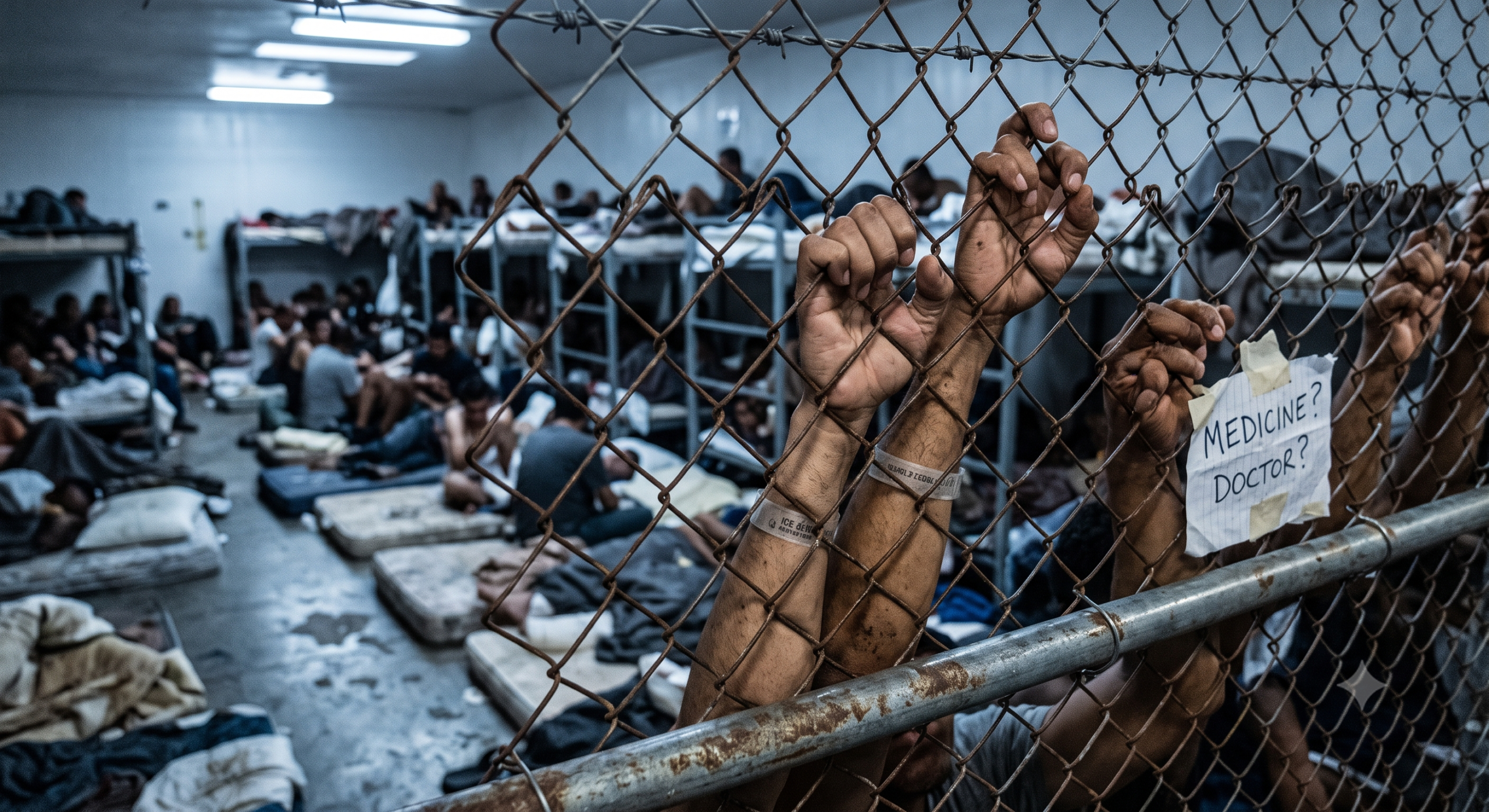
In recent weeks, a series of federal court orders have put the spotlight on confinement conditions in Immigration and Customs Enforcement (ICE) detention centers, forcing the Government to guarantee basic services following reports of extreme overcrowding, lack of medical care, and unsanitary environments.
In California, Federal Judge Sunshine Suzanne Sykes issued a preliminary injunction demanding that authorities guarantee humane conditions at the Adelanto Processing Center, managed by the private contractor GEO Group. The order mandates providing 24-hour drinking water, adequate food, hygiene, clean sheets, and timely access to medications.
The lawsuit prompting this decision alleges that the center is plagued by disease and mold, violating the Fifth Amendment against inhumane forms of confinement. Despite this, the Department of Homeland Security (DHS) dismissed the accusations as “false” and attributed the order to an “activist judge,” claiming that ICE maintains standards superior to many state prisons.
The Collapse of “26 Federal Plaza” in New York
One of the most critical cases is unfolding in Manhattan, where a federal judge had to limit the capacity of detention rooms at 26 Federal Plaza after detecting a “serious risk of irreparable harm.” Investigations based on internal communications revealed that detainees were crammed into spaces so tight they had only 10 square feet per person—an area equivalent to a telephone booth.
Among the conditions reported at this facility are:
- Sleep deprivation: Detainees slept sitting up due to a lack of physical space.
- Lack of hygiene: Rooms that reeked of unwashed bodies and a lack of showers.
- Medical negligence: People with serious conditions such as tuberculosis, kidney failure, and heart problems did not receive adequate treatment.
A National Pattern of Mortality and Lack of Oversight
These judicial interventions occur against a backdrop of growing concern for the safety of immigrants in custody. So far in 2026, at least 22 people have died in ICE centers, and the mortality rate has recently doubled.
Beyond the physical conditions, the oversight of agents’ conduct is also under scrutiny. Out of 56 complaints of excessive force filed since the beginning of the current administration, only one officer has been referred for disciplinary action, and to date, no effective sanctions have been applied.
As the Government continues its strategy of mass deportations, the expansion of the detention system through the use of private prisons and increased operational capacity continues to face fierce resistance in federal courts over alleged violations of fundamental human rights.
 EN
EN  ES
ES  ZH
ZH  FR
FR