
For two years, thousands of people were denied asylum not because of what happened to them at home, but because of how they crossed the border. A federal appeals court has now held that this restriction conflicts with the statute.
At Campos Law Firm, we closely monitor developments in U.S. immigration policy to protect our clients’ rights and future. Here is what the court decided, who it reaches, and what it does not do.
What did the court decide?
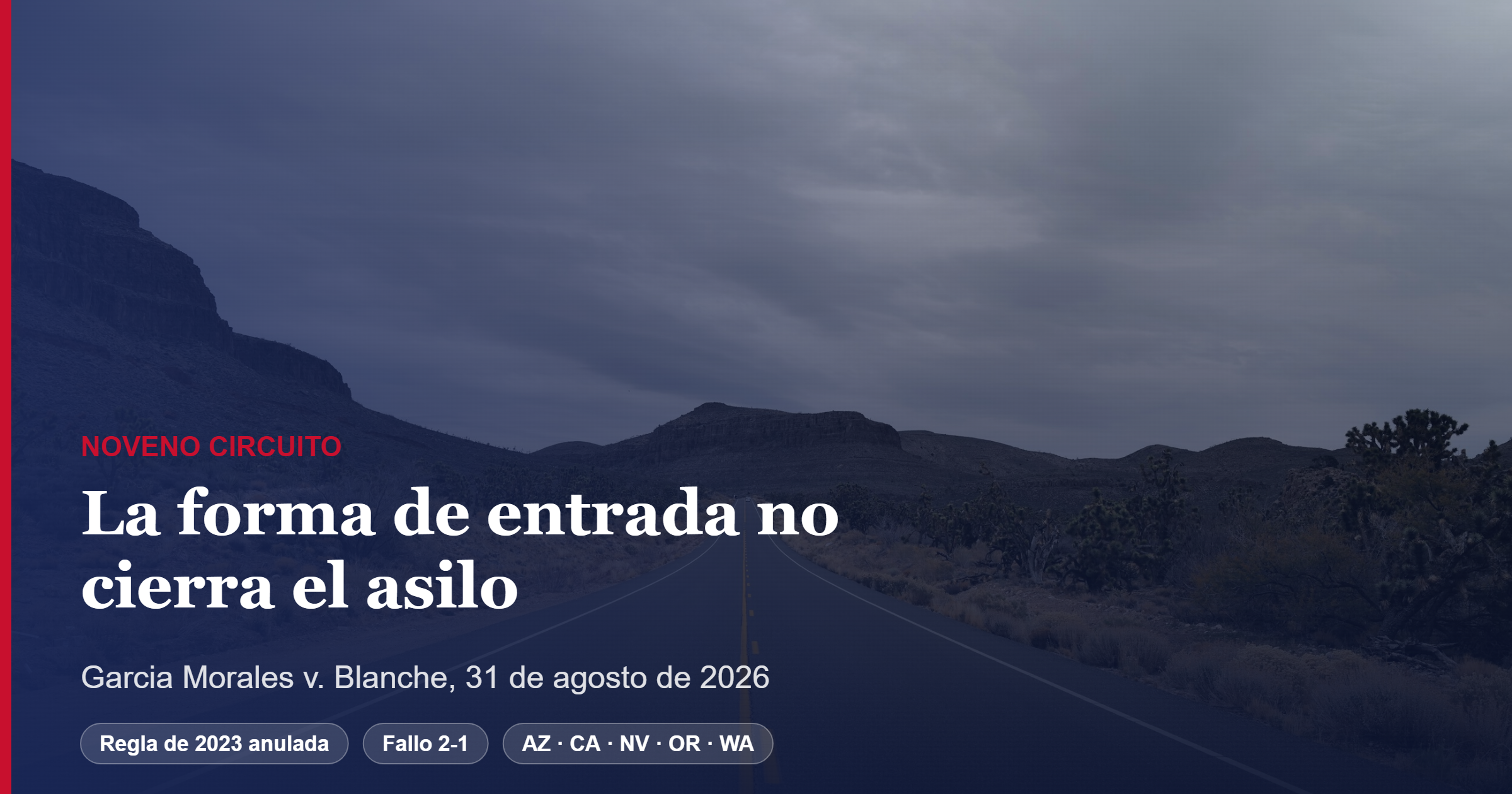
On August 31, 2026, a panel of the U.S. Court of Appeals for the Ninth Circuit decided Garcia Morales v. Blanche (No. 25-1760) and held the Circumvention of Lawful Pathways rule, published on May 16, 2023, to be invalid.
That rule created a presumption of asylum ineligibility for people who entered between ports of entry, subject to certain exceptions. The court held that restricting eligibility based on manner of entry conflicts with the text of the statute: 8 U.S.C. § 1158(a)(1) provides that any noncitizen physically present in the United States may apply for asylum, “whether or not at a designated port of arrival.”
The government argued the rule survived because it was not an absolute bar but a rebuttable presumption with exceptions. The panel rejected that: it found each exception legally invalid or practically unavailable, and held that restricting asylum for any subset of people because of how they entered is impermissible, exceptions or not.
The decision was 2 to 1. Judge Richard A. Paez wrote the majority, joined by district judge Mustafa T. Kasubhai sitting by designation; Judge Patrick J. Bumatay dissented. The court granted the petition for review and remanded to the Board of Immigration Appeals (BIA) for consideration on the merits, including full application of the mixed motives framework.
Who can this decision help?
The rule applied to non-Mexican nationals who entered between ports of entry between May 11, 2023 and May 11, 2025. If your case falls in that window and the denial rested on that presumption, this ruling is directly relevant.
Geography matters: the precedent binds within the Ninth Circuit, which covers Alaska, Arizona, California, Hawaii, Idaho, Montana, Nevada, Oregon, and Washington, plus Guam and the Northern Mariana Islands. For our clients in Oregon it applies directly; in Colorado, Utah, and Indiana — other circuits — it is not binding, though it can be cited as persuasive authority.
The fact that the rule has already expired does not make it irrelevant: pending cases, appeals, and final orders issued while it was in force are all still out there.
What does this ruling not do?
This is where false expectations get built, so it deserves to be blunt.
- It does not grant you asylum. It removes an obstacle; it does not decide the merits. You still must prove past persecution or a well-founded fear, the nexus to a protected ground, and the credibility of your account.
- It does not reopen your case automatically. No file reopens by itself. The proper motion or petition must be filed, and there are deadlines.
- It does not erase other grounds for the denial. If the judge also found a lack of credibility, no nexus, an untimely filing under the one-year rule, or a ground of inadmissibility, those still stand.
- It is not the last word. The government may seek rehearing en banc or review in the Supreme Court. This can change.
What should you do if you were denied over your manner of entry?
- Get the full written decision from the immigration judge and, if there is one, from the BIA. You need to read exactly what the denial rested on: whether the manner-of-entry presumption appears, and whether it was the only ground.
- Check the deadlines, which are short and are not extended. A motion to reopen generally carries 90 days from the final order; a motion to reconsider, 30 days; and a petition for review in the court of appeals, 30 days from the BIA’s final order. A change in the law can open arguments, but it does not pause the calendar on its own.
- If your case is still pending before the BIA or the court, this precedent can be brought in through supplemental authority. Talk to your attorney this week, not next month.
- Rebuild the evidence on the merits: country conditions reports, police reports, medical records, witnesses. If the case returns to the merits, that is where it is won or lost.
- Do not travel outside the United States or file new applications without advice first. Departing can trigger consequences that are hard to undo.
- Be wary of anyone who promises you a result because of this ruling. No one can guarantee asylum, and anyone who does is not helping you.
Protect Your Asylum Case with Campos Law Firm
A change in case law only helps if someone applies it to your file in time. Immigration deadlines do not wait for the picture to clear.
At Campos Law Firm we read the decision in your case, identify what the denial rested on, and assess honestly whether this precedent reaches you. Do not leave your immigration status to chance. Call us today at +1 (844) 922-6767 to schedule a free, confidential consultation in English or Spanish. Campos Law Firm: Legal Solutions in All Areas of Law.
 English
  Spanish