
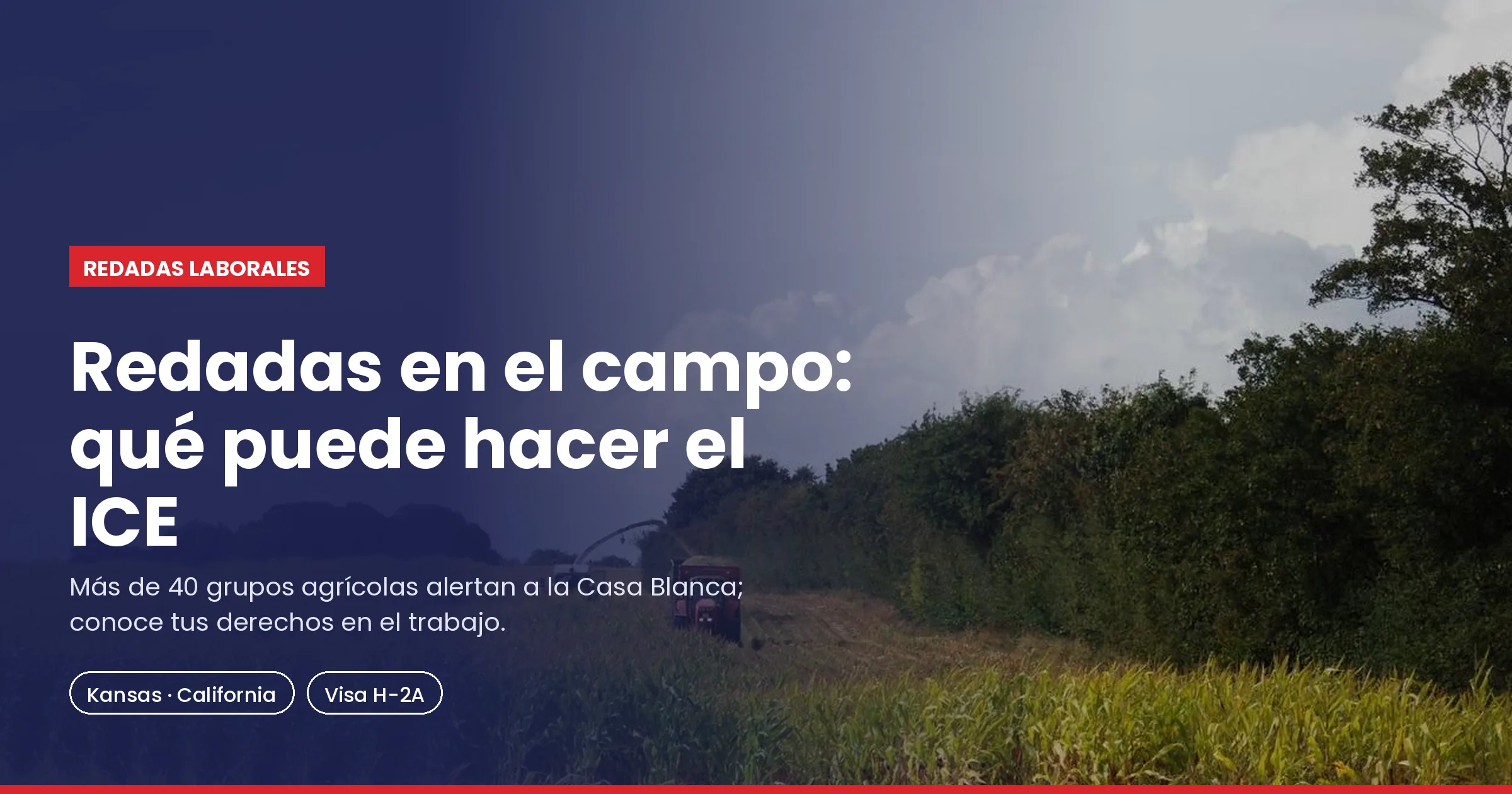
ICE raids on farms are no longer only a concern for workers: growers say they are disrupting the food supply. At Campos Law Firm, we closely monitor developments in U.S. immigration policy to protect our clients’ rights and future. On October 23, 2026, The Washington Post reported that more than 40 farmers and agricultural organizations warned President Donald Trump and congressional leaders that immigration enforcement is disrupting food production and could push grocery prices higher.
If you work in the fields, at a meatpacking plant, or on a dairy farm, this story hits close to home. Below, we explain what is known, what is not, and what you can do.
What did the farm groups warn about?
According to the Post’s report, picked up by industry outlets such as RFD-TV and PNW Ag, the signers represent dairy, livestock, and produce growers, including the Milk Producers Council, the Texas International Produce Association, and the Kansas Livestock Association. Their message: raids have hit meatpacking plants, livestock shipments, and harvests in several states, and losing experienced workers could leave crops in the field.
The groups are asking for legislation that would grant legal work authorization to established agricultural employees. The Post notes that roughly 66% of the nation’s farmworkers were born outside the United States. These are industry warnings, not an official finding about future prices.
What is happening in Kansas, Pennsylvania, and California?
On September 25, Reuters reported that immigration agents fanned out across southwest Kansas, around Dodge City, Liberal, and Garden City, stopping drivers to ask about their status and patrolling near National Beef and Cargill plants. The Kansas Livestock Association, together with cattle groups from Oklahoma and Texas, said the operations delayed shipments of thousands of cattle and had a “massive chilling effect” on skilled, documented workers.
In Pennsylvania, LancasterOnline reported that ICE arrested 17 employees of poultry hauler Melhorn in three operations in August and September; PennAg Industries Association president Christian Herr says some had valid documentation, a claim ICE did not answer. In California, the Post describes farmworker arrests during sweeps. In Congress, Rep. Glenn Thompson’s Securing Agriculture’s Workforce Act, which would extend H-2A visas to year-round operations, remains in committee.
During ICE raids, what can agents do at your workplace?
This is the distinction that matters most. Agents may enter and ask questions in the public areas of a business, such as a parking lot or a customer-facing area. To enter private areas (barns, production floors, locker rooms, worker housing), they need a judicial warrant signed by a judge or the employer’s voluntary consent.
An ICE administrative warrant (Forms I-200 or I-205) is signed by an immigration officer, not a judge, and on its own does not authorize entry into private spaces. That is the general rule explained by the New York Immigration Coalition and Illinois Legal Aid; how it plays out in a given operation depends on the facts. A non-supervisory employee can say they have no authority to give consent and refer agents to a manager.
During an operation you keep basic rights regardless of your status: you may remain silent, you do not have to say where you were born or how you entered the country, you may refuse a search of your belongings, and you may ask to speak with an attorney. Do not run and do not present false documents; both can make your situation worse.
What protections does an H-2A worker have?
If you hold an H-2A visa, your status is tied to the employer that sponsored you, but that does not leave you without rights. According to the Department of Labor, your employer must pay the special wage rate for your region, provide safe and clean housing, provide safe transportation when the job requires overnight travel, and guarantee at least 75% of the hours in your contract. Complaints go to the Wage and Hour Division at 1-866-487-9243.
Some protections from the 2024 farmworker rule, including certain anti-retaliation guarantees, are suspended and the government has proposed rescinding them. An immigration arrest does not erase wages you already earned, either. Our immigration attorneys can review your visa, your contract, and your options if your employer threatens to “call ICE.”
What can you do if there is a raid at your job?
- Stay calm, do not run, and ask whether you are free to leave: if you are not under arrest, you may walk away.
- Remain silent and sign nothing until an attorney reviews it; some forms amount to accepting voluntary departure.
- Ask to see the warrant: a judicial warrant carries a judge’s signature and a court’s name; an administrative one does not.
- Have a family plan: copies of your documents, your A-number if you have one, an attorney’s phone number, and who will care for your children.
- If a coworker is detained: note where they are being taken and use the ICE Online Detainee Locator (locator.ice.gov).
Protect Your Rights with Campos Law Firm
The industry’s warnings confirm what we see every day: enforcement operations do not distinguish between people with papers and people without them, and fear paralyzes entire communities. Knowing what ICE can do, and having a plan before anything happens, makes the difference.
If you work in the fields or at a plant and fear a raid, or if a family member has already been detained, Campos Law Firm is here to help you. Do not leave your immigration status to chance. Call us today at +1 (844) 922-6767 to schedule a free, confidential consultation in English or Spanish. Campos Law Firm: Legal Solutions in All Areas of Law.
With information from The Washington Post, Reuters, LancasterOnline, and the Department of Labor.