
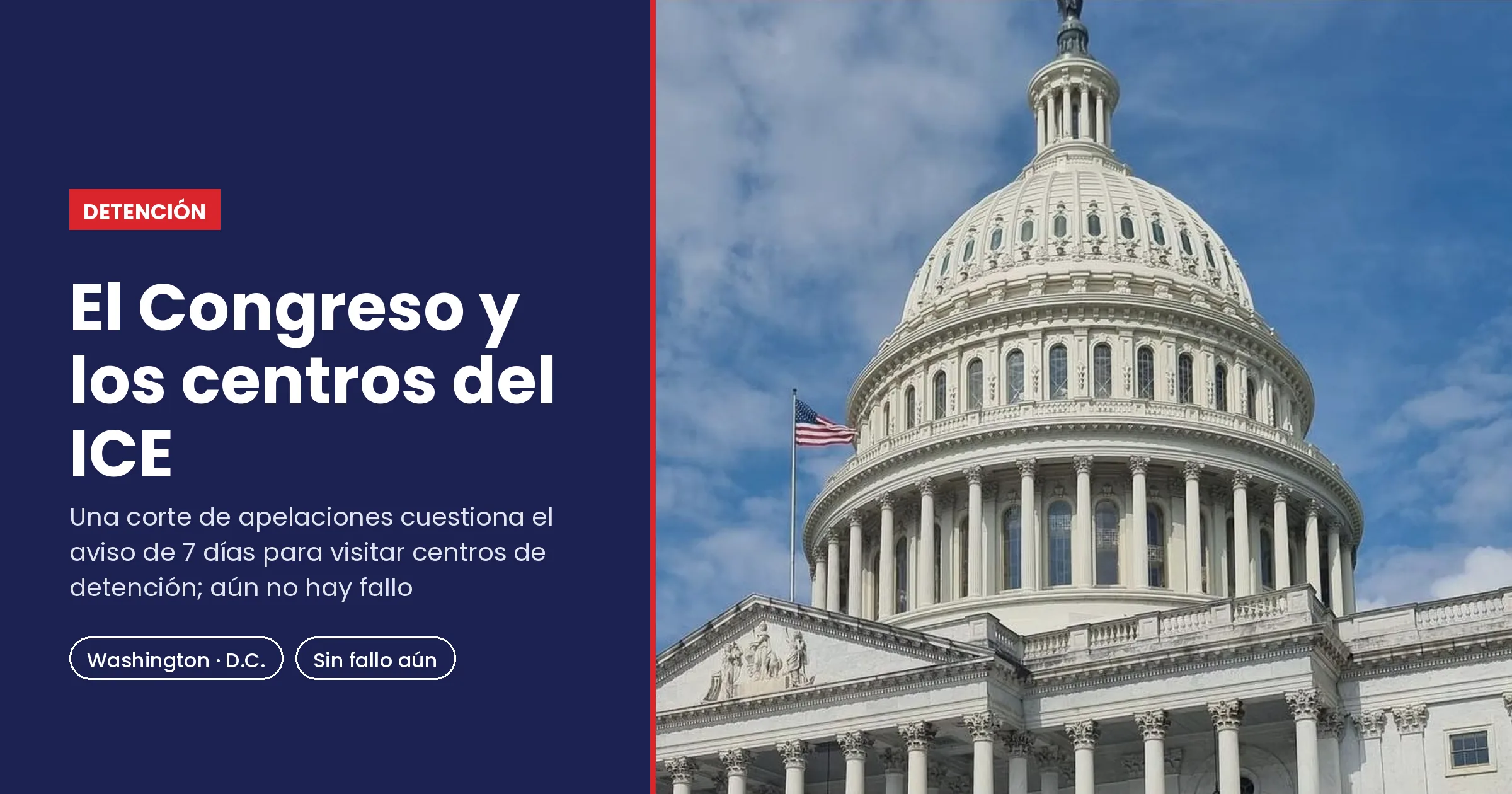
ICE detention oversight reached the U.S. Court of Appeals for the D.C. Circuit on November 3, 2026, when a three-judge panel heard the government’s case for requiring lawmakers to give seven days’ notice before inspecting detention centers. At Campos Law Firm, we closely monitor developments in U.S. immigration policy to protect our clients’ rights and future. According to Reuters, the judges appeared wary of those arguments, but there is no ruling yet.
Questions from the bench are not a decision. Here is what we know, what we do not know yet, and what you can do if a relative is in Immigration and Customs Enforcement (ICE) custody.
What Is the ICE Detention Oversight Appeal About?
The case is Neguse v. U.S. Immigration and Customs Enforcement, and the appeal is No. 26-5072, according to the Civil Rights Litigation Clearinghouse. The government is challenging a March 2, 2026 order by U.S. District Judge Jia M. Cobb in Washington, D.C., which paused the seven-day notice requirement while the lawsuit moves forward.
Until the appeals court rules, that order stays in place: members of Congress can visit detention facilities unannounced, although their staff must still give 24 hours’ notice, according to Law&Crime. There is no date for a decision.
How Did the Case Start, and Who Is Suing?
The lawsuit was filed on July 30, 2025. It is led by Rep. Joe Neguse of Colorado together with other House Democrats; Rep. Kelly Morrison joined in January 2026, bringing the group to 13 plaintiffs. They include Rep. Jason Crow, whose district covers the privately run ICE detention center in Aurora, Colorado. They are represented by Democracy Forward and American Oversight.
The lawmakers rely on Section 527, a provision Congress has written into spending laws since 2019 that bars the Department of Homeland Security (DHS) from using funds to block their oversight visits. Judge Cobb paused a first version of the rule on December 17, 2025. On January 8, 2026, then-DHS Secretary Kristi Noem issued a nearly identical policy, one day after an ICE officer fatally shot U.S. citizen Renee Good in Minneapolis, and argued it would be paid for with money not covered by that restriction. The judge blocked it again in February and in March.
On May 8, the same appeals court unanimously refused to pause Judge Cobb’s order while the appeal was pending. In a concurrence, Judge Neomi Rao wrote that the government would likely win its argument that the lawmakers lack standing to sue, but that it had not shown irreparable harm. That question remains open.
Why Does This Oversight Matter to Detainees’ Families?
An unannounced visit shows a facility as it runs day to day. When she paused the rule, Judge Cobb noted that the government had not cited “concrete examples of safety issues” caused by such visits, according to the Associated Press. For many families, their representative’s office is also a channel for raising complaints about health, food, or treatment.
It is important not to overstate what this case does: it does not release anyone or change any individual deportation case. A congressional visit is no substitute for a lawyer. Complaints about conditions also end up in court, as we explain in our article on the ICE detention conditions lawsuit in Indiana.
What Should You Document About Detention Conditions?
Whatever the panel decides, an organized record helps your attorney file complaints, request medical care, or assess whether there are grounds to seek your relative’s release.
- Location and transfers: write down the facility name, address, and the date of every transfer. If your relative does not appear in the system, read our guide on the ICE detainee locator lawsuit.
- Specific conditions: note the date and what your relative tells you about space, temperature, food, water, hygiene, medical care, or isolation. Precise details carry more weight than general descriptions.
- Requests and responses: ask your relative to keep a copy of every written request to the facility and the answer they received.
- Calls and access to counsel: log the date, time, and length of each call, and whether calls are cut off or legal calls are denied.
- Formal complaints: the ICE Detention Reporting and Information Line (1-888-351-4024) takes reports of abuse and serious unresolved problems. Keep the date and reference of each report.
Protect Your Rights with Campos Law Firm
What happens inside a detention center can affect your relative’s health and the options in their case. We do not make unrealistic promises: we provide serious legal representation backed by preparation and integrity. Our team of immigration attorneys can help you organize the paperwork and assess the remedies available, and if your relative is held at the Aurora facility, you can visit our Aurora office.
Do not leave your immigration status to chance. Call us today at +1 (844) 922-6767 to schedule a free, confidential consultation in English or Spanish. Campos Law Firm: Legal Solutions in All Areas of Law.
With information from Reuters, the Associated Press, Roll Call, Law&Crime, JURIST, and the Civil Rights Litigation Clearinghouse.