

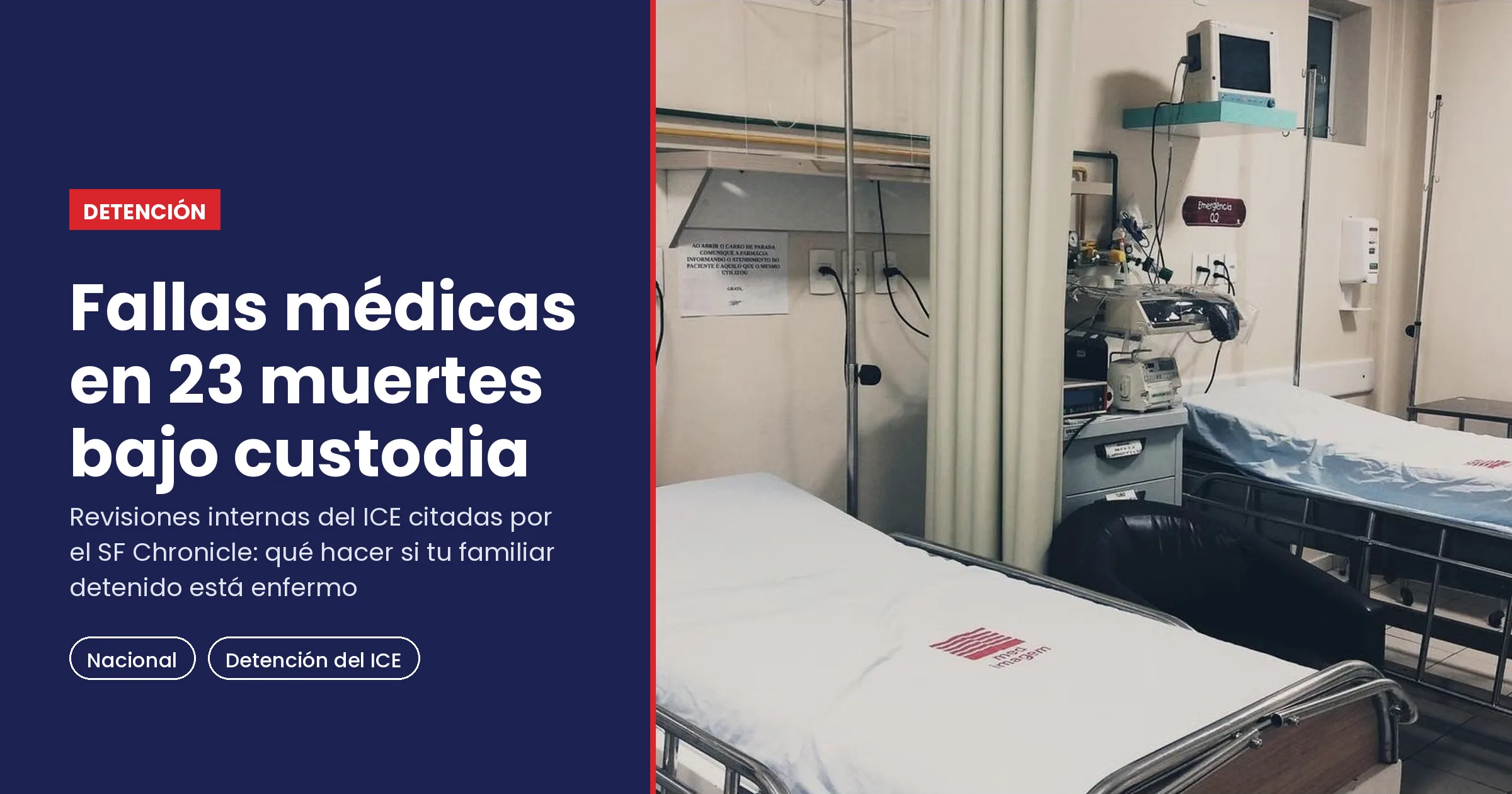
ICE custody deaths are back in the spotlight after a San Francisco Chronicle investigation published on November 6, 2026. At Campos Law Firm, we closely monitor developments in U.S. immigration policy to protect our clients’ rights and future. According to the newspaper, Immigration and Customs Enforcement’s (ICE) own reviewers found deficient medical care in 23 of 29 deaths they examined.
Here is what we know, what we do not know yet, and what you can do if a loved one is detained.
What Did the Investigation Reveal About ICE Custody Deaths?
The Chronicle obtained internal ICE reports on 29 people who died in immigration custody between January 2025 and January 2026, as summarized by The New Republic. In 23 of those cases, the agency’s reviewers concluded that the medical care detainees received before their deaths was deficient.
The reports use phrases such as care that “deviated from safe limits of practice.” According to the same summary, in at least eight cases staff performed CPR incorrectly or did not perform it at all. These mortality reviews are prepared by the ICE Health Service Corps (IHSC) based on medical records and staff interviews.
It is not the first warning sign. In September, The Intercept reported that ICE posted and then removed from its website eight reviews of 2025 deaths that described problems such as mismanaged medication and delayed treatment.
We covered it on the Campos Law Firm Instagram:
Does This Mean the Failures Caused the Deaths?
Not necessarily, and it matters to say this precisely. A review that finds failures in care does not, on its own, establish that those failures caused each death. In fact, according to The New Republic, in three of the cases investigators concluded that the deficient care did not directly contribute to the death.
As of publication, we found no public response from ICE or the Department of Homeland Security (DHS) to this reporting. In December 2025, then-DHS spokesperson Tricia McLaughlin told Newsweek there had been no spike in deaths and that the agency maintained a “higher standard of care than most prisons.” According to The New Republic, 2025 saw the most detainee deaths since 2003.
What Should You Do If a Detained Family Member Has Medical Needs?
If your loved one has a chronic illness, takes medication, or needs mental health care, acting early and in writing makes a difference. We explained part of this process after the death of a detainee in ICE custody in Georgia. These are the key steps:
- Document their medical history: gather diagnoses, prescriptions, and dosages, and ask the treating doctor for a letter explaining why treatment cannot be interrupted.
- Request care in writing: your family member can submit medical requests at the facility; ask them to note the date of each one and keep a copy.
- Keep a log: record symptoms, calls, facility responses, and the names of staff you speak with.
- Contact an immigration attorney: they can reach the assigned deportation officer, send the medical documentation, and assess whether to request bond or humanitarian parole.
- Use complaint channels: the ICE Detention Reporting and Information Line (1-888-351-4024), the DHS Office of Inspector General (OIG) hotline, and the Office for Civil Rights and Civil Liberties (CRCL) accept complaints.
Keep in mind that CRCL has faced major staff cuts since 2025 and that the Office of the Immigration Detention Ombudsman (OIDO) was shut down, according to Mother Jones. A complaint creates a record, but it does not replace an attorney’s work. If facility conditions are the underlying problem, you may also find useful what we covered about the lawsuit over ICE detention conditions in Indiana.
What Should You Avoid?
- Do not wait for things to get worse: a medical request left unanswered for days is a reason to escalate right away.
- Do not post medical information on social media: talk to the attorney first, because that information can affect the case.
- Do not sign documents you do not understand: neither you nor your family member should accept voluntary departure or removal without legal advice.
Protect Your Rights with Campos Law Firm
No family should find out too late that their loved one did not get the care they needed. We do not make unrealistic promises: we provide serious legal representation backed by preparation and integrity. Our team of immigration attorneys can help you locate your family member, document their medical situation, and evaluate options to request their release.
Do not leave your immigration status to chance. Call us today at +1 (844) 922-6767 to schedule a free, confidential consultation in English or Spanish. Campos Law Firm: Legal Solutions in All Areas of Law.
With information from the newspaper San Francisco Chronicle, the magazine The New Republic, the weekly Newsweek and the magazine Mother Jones.