
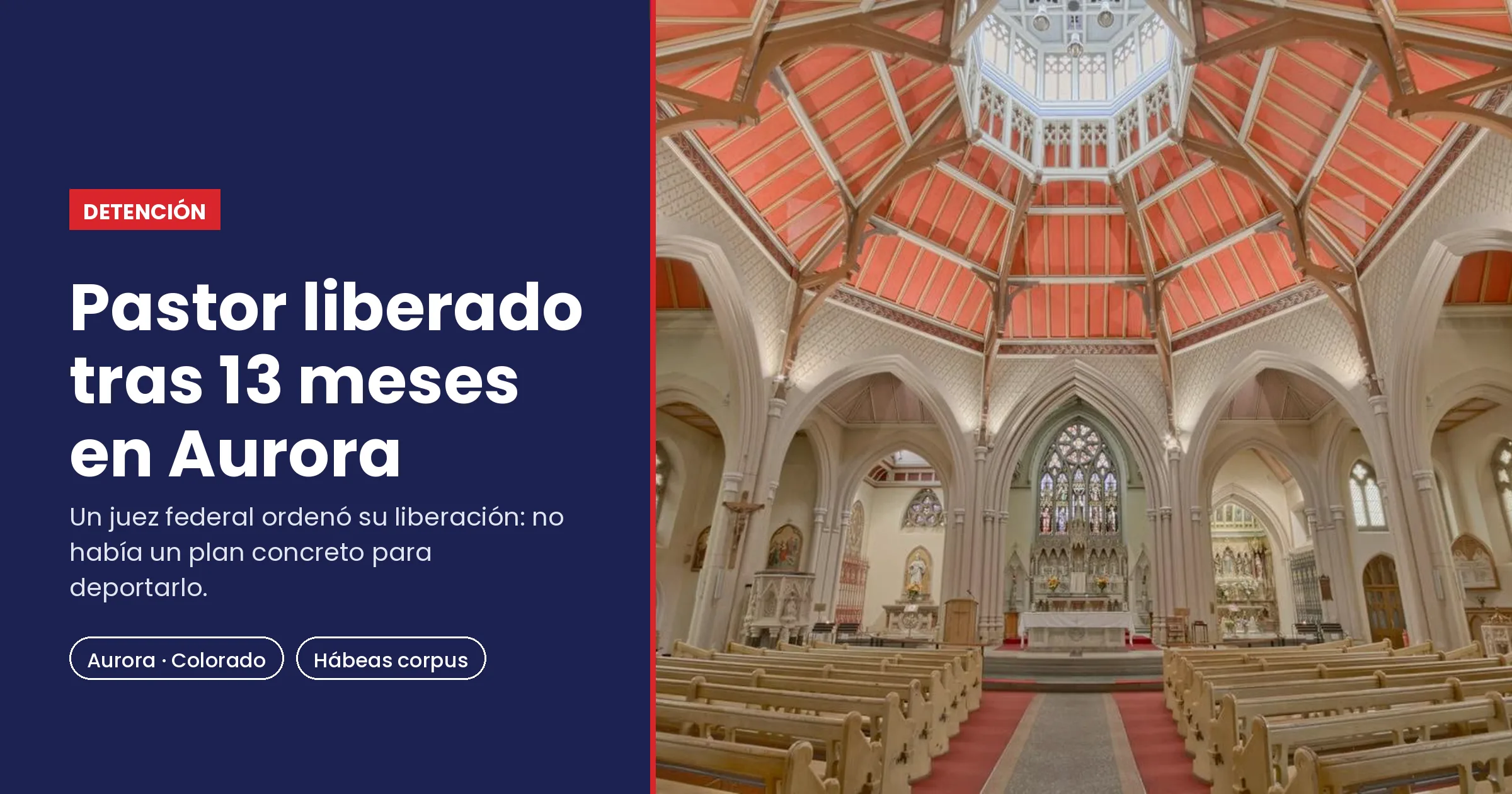
At Campos Law Firm, we closely monitor developments in U.S. immigration policy to protect our clients’ rights and future. On October 21, 2026, Rev. Edward Nalwamba, a retired Anglican priest from Greenwood Village, Colorado, walked out of the Immigration and Customs Enforcement (ICE) detention center in Aurora after 13 months in custody, on the order of a federal judge.
The case unfolded a few miles from our headquarters, and it raises a question we hear every day: how long can ICE keep someone detained? Below, we explain what is known, what is not, and what you can do.
What happened to Rev. Nalwamba?
Nalwamba, a Ugandan citizen who turns 79 in November, came to the United States in January 2002 for a religious conference and stayed after his authorization expired, according to Colorado Newsline. His asylum claim was denied and his removal order became final in 2010; ICE held him for about eight months and released him in 2011 under an order of supervision, which he complied with for nearly 15 years while serving as a priest and caring for people with disabilities.
On September 18, 2025, ICE revoked that supervision and detained him in Aurora, at a facility run by the private company GEO Group. His lawyers filed a first habeas corpus petition, but in June 2026 a judge denied it because ICE swore that his deportation to Uganda was scheduled for June 30. That deportation never took place, and ICE kept him in custody.
Why did a judge order his release?
On October 19, 2026, U.S. Magistrate Judge Cyrus Chung ruled on a second habeas petition and ordered him freed. According to The Washington Post, as cited in local coverage, the judge found that the government had not shown it could actually remove him and that his custody far exceeded the period the law treats as reasonable. In the judge’s words, “there is not even a concrete plan” for a deportation.
During his detention, Nalwamba lost the ability to walk and developed persistent respiratory symptoms; his attorney, Joy Athanasiou, says he received no physical therapy. The Department of Homeland Security (DHS) has rejected claims that he was denied medical care and says he received regular treatment, according to reports. On the day he left, according to Sen. John Hickenlooper, the facility took away his wheelchair at the door and two fellow detainees had to carry him to the waiting vehicle.
How long can ICE detain someone with a removal order?
The law gives ICE 90 days to carry out a final removal order. In 2001, the Supreme Court held in Zadvydas v. Davis that detention beyond that period cannot be indefinite: six months is considered “presumptively reasonable.” After six months, if the person shows there is no significant likelihood of removal in the reasonably foreseeable future, the government must rebut that showing with evidence or release the person under supervision.
The tool for enforcing that limit is habeas corpus, a petition filed in federal district court, not in Immigration Court, that forces the government to justify why it is holding someone. Nalwamba’s case shows both sides of it: the first petition failed because ICE produced a flight date; the second succeeded once that date came and went. It is an individual ruling, not a general release order, and every file is judged on its own facts.
Release also does not close the immigration case. Nalwamba’s removal order remains in effect; in the spring, his attorneys filed a motion with the Board of Immigration Appeals (BIA) to reopen his asylum claim based on worsening conditions in Uganda, and that motion is still pending.
What can you do if a family member has been detained for months?
- Build a timeline: the exact date of arrest, custody reviews, ICE interviews, and every announced deportation date that did not happen. That timeline is the foundation of any habeas petition.
- Confirm the status of the order: being detained with an open case in Immigration Court is not the same as being detained under a final order; the legal limits and strategies differ.
- Document health: medical requests, the facility’s responses, weight loss, or loss of mobility. Medical records carry weight in court and with members of Congress.
- Ask whether removal is realistically possible: if the home country is not issuing travel documents or accepting flights, that fact can be decisive after six months.
- Pursue parallel paths: a motion to reopen or a stay of removal can move forward at the same time as the habeas petition. Our immigration attorneys review both routes in a single consultation.
If your family member is in Aurora, our Aurora, Colorado office is minutes from the detention center. We have previously covered protests and releases at ICE detention centers on this blog.
Protect Your Rights with Campos Law Firm
Rev. Nalwamba’s case does not guarantee the same outcome for anyone else, but it confirms what the law already said: immigration detention has limits, and there are tools to enforce them. The difference between additional months behind bars and a release often comes down to documentation and the timing of the right petition.
Do not leave your immigration status to chance. Call us today at +1 (844) 922-6767 to schedule a free, confidential consultation in English or Spanish. Campos Law Firm: Legal Solutions in All Areas of Law.
With information from The Washington Post, Colorado Newsline, Sentinel Colorado, Westword, and the Nalwamba v. Baltazar decision of the U.S. District Court for the District of Colorado.