
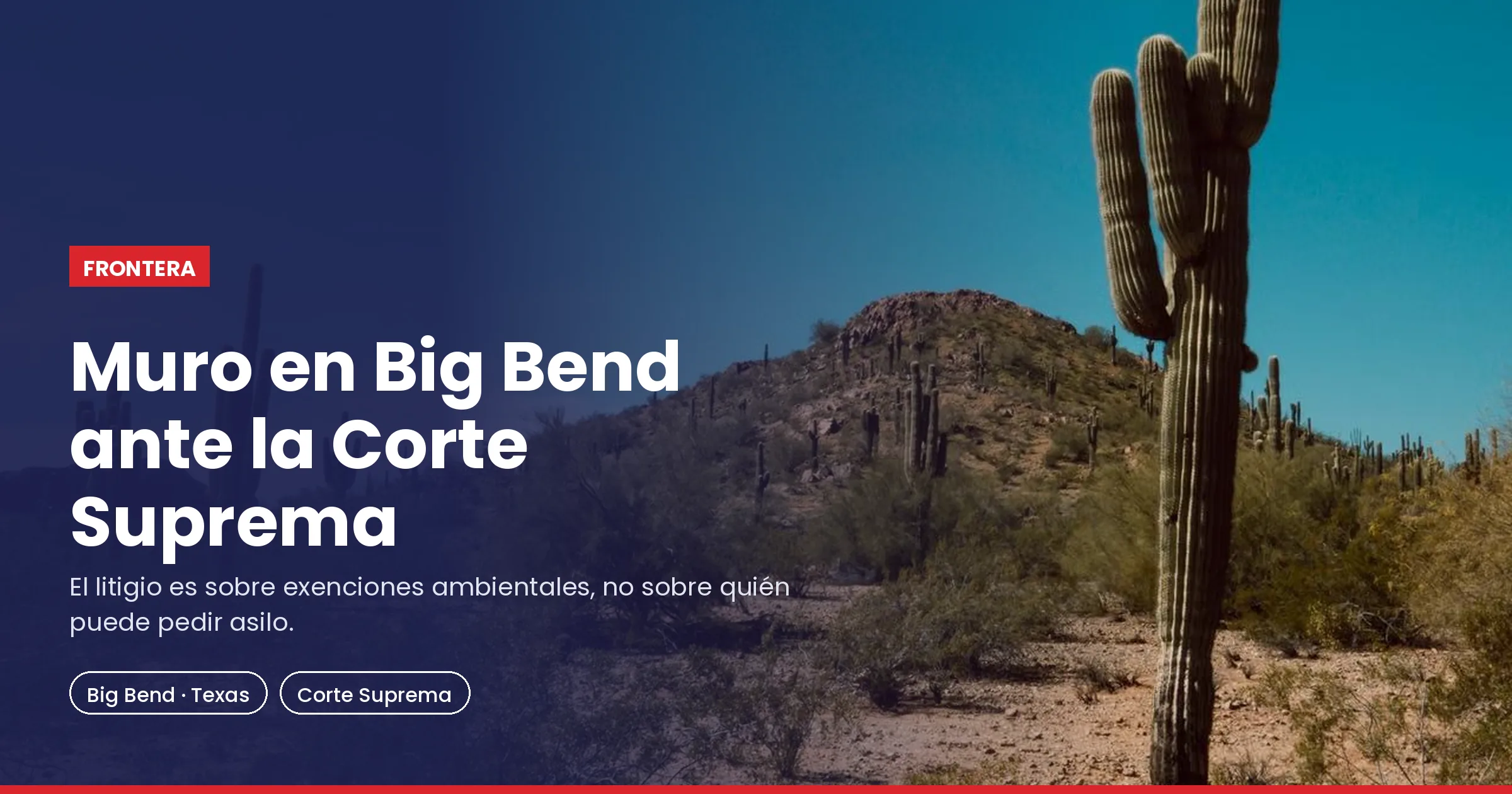
At Campos Law Firm, we closely monitor developments in U.S. immigration policy to protect our clients’ rights and future. On October 21, 2026, the federal government filed an emergency application with the Supreme Court asking it to lift the court order that halted construction of the border wall in the Big Bend region of West Texas.
The headline sounds like a sweeping change at the border, but the fine print matters. Below, we explain what is known, what is not, and what you can do.
What happened in Big Bend?
Construction began on August 6, 2026, near Santa Elena Canyon inside Big Bend National Park, according to the Center for Biological Diversity, one of the plaintiffs. The project, which the government values at about $1.7 billion according to Al Jazeera, combines 30-foot steel bollard walls on private land, vehicle barriers and patrol roads inside the park, and surveillance technology.
On October 2, U.S. District Judge Kathleen Cardone of El Paso issued a preliminary injunction halting work across the entire project area, roughly 500 miles of border, while she considers the lawsuit filed by the Center for Biological Diversity, Friends of the Ruidosa Church, and a local river guide. On October 20 the judge denied the government’s request to resume construction, and the next day the Justice Department went to the Supreme Court, as the Associated Press reported.
What is the government asking for, and what did the judge find?
The core of the case is not whether a wall should exist, but how far the Department of Homeland Security (DHS) can go in setting laws aside. A 1996 statute, the Illegal Immigration Reform and Immigrant Responsibility Act (IIRIRA), as expanded by the REAL ID Act of 2005, lets the DHS secretary waive legal requirements to build barriers in areas of “high illegal entry.” In Big Bend, the waiver covered dozens of laws, including the Endangered Species Act and the Wild and Scenic Rivers Act.
The plaintiffs argue that Big Bend, which accounted for just 1.3% of border apprehensions in 2025 according to the Center for Biological Diversity, is not an area of high illegal entry, and that Congress never authorized walling off the entire border. Judge Cardone found they are likely to succeed on their claim that the waivers exceeded the secretary’s authority. The government calls the injunction “baseless,” says the pause costs more than $460,000 a day, and warns that an unwalled segment would become a “funnel point” for illegal crossings and smugglers.
The Supreme Court has not decided anything yet. According to reports, Justice Samuel Alito set October 29 as the deadline for the plaintiffs to respond. An emergency application is not a ruling: the Court can lift the injunction, leave it in place, or take another procedural step.
What changes for your asylum case or immigration application?
Nothing, for now, and that deserves to be said plainly. This lawsuit is about physical infrastructure and environmental and historic-preservation laws. It does not change who may apply for asylum, how a green card is processed, what happens to a case before the Immigration Court, or when Immigration and Customs Enforcement (ICE) may detain someone.
The rules on admission and asylum come from the Immigration and Nationality Act, from regulations, and from other orders and proclamations, not from a construction contract. A wall may change where and how people cross, but it does not change the legal requirements for a benefit or the rights of someone already inside the country. If you have an application pending with U.S. Citizenship and Immigration Services (USCIS) or a hearing on the calendar, your case continues exactly as before.
What is worth watching is the broader context: Congress allocated $46 billion to Customs and Border Protection (CBP) for border infrastructure in 2025, and that budget comes with more agents, more technology, and more operations. The real risk for an immigrant family is not the wall itself, but the increase in enforcement inside the country.
What can you do if you live near the border or have an open case?
- Do not confuse headlines: news about the wall does not mean asylum is closed or your application was canceled. Verify any change with your attorney before acting.
- If you live in West Texas: the injunction covers private and state land along the river; if you own property and receive government notices about it, keep them and get advice before signing anything.
- If you cross the border for work or family: use official ports of entry only and carry your documents. Crossing between ports exposes you to expedited removal, wall or no wall.
- If you have a pending case: keep every appointment, update your address with USCIS or the court, and keep copies of everything. Our immigration attorneys can review whether increased enforcement affects your strategy.
Protect Your Immigration Status with Campos Law Firm
The Supreme Court’s decision will determine whether the bulldozers return to Big Bend, but it will say nothing about your green card, your asylum claim, or your defense before a judge. Those answers depend on your history, your dates, and the strategy you build with an attorney who knows your file. In a country where every decision can change your future, having the right information is your best tool.
Do not leave your immigration status to chance. Call us today at +1 (844) 922-6767 to schedule a free, confidential consultation in English or Spanish. Campos Law Firm: Legal Solutions in All Areas of Law.
With information from the Associated Press, Marfa Public Radio / Texas Public Radio, Al Jazeera, and the Center for Biological Diversity.