
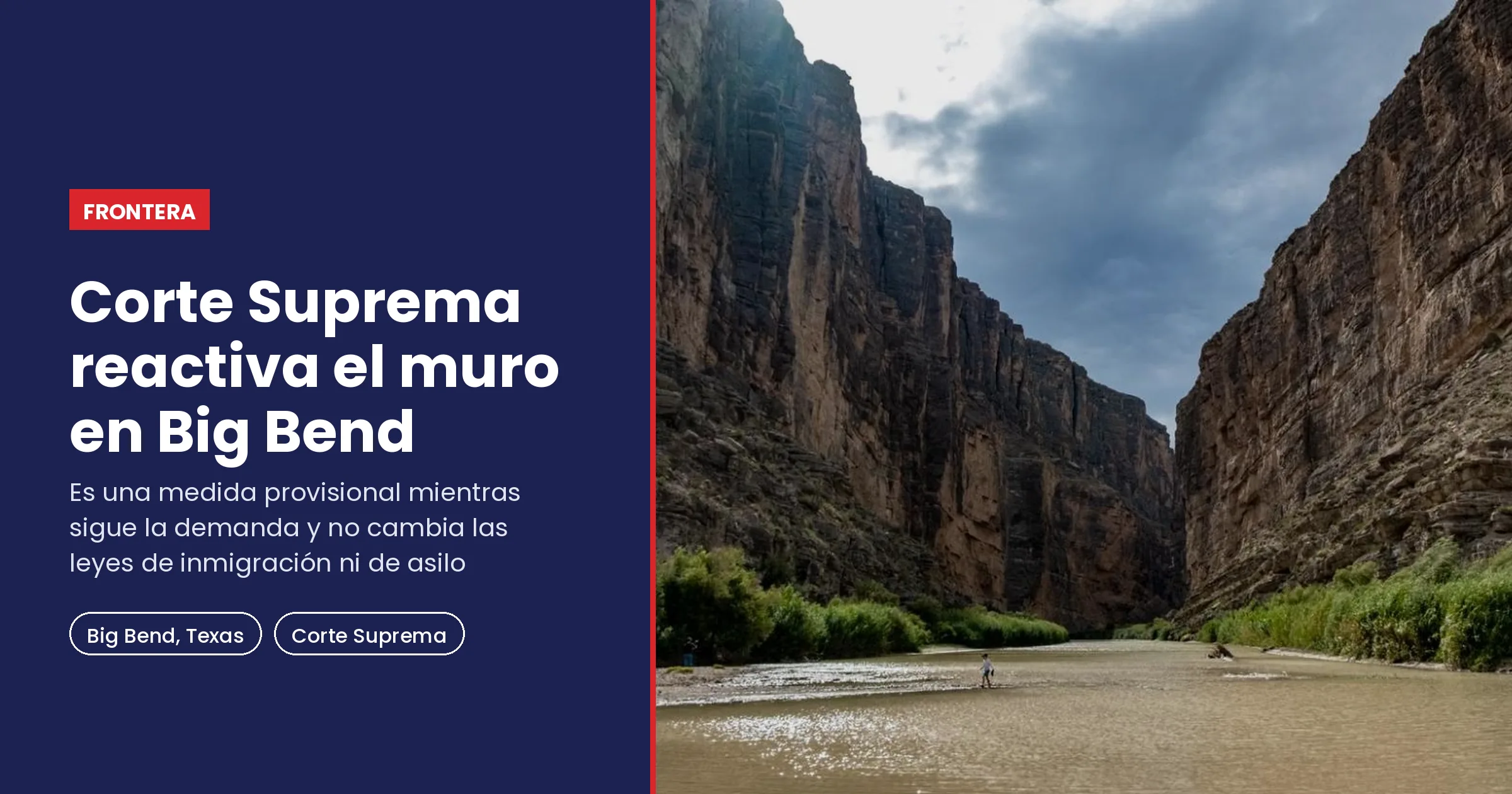
Work on the Big Bend border wall in Texas can resume after a Supreme Court order issued on Monday, November 9, 2026. At Campos Law Firm, we closely monitor developments in U.S. immigration policy to protect our clients’ rights and future. The details matter here: this is a temporary measure, not the end of the case.
In October we explained why the government took the Big Bend case to the Supreme Court. Here is what we know, what we do not know yet, and what you can do.
What Did the Supreme Court Decide About Big Bend?
In a four-page unsigned order in Mullin v. Friends of the Ruidosa Church, the Supreme Court paused a federal judge’s order that had stopped border barrier and road construction in the Big Bend region. According to SCOTUSblog, the Court did, however, deny the government’s request to summarily reverse that order.
The majority found the government is very likely to win on a key point: that the lower court could not review the claim at all. The only noted dissent came from Justice Ketanji Brown Jackson, who would have denied the government’s request without explaining why.
The Court also weighed the cost of the pause. A U.S. Customs and Border Protection (CBP) official said the halt was costing nearly $500,000 a day in unrecoverable expenses, according to Fox 4.
Who Sued, and What Had the Judge Ordered?
The challengers are the Center for Biological Diversity, Friends of the Ruidosa Church (a group dedicated to preserving a historic church in Ruidosa), and a local river guide, according to the AP. They challenge the waivers of environmental and conservation laws that the Department of Homeland Security (DHS) issued to speed up construction, based on a 1996 law.
On October 2, U.S. District Judge Kathleen Cardone of the Western District of Texas halted construction in the region until the government complied with environmental laws. According to SCOTUSblog, she found the Homeland Security secretary likely lacked authority for such broad waivers and noted that Big Bend accounts for 0.3% to 2.2% of migrant apprehensions at the border.
The Supreme Court responded that the 1996 law limits challenges to those waivers to constitutional claims, and this one was not. According to the AP, the government paused work inside Big Bend National Park in August and says no steel walls are planned there, although it had planned a road and some vehicle barriers.
Does the Big Bend Border Wall Change Asylum or Immigration Law?
No. The order is about construction and environmental waivers; it does not change immigration law or decide anyone’s case. Rules on asylum at the border are being litigated in separate cases, and any change to them should be confirmed through official sources, not rumors.
It is not a final ruling either. The pause lasts while the government asks the Supreme Court to review the case: if the Court declines, the pause ends; if it agrees, the pause stays in place until it rules. We saw a similar mechanism in the decision on administrative closure at the Supreme Court.
The issue does not split neatly along party lines. According to the AP, Big Bend residents from both parties oppose the project, and Republican Sen. John Cornyn of Texas wrote an op-ed against it. CBP, for its part, says that without a barrier, cartels would take advantage of the area.
What Does It Mean for Border Communities and Migrants?
- For local residents and landowners: work may resume, although CBP has not said when. If you receive a request for access to your land or a notice about your property, talk to an attorney before you sign anything.
- For people with an immigration case: nothing changes in your process. Your court dates, deadlines, and applications stay the same.
- For families with relatives on the way: be wary of smugglers who use news like this to sell “routes” or promises. Crossing outside a port of entry can carry serious criminal and immigration consequences.
- For everyone: base your decisions on official sources and legal advice, not headlines.
Protect Your Immigration Status with Campos Law Firm
Border rulings make headlines, but what shapes your future is your individual case: your history, your deadlines, and the options current law gives you. We do not make unrealistic promises: we provide serious legal representation backed by preparation and integrity. Our team of immigration attorneys can review your situation, including from our Irving, Texas office.
Do not leave your immigration status to chance. Call us today at +1 (844) 922-6767 to schedule a free, confidential consultation in English or Spanish. Campos Law Firm: Legal Solutions in All Areas of Law.
With information from SCOTUSblog, the Associated Press and Fox 4.