
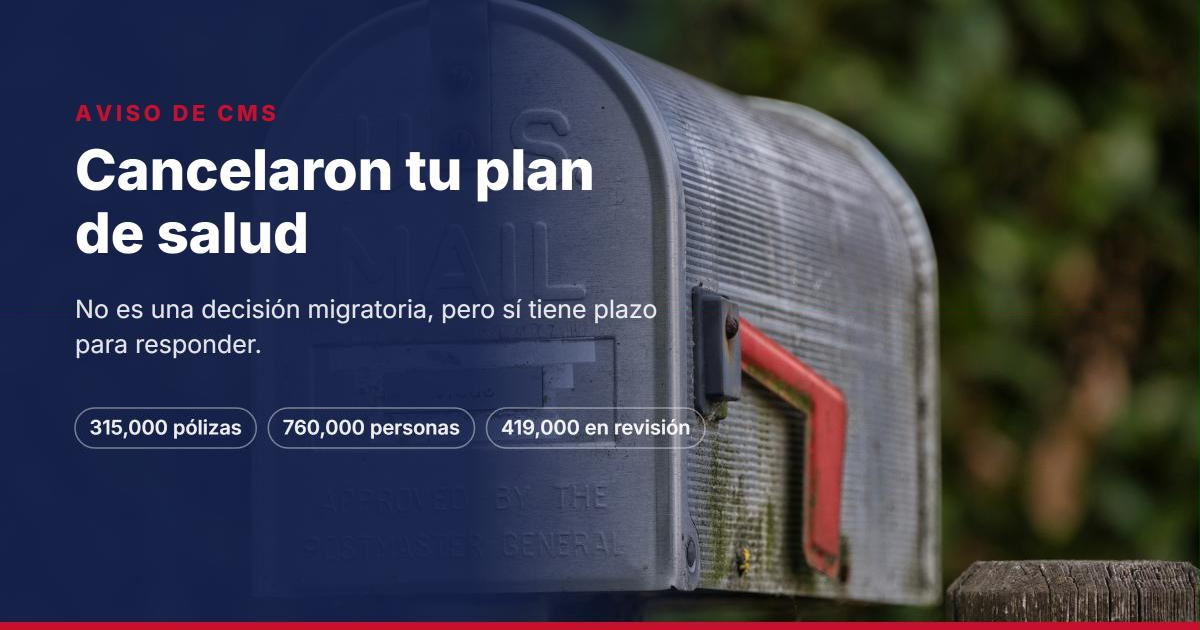
At Campos Law Firm, we closely monitor developments in U.S. immigration policy to protect our clients’ rights and future. On September 22, 2026, the Centers for Medicare and Medicaid Services (CMS) reported that during August it canceled 315,000 marketplace health policies, covering roughly 760,000 people, in part over unverified citizenship or immigration documentation.
Here is what the agency actually did, why a coverage cancellation is not an immigration decision, and what to do if a letter arrives.
What exactly did CMS do?
The review is part of a campaign against improper marketplace enrollments. The reasons cited include enrollees whose citizenship or immigration documentation could not be verified, and cases where insurers could not identify claims or reach the consumer.
The agency also announced two measures worth tracking:
- 419,000 people face additional verification of their legal status and income.
- New agent and broker registrations with the federally facilitated exchanges are frozen until February 1, 2027.
That last point explains much of the underlying problem: a share of the questioned enrollments came through third parties, sometimes without the person’s knowledge. That is why some families discover a policy they never requested, while others lose the one they did.
Losing the policy is not an immigration decision
This is the most reassuring part, and the most commonly misread.
An administrative coverage cancellation is decided by a health agency, not an immigration authority. It is not a determination about your status, it does not generate a removal order, and it does not mean anyone concluded you are in the country without authorization. In many cases it is a data match that failed: a name spelled differently, an expired document number, a record never updated after a renewal.
It is also worth separating two things people often blend. Public charge is an inadmissibility test applied in certain residence filings, and subsidized marketplace health benefits are not weighed in that analysis the way some other programs are. A canceled policy does not mean you “used benefits” against yourself.
That said, there is a real and different risk: being left without medical coverage. That one has immediate consequences for your family.
Who can have marketplace coverage based on status?
Generally, people lawfully present in the United States — permanent residents, refugees and asylees, and people with certain temporary or humanitarian statuses, among other categories — may enroll in the marketplace and, depending on income, qualify for tax credits.
People without status cannot enroll in the marketplace, though they can use community health centers, buy coverage outside the marketplace, and access emergency Medicaid in the situations the law provides. Citizen or resident children in a family keep their own eligibility even when their parents do not have it.
Categories change and some situations are in litigation, so specific eligibility should be confirmed case by case before filing or renewing anything.
What should you do if your plan was canceled or documents are requested?
- Do not ignore the letter: there is almost always a deadline, and letting it pass turns a fixable problem into a permanent loss of coverage.
- Send exactly the document requested: green card, employment authorization document, approval notice, or whatever matches your category — with your name spelled as it appears in the system.
- Keep proof of everything you send: date, confirmation number, and a copy. That is what lets you follow up later.
- Check whether someone enrolled you without permission: if a policy appears that you do not recognize, report it; that can be corrected too.
- Ask about a special enrollment period: losing coverage usually opens a window to re-enroll outside open enrollment.
- Get advice before sending immigration documents: if your case is pending or you are unsure what to submit, review it with your attorney first.
Protect Your Immigration Status with Campos Law Firm
A letter from a federal agency should not cost a family its access to a doctor or its peace of mind. Our team reviews which document matches your category, checks that your record is consistent across agencies, and stands with you if the inconsistency touches your immigration case. We do not make unrealistic promises. We provide serious legal representation backed by preparation and integrity.
Do not leave your immigration status to chance. Call us today at +1 (844) 922-6767 to schedule a free, confidential consultation in English or Spanish. Campos Law Firm: Legal Solutions in All Areas of Law.

 English
  Spanish