
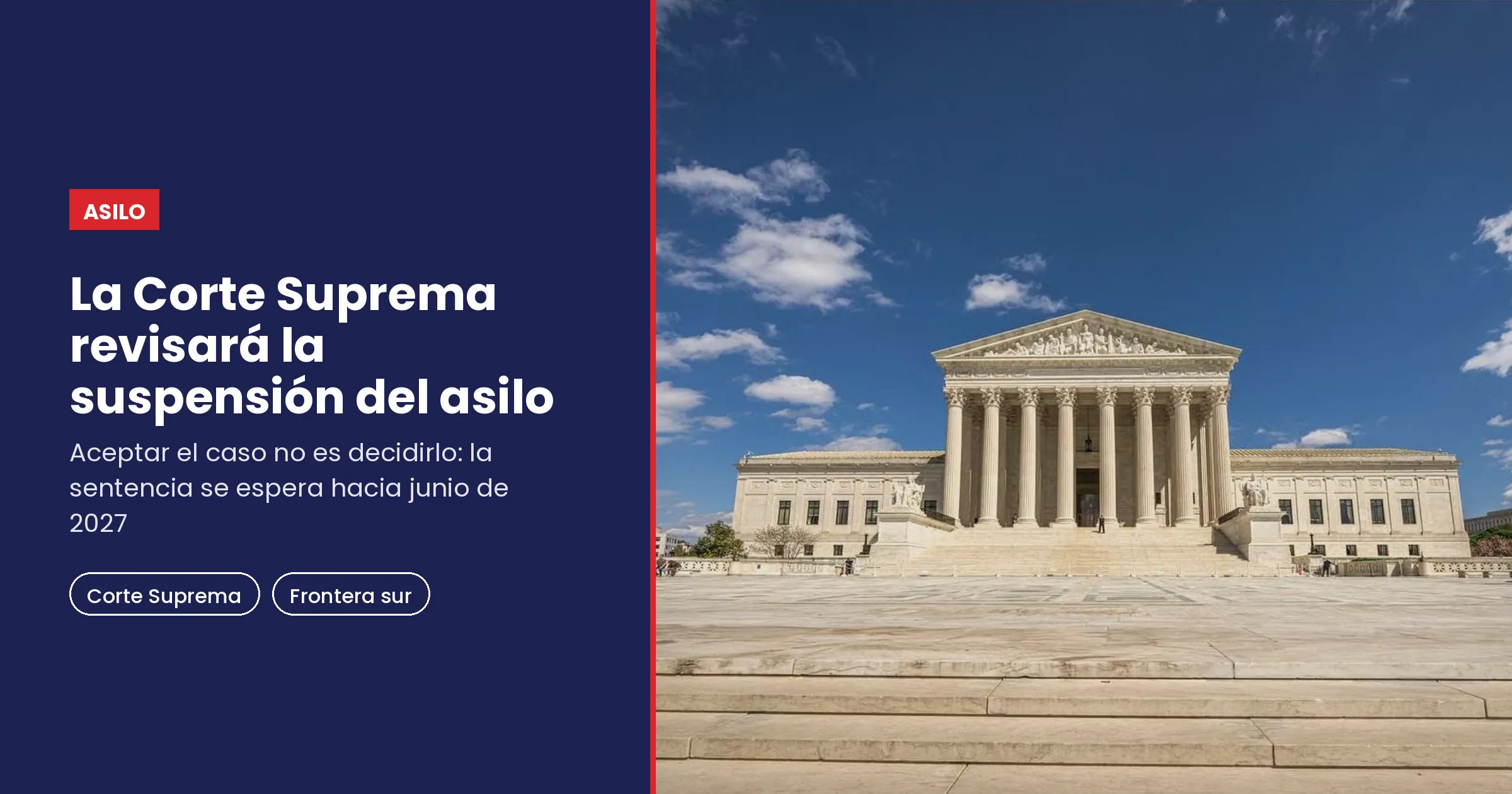
The Supreme Court asylum case over the southern border is now on the docket: on November 13, 2026, the justices agreed to review the presidential proclamation that suspends access to asylum there. At Campos Law Firm, we closely monitor developments in U.S. immigration policy to protect our clients’ rights and future. The key point: the Court has not ruled on the merits yet.
Here is what we know, what we do not know yet, and what you can do.
What Did the Supreme Court Agree to Review?
The case is Mullin v. Refugee and Immigrant Center for Education and Legal Services (No. 26-239). According to the Court’s official docket, the government filed its petition on August 24, 2026, and the Court granted it on November 13, limited to the first two questions presented.
The first question is whether Proclamation 10888 and its implementing guidance lawfully suspended the entry of certain noncitizens and cut off their legal paths to remain in the country, including asylum. The second is whether a federal statute (8 U.S.C. § 1252(f)(1)) bars the classwide relief, covering an entire group of people, that the trial court ordered, according to SCOTUSblog’s summary.
The proclamation, signed at the start of President Donald Trump’s second term, declares that the situation at the southern border is an “invasion.” According to SCOTUSblog, it directs officials to quickly remove people who cross without authorization, without the usual process and without a chance to seek asylum.
What Did the Lower Courts Decide?
U.S. District Judge Randolph Moss found that the proclamation and its guidance violate federal immigration law. On April 24, 2026, the U.S. Court of Appeals for the D.C. Circuit upheld that decision in an opinion by Judge J. Michelle Childs; that is the ruling the Supreme Court will now review. According to the docket, the D.C. Circuit denied rehearing on July 23, 2026.
According to the AP’s coverage of the April ruling, the panel held that the law gives people a right to seek asylum at the border and that the president cannot create his own removal procedures or eliminate those under the Convention Against Torture. Judge Justin Walker dissented in part: according to the AP, he said the government may broadly deny asylum, though he agreed it cannot deport anyone to a country where they would be persecuted.
The government sees it differently. In its petition, Solicitor General D. John Sauer said the ruling “threatens to dismantle” a tool the administration considers indispensable for border control, according to SCOTUSblog. The plaintiff organization, RAICES, and the American Civil Liberties Union (ACLU) defend the D.C. Circuit’s decision.
What Still Applies Today in the Supreme Court Asylum Case?
According to SCOTUSblog, the D.C. Circuit’s decision is on hold, which has allowed the government to keep the asylum restrictions in place while the case moves forward. As of publication, we have not found any order changing that, and granting review does not change it on its own.
When will there be an answer? The Court has not set a date. According to press reports, oral arguments are expected in spring 2027, with a decision around June 2027, at the end of the term.
Do not confuse this case with another one. On June 25, 2026, the Court ruled 6-3 for the government in a separate case on “metering,” a practice that lets agents turn back asylum seekers before they enter the country. We are also following the Big Bend border wall case at the Supreme Court, another dispute that does not resolve the proclamation case.
What Can You Do If You Are Seeking Protection?
- Watch the one-year deadline: as a general rule, an asylum application must be filed within one year of your last arrival in the U.S., with limited exceptions. If you are already here, do not wait until June to get advice.
- Ask about withholding and CAT: withholding of removal and protection under the Convention Against Torture (CAT) do not have the one-year deadline, but they require a higher standard of proof and do not lead to a green card. We explained this in the case of a nurse with withholding detained by ICE.
- Do not travel to the border based on rumors: the Court taking the case does not open the border or change the current rules. Be wary of anyone who says otherwise or charges you to “get you across.”
- Review how and when you entered: how the proclamation affects you depends on your date and manner of entry; that can only be assessed with your documents.
- Do not sign anything without reading it: especially voluntary departure forms or hearing waivers.
Protect Your Immigration Status with Campos Law Firm
A Supreme Court case can take months, but the deadlines on your application keep running. We do not make unrealistic promises: we provide serious legal representation backed by preparation and integrity. Our team of immigration attorneys can review whether you qualify for asylum, withholding, or CAT and what steps to take today.
Do not leave your immigration status to chance. Call us today at +1 (844) 922-6767 to schedule a free, confidential consultation in English or Spanish. Campos Law Firm: Legal Solutions in All Areas of Law.
With information from the U.S. Supreme Court, SCOTUSblog, the AP and Minnesota Lawyer.