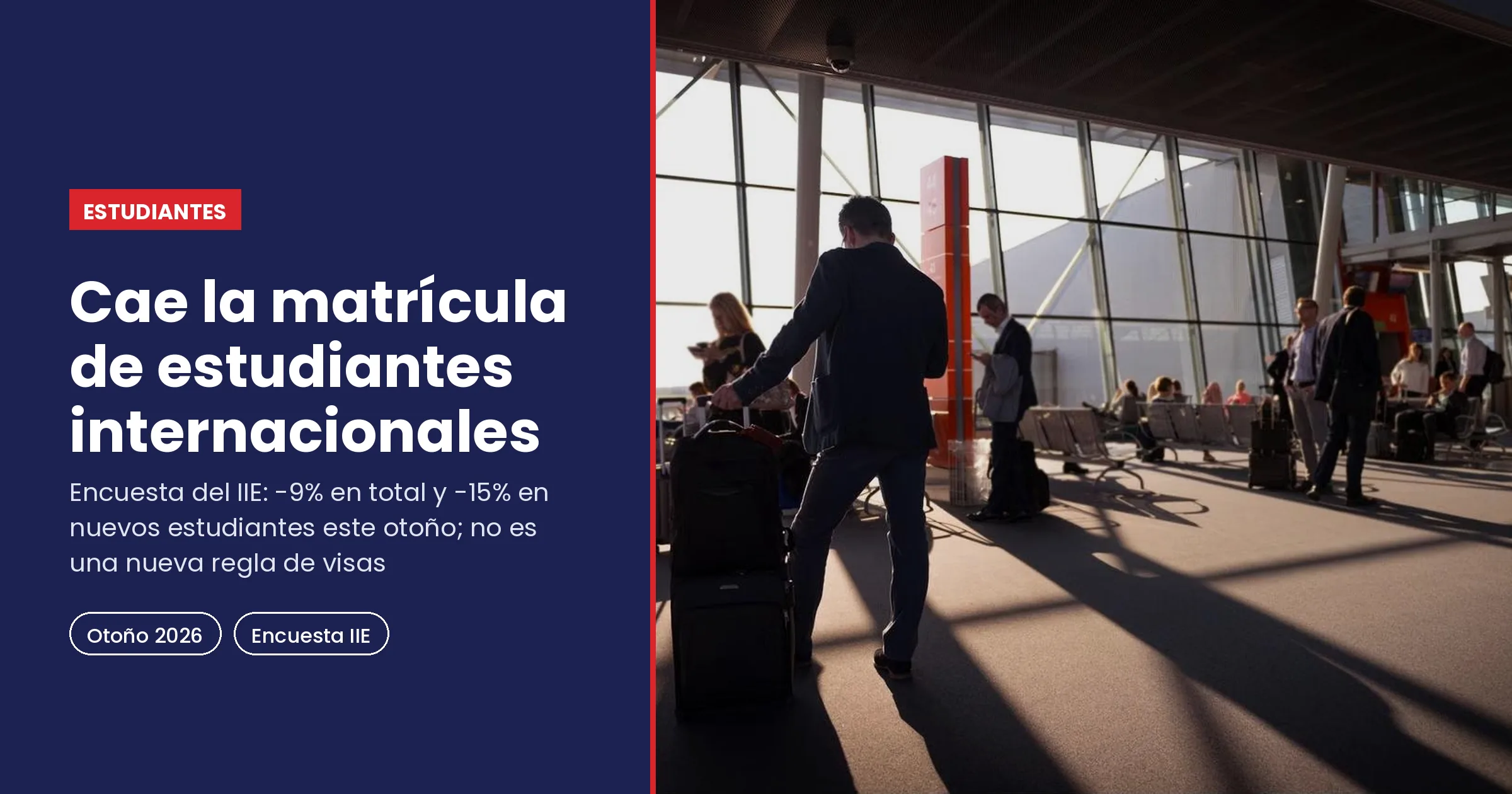
International student enrollment in the United States fell 9% this fall, and the number of new students dropped 15%, according to an Institute of International Education (IIE) survey reported by The Associated Press (AP) on November 16, 2026. At Campos Law Firm, we closely monitor developments in U.S. immigration policy to protect our clients’ rights and future.
The first thing to know: this is a survey, not a new law or a new visa rule. Here is what we know, what we do not know yet, and what you can do if you or your child study in the U.S.
What Does the IIE Survey Show?
The IIE, a nonprofit that publishes the annual Open Doors report, runs a quick fall survey with 10 higher education associations. This year 809 institutions responded, according to The PIE News and Higher Ed Dive. The data is preliminary: full numbers for this fall will be released next year.
According to AP, the drop is steeper in graduate programs (15%) than at the undergraduate level (3%). Participation in Optional Practical Training (OPT), the temporary work authorization many F-1 students use after graduation, fell 6%.
The Open Doors 2026 report, released the same day, covers the previous academic year (2025-26): more than 1.1 million international students, a 3% decline overall and a drop of nearly 18% in new students, the second straight annual decline.
Why Did International Student Enrollment Drop?
Among colleges that reported declines, 88% pointed to the visa application process and 70% to travel restrictions, AP reported. Sixty percent said students chose other countries, and 45% cited costs, according to The PIE News. In August, NAFSA had already warned that visa bans, trouble getting consular appointments, and policy uncertainty could drive away up to 111,000 students.
AP also points to other Department of Homeland Security (DHS) measures:
- A fee for each OPT student: DHS proposed charging schools for every student who participates in OPT. It is a proposed rule, not a final one. Ninety-five percent of surveyed schools believe students would look to another country if OPT were limited.
- A four-year cap on stays: a rule would bar students from staying more than four years without federal approval, but a judge has temporarily blocked it.
- Status terminations and detentions: according to AP, DHS has terminated the legal status of thousands of international students and has detained and deported many of them.
Homeland Security Secretary Markwayne Mullin has said the changes are meant to close loopholes some students were exploiting, according to AP. On the other side, Miriam Feldblum, president and CEO of the Presidents’ Alliance on Higher Education and Immigration, told Higher Ed Dive that the policies are “creating uncertainty at every stage” of a student’s journey.
Does This Change Your F-1 or J-1 Visa?
Not by itself. The survey does not change any rules: if you hold an F-1 or J-1 visa and maintain your status, your situation does not change because of this news. What has changed is the environment: more scrutiny and less room for error.
Keep the key distinction in mind: the visa is the document that lets you enter; your status is your permission to remain here, and it depends on following the conditions of your program as recorded in SEVIS. An expired visa does not put you out of status if you keep studying according to the rules, but you will need to renew it at a consulate if you leave the country. Cases such as the Berkeley student detained by ICE or the case of Mahmoud Khalil at the Supreme Court show that each situation is decided case by case.
What Can Latin American Students and Their Families Do?
- Protect your status every day: keep a full course load, do not work without authorization, and report any change of address to your designated school official (DSO) within 10 days.
- Check your SEVIS record: make sure your I-20 or DS-2019 is current and accurate. If you receive a termination notice, talk to your DSO and an attorney right away.
- Plan your OPT early: file within the deadlines and report your employment. Keep an eye on the proposed fee rule, which is not final.
- Do not leave the country without checking: before you travel, confirm the travel signature on your I-20, your visa’s validity, any restrictions that apply to your nationality, and consular appointment wait times. If you have a pending asylum application, leaving without advance parole can be treated as abandonment.
- Get advice before a change of status: if you plan to switch to another visa or stay after graduation, consult before your program ends. A date mistake can leave you out of status.
- Families: be wary of “notarios” who promise fast visas; only an attorney or an accredited representative can advise you.
Protect Your Immigration Status with Campos Law Firm
A survey does not change the law, but it does show that studying in the United States now takes more planning than before. We do not make unrealistic promises: we provide serious legal representation backed by preparation and integrity. Our team of immigration attorneys can review your student status, your OPT, or a possible change of status.
Do not leave your immigration status to chance. Call us today at +1 (844) 922-6767 to schedule a free, confidential consultation in English or Spanish. Campos Law Firm: Legal Solutions in All Areas of Law.
With information from AP, The PIE News, Higher Ed Dive and NAFSA.