
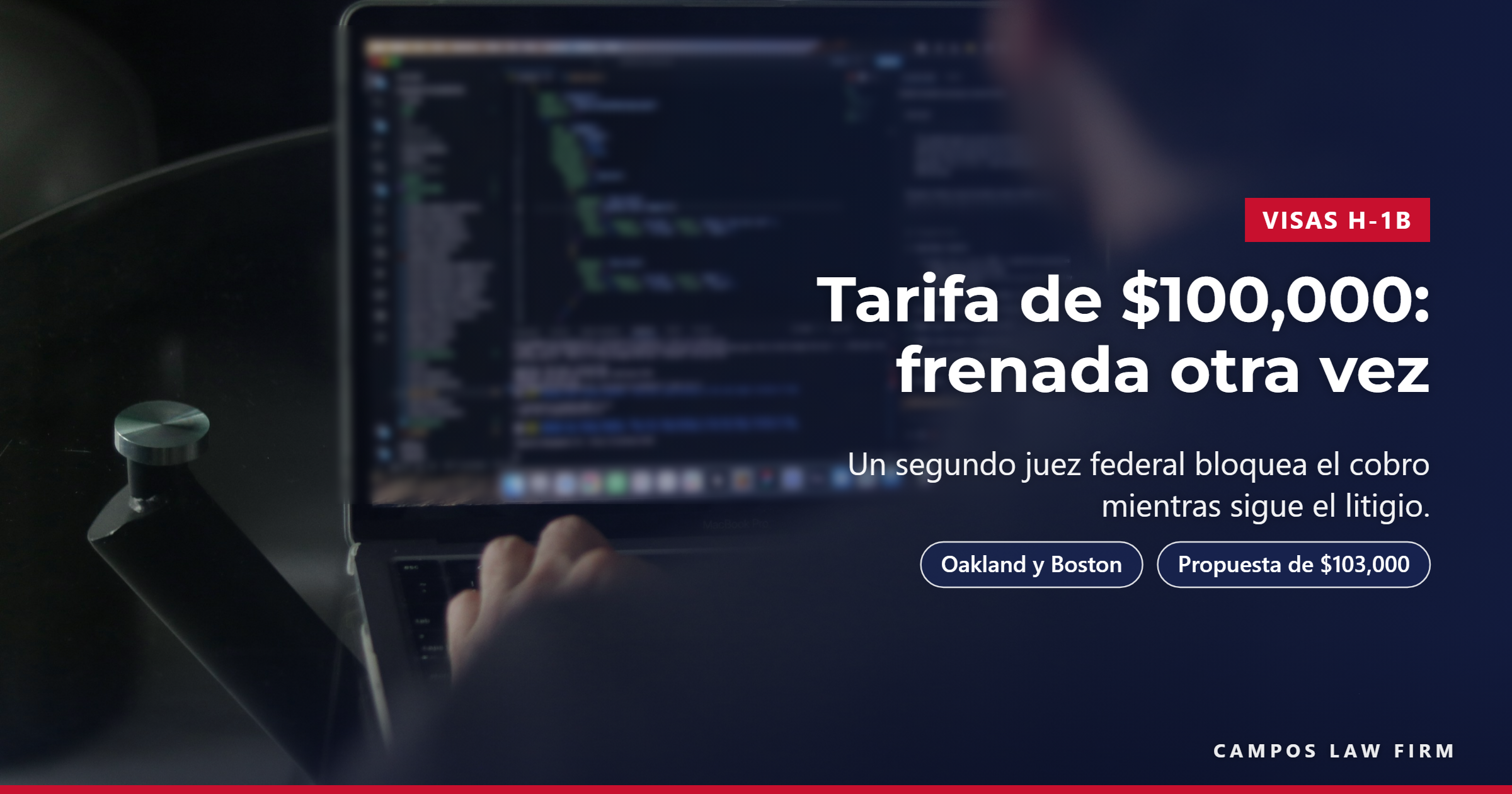
At Campos Law Firm, we closely monitor developments in U.S. immigration policy to protect our clients’ rights and future. On September 30, 2026, U.S. District Judge Haywood Gilliam of the Northern District of California in Oakland blocked the $100,000 fee the government imposed on new H-1B visa petitions.
It is the second federal court to halt the measure. Below, we explain what we know, what we don’t, and what employers and professionals can do.
What Did the Judge Decide?
According to Reuters, Judge Gilliam found that U.S. Citizenship and Immigration Services (USCIS) and the State Department failed to follow the necessary rulemaking process before enforcing the fee. He granted a request to stop its collection while the case continues.
The lawsuit was filed in October 2025 by a coalition of unions, employers, and nonprofits represented by the legal group Democracy Forward. “Today’s decision … protects a system that was thrown into chaos overnight,” said Steve Bressler of Democracy Forward. The White House did not immediately comment.
How Did We Get Here?
The fee came from a presidential proclamation in September 2025 and applied to new H-1B petitions for workers outside the country. Before that, petition costs typically ranged from $2,000 to $5,000.
- June 2026: a federal judge in Boston vacated the payment requirement in a case brought by 20 states, led by California and Massachusetts, on behalf of public universities and health systems.
- July 2026: the U.S. Court of Appeals for the First Circuit declined to pause that ruling during the appeal.
- September 2026: the measure was set to expire on September 21, but the administration extended it for one year, through September 21, 2027.
- September 30, 2026: the second block arrives, this time from Oakland.
Do Employers Still Have to Pay the $100,000?
For now, court orders prevent USCIS and the State Department from collecting the fee, according to analyses by immigration law firms tracking the case. But this is not a final win: the government can appeal, and a higher court could change the picture.
There is also a separate front. In August, the Department of Homeland Security (DHS) proposed a permanent fee of about $103,000 through formal rulemaking. If that rule is finalized, the core argument in these rulings, that proper procedure was not followed, may not apply in the same way, and the legal fight would shift.
Keep in mind that the fee does not change H-1B requirements: you still need a sponsoring employer, a specialty occupation, and, in most cases, a slot in the annual lottery.
What Can Employers and Professionals Do?
- Check the case status before filing: an appeal could change things, so confirm where matters stand on your exact filing date.
- Keep records of payment or non-payment: whether you filed with or without the fee, save all evidence and dates.
- If you already paid: ask an attorney whether any path exists to seek a refund, depending on when and how payment was made.
- Professionals abroad: do not travel or resign from a job until your employer and attorney confirm next steps.
- Watch the DHS rule: the $103,000 proposal is moving forward and could become the next battleground.
Protect Your Immigration Status with Campos Law Firm
Changes to work visas affect businesses and families at the same time. Our team guides employers and professionals through every stage of the H-1B process, with a strategy based on current law rather than headlines. In a country where every decision can change your future, having the right information is your best tool.
Do not leave your immigration status to chance. Call us today at +1 (844) 922-6767 to schedule a free, confidential consultation in English or Spanish. Campos Law Firm: Legal Solutions in All Areas of Law.
 English
  Spanish