
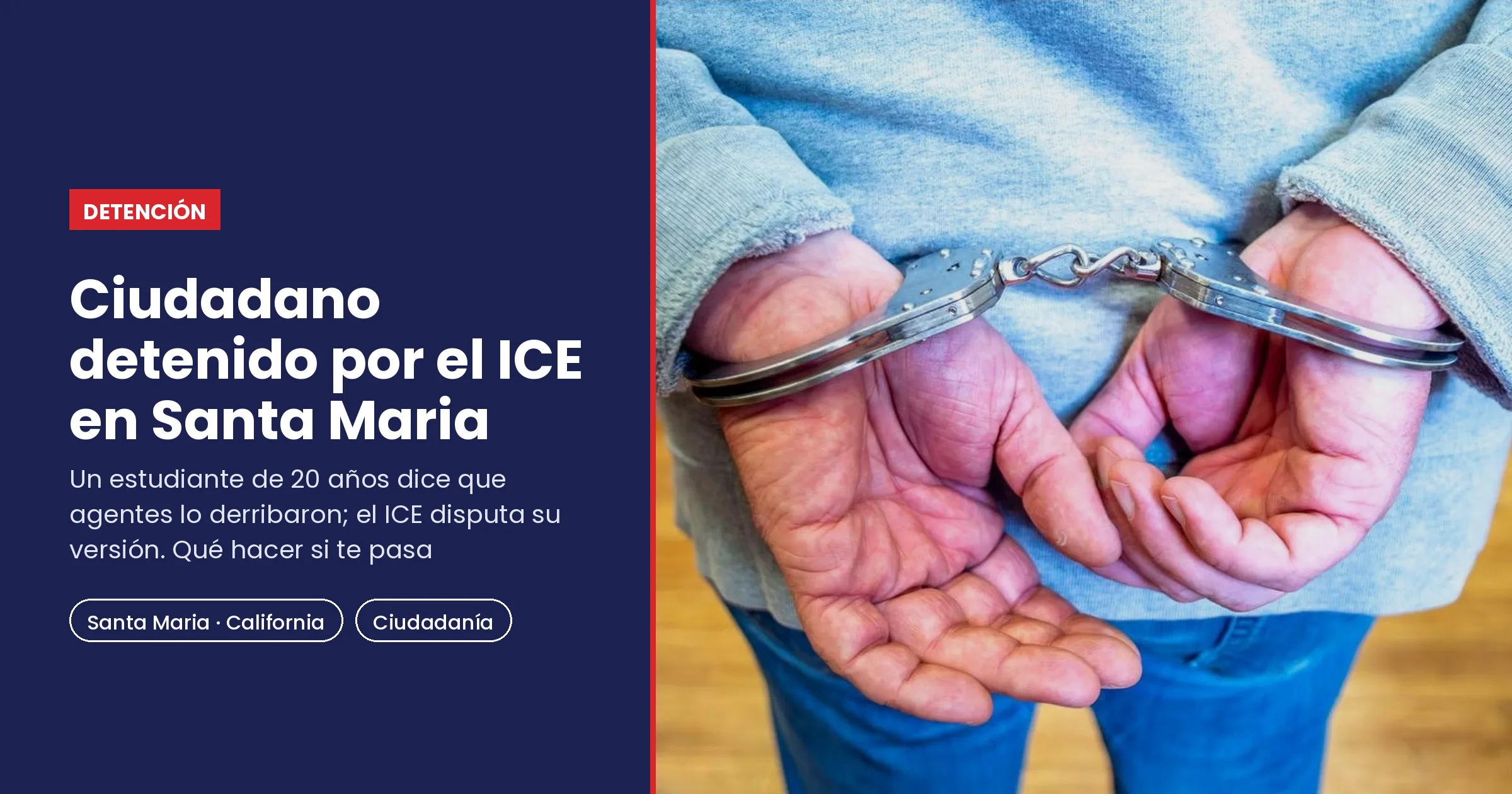
A Santa Maria ICE detention of a young U.S. citizen walking to school in California has become a national story. On November 5, 2026, The Guardian reported the account of Erik Zepeda, 20, who says immigration agents restrained and handcuffed him on October 21, along with the response of Immigration and Customs Enforcement (ICE), which disputes parts of that account.
At Campos Law Firm, we closely monitor developments in U.S. immigration policy to protect our clients’ rights and future. The facts remain in dispute, and no authority has made any finding of responsibility. Below, we explain what is known, what is not, and what you can do.
What happened in Santa Maria, according to each side?
Zepeda is a special education student at Santa Maria High School and, according to local station KEYT, has a disability that limits his verbal communication. According to his mentor and former teacher, Glenn Goldin, and witnesses quoted by local media, agents tackled him on the morning of Wednesday, October 21, handcuffed him, put him in a vehicle, and questioned him. They say he was never asked for his ID, which was in his wallet.
After he was released, Zepeda walked to school, where staff saw his injuries and called an ambulance. Goldin said his wrist was broken in three places and needed surgery; the school district and police confirmed the ambulance ride, treatment, and surgery, KEYT reported. The Guardian reported that his lawyers describe serious injuries.
ICE confirmed a “targeted enforcement operation” that day and said officers encountered a man they believed matched the description of their target. According to its statement, the young man “resisted officers, refused lawful commands, and assumed a fighting stance with clenched fists,” and he was released once his identity was confirmed. ICE called the claims of broken bones false and said Zepeda “never requested medical assistance.”
What investigations are underway?
Santa Maria police obtained security footage from a store across the street and turned it over to investigators and the Department of Homeland Security (DHS). School superintendent Antonio Garcia said the information went to the county District Attorney, the California Attorney General, and ICE’s Los Angeles office. Santa Barbara County District Attorney John Savrnoch called the reports “deeply troubling.”
On October 29, Rep. Salud Carbajal sent a letter to DHS Secretary Markwayne Mullin requesting an investigation, including the protocols for verifying identity and approaching people with disabilities. As of November 2, DHS had not responded, according to the Santa Barbara Independent. Students in Santa Maria and Lompoc walked out of class in support of Zepeda.
Can ICE detain a U.S. citizen?
ICE has no authority to detain a U.S. citizen on immigration grounds. But agents can stop you if they believe, rightly or wrongly, that you are someone else or that you lack status, and hold you while they check who you are. That is why carrying proof of identity and citizenship matters in the first few minutes.
Zepeda’s case is not the only one. In October, we covered a U.S. citizen held by ICE for nearly a year, including the documents that prove citizenship if you are detained by mistake.
What should you do if you are a citizen and ICE detains you?
These steps do not guarantee an outcome, but they protect your safety and your case:
- Stay calm and do not resist: even if you believe the stop is wrong, resisting can put you at risk and lead to charges. Say clearly: “I am a U.S. citizen.”
- Carry proof of citizenship: a U.S. passport card fits in your wallet and proves both identity and citizenship. A driver’s license, even a Real ID, proves identity but not citizenship. Keep your certified birth certificate or naturalization certificate at home, with a copy your family can reach.
- If you have a disability: carry a card that explains your condition and how to communicate with you, plus an emergency contact number.
- Stay silent and do not sign anything: you have the right not to answer questions without a lawyer and not to sign documents you do not understand.
- Ask for medical care: if you are hurt, say so out loud and ask for help. Then see a doctor and request copies of all medical records, X-rays, and photos of your injuries.
- Preserve video: ask witnesses to keep their original recordings unedited and write down their names and phone numbers. Identify nearby business cameras: many erase footage within days.
- Write everything down: date, time, place, number of agents, vehicles, plates, and what they told you.
If you were harmed, claims against the federal government have strict deadlines; for example, an administrative claim under the Federal Tort Claims Act (FTCA) must be filed within two years. Our immigration attorneys can review your situation and guide you through the next steps.
Protect Your Rights with Campos Law Firm
Erik Zepeda’s case is still under investigation, and what the videos and medical records show will be key to resolving the conflicting accounts. What it does show is that the right documents and evidence preserved in time can change how a situation like this unfolds. Campos Law Firm is here to help you.
Do not leave your immigration status to chance. Call us today at +1 (844) 922-6767 to schedule a free, confidential consultation in English or Spanish. Campos Law Firm: Legal Solutions in All Areas of Law.
With information from The Guardian and KEYT, as well as the Santa Barbara Independent.