

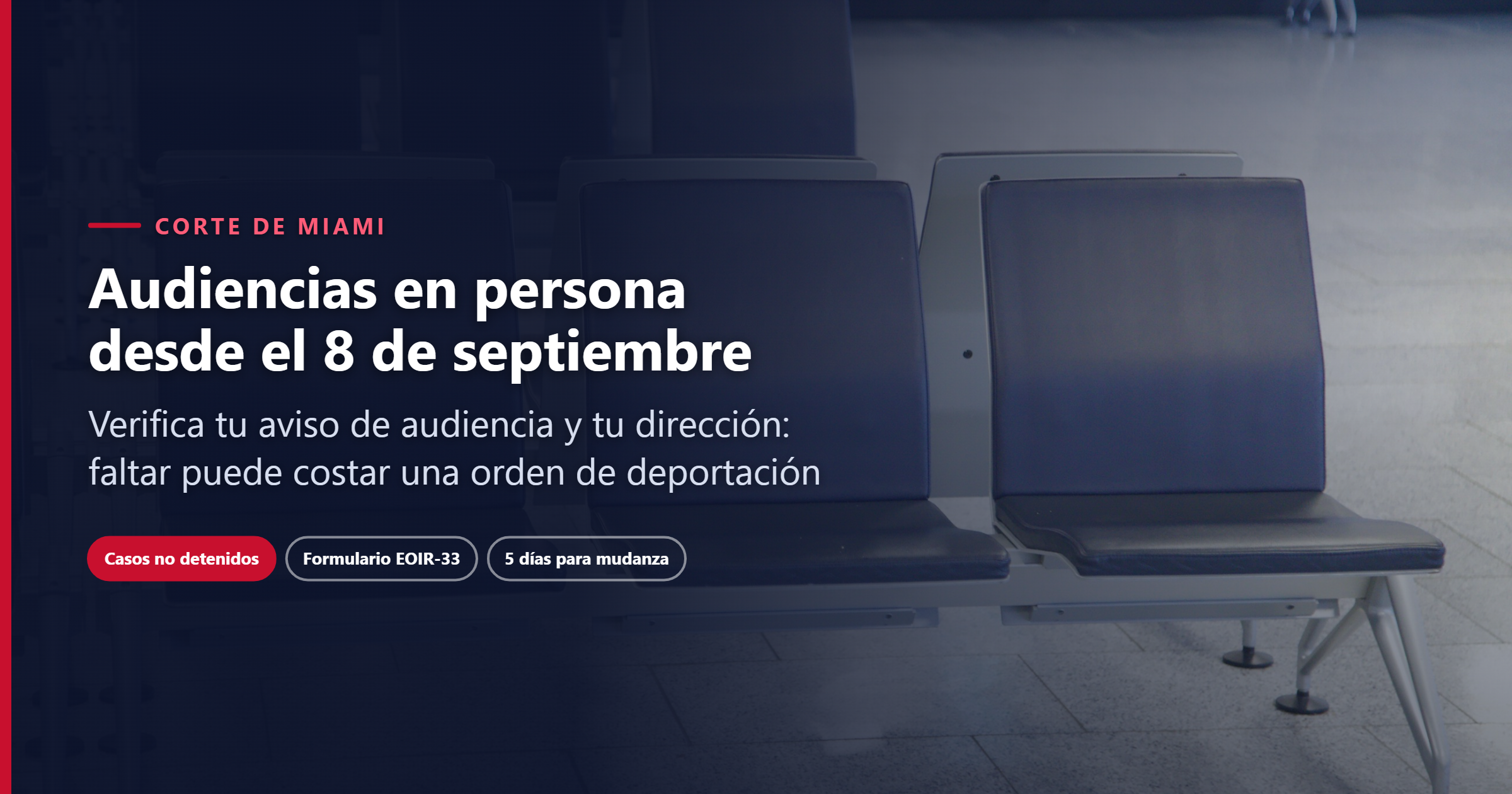
If you have a hearing at the Miami Immigration Court, one rule does not change with any announcement: missing it is the worst possible decision. An absence can produce a removal order issued without you present, and recovering from that is far harder than showing up.
At Campos Law Firm, we closely monitor developments in U.S. immigration policy to protect our clients’ rights and future. Below, we explain what changed, what is still unclear, and how to verify your own hearing.
What is happening?
Starting September 8, 2026, the Miami Immigration Court requires in-person appearance in non-detained cases, for both master calendar and individual hearings. As Univision 23 and Telemundo 51 reported, the change was communicated by email to attorneys, in a message attributed to the court’s assistant chief immigration judge.
This deserves precision: there is no public notice from the Executive Office for Immigration Review (EOIR) about this change. The Miami court’s official page does not mention it, and EOIR’s own page still publishes Webex links for Miami judges. No one has publicly explained that contradiction.
There is also a wider context than the end of virtual hearings. NPR reported on September 2 that Miami judges are holding mass master calendar hearings, with more than 100 cases per session compared with roughly 36 before, and advancing dates that had been set for 2027. Miami-Dade County leads the nation with 137,373 pending cases, according to TRAC at Syracuse University.
The effect is already visible. At the Miami court, removal orders issued in absentia rose from 1,383 in May to 2,886 in July, a 108 percent increase.
Does this mean no one can appear by video?
Not exactly, and this is where circulating information overshoots.
The EOIR director’s memorandum on internet-based hearings, in effect since 2022, provides that the court decides the format, and that a judge should accommodate a request to appear remotely where appropriate and practicable. That memorandum has not been rescinded.
The Immigration Court Practice Manual provides specific mechanisms, all by motion to the judge:
- Motion to waive appearance at a master calendar hearing (chapter 3.14(m)(2)), which may be oral or written.
- Motion to permit telephonic appearance (chapter 3.14(n)), oral or written, stating the date, time, and reason.
- Motion to present video testimony (chapter 3.14(o)(2)), written only, explaining why the witness cannot appear.
One detail from EOIR’s own page is worth knowing: anyone without an attorney of record defaults to an in-person hearing, regardless of what the listing shows.
The safe instruction, then, is this: read your Notice of Hearing and assume nothing. Without a written order from the judge authorizing otherwise, you appear in person.
What happens if you miss a hearing?
This is the hardest thing to undo. The law (section 240(b)(5) of the Immigration and Nationality Act) allows a judge to enter a removal order in absentia when a properly notified person does not appear.
Reopening is possible, but the requirements are strict:
- Exceptional circumstances: a 180-day deadline applies, and the standard is high. The statute names serious illness of the person or a close relative, the death of a relative, or battery and extreme cruelty. Traffic, forgetting, or confusion do not qualify.
- Lack of notice: no time limit applies, but you must show the notice never arrived as the law requires.
An in absentia order also carries 10 years of ineligibility for several forms of discretionary relief. So the rule is simple: if you are unsure, show up.
How do you verify your hearing, and what do you bring?
- Read the paper Notice of Hearing. It is the controlling document. If the online system says one thing and your paper says another, the paper wins.
- Check the automated system: the 1-800-898-7180 line or the ACIS portal at acis.eoir.justice.gov, using your A-number. Both warn that the information is for convenience only and may be out of date.
- Update your address on Form EOIR-33 within 5 days of any move. It is separate from USCIS Form AR-11: changing your address there does not update the court, and this is the most common cause of in absentia orders.
- Arrive well ahead of time. With current lines, one to two hours is reasonable. The printed time is your reporting time, not an estimate.
- Bring with you: the original Notice of Hearing, photo identification, your A-number, copies of everything you have filed, and proof of your change of address if applicable.
- If you genuinely cannot attend, file in writing and well in advance for a continuance or remote appearance. But filing a motion is not the same as having it granted: without a written order from the judge, you must appear.
One point we will not leave out: since 2025, ICE arrests in immigration court hallways have been documented, and that practice is in active litigation. That is a reason to attend with an attorney, not a reason to stay away.
Protect Your Case with Campos Law Firm
This change is being applied without a public notice behind it, and that produces exactly the kind of confusion that leads to missed hearings. What is clear is that your Notice of Hearing and your registered address matter more than any rumor.
At Campos Law Firm we verify where your case stands, file the motions that apply, and go with you to court. Do not leave your immigration status to chance. Call us today at +1 (844) 922-6767 to schedule a free, confidential consultation in English or Spanish. Campos Law Firm: Legal Solutions in All Areas of Law.