

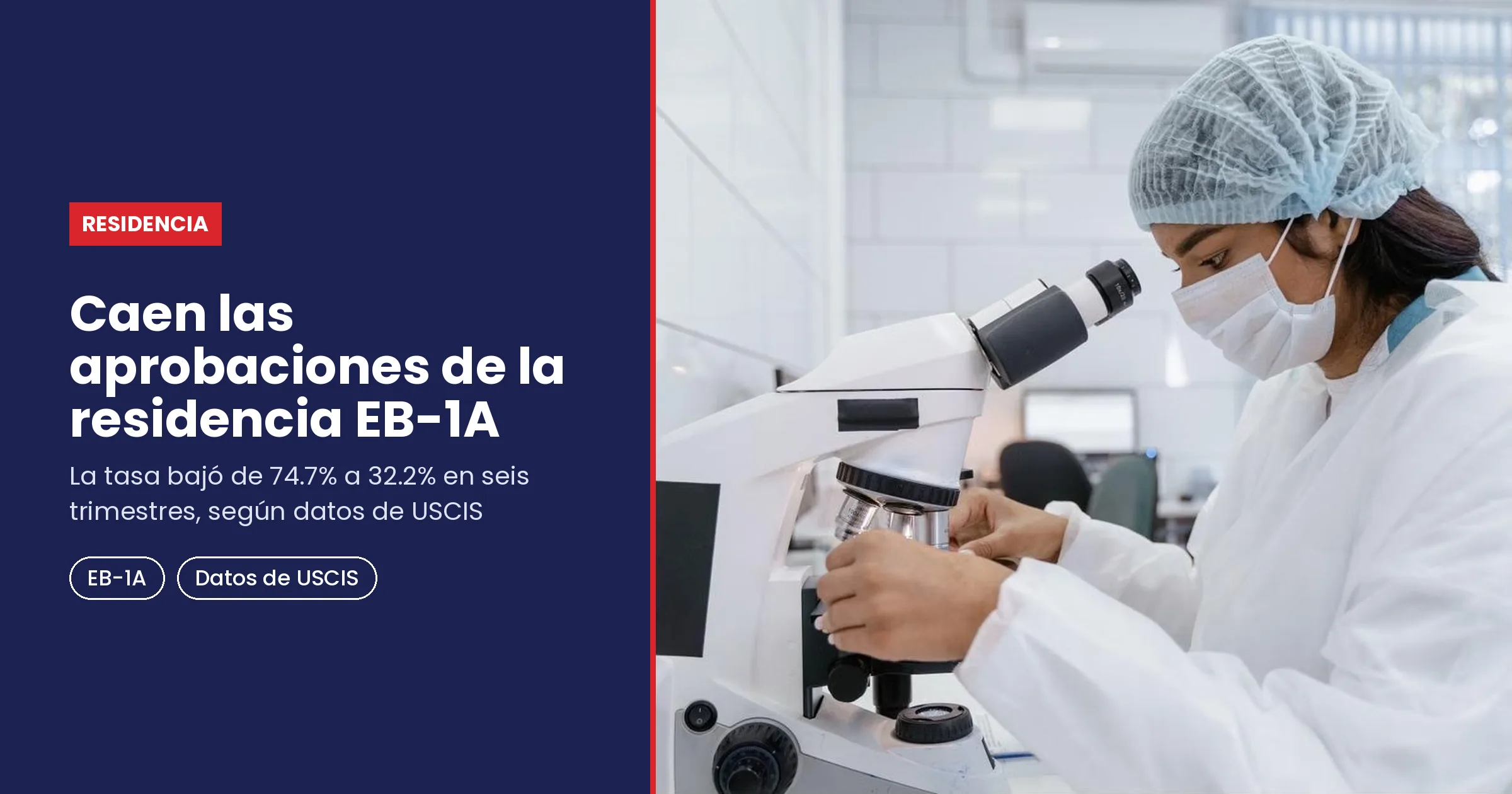
The EB-1A approval rate, for the extraordinary ability green card, keeps falling. At Campos Law Firm, we closely monitor developments in U.S. immigration policy to protect our clients’ rights and future. On November 27, The Washington Post published a report on rising denials in this category, and quarterly data from U.S. Citizenship and Immigration Services (USCIS) show the same trend.
These figures do not explain why the drop is happening, and this is not a new law. Here is what the data show, what the EB-1A is, and what you can do if you plan to apply.
What Does the EB-1A Approval Rate Data Show?
According to analyses by Manifest Law and F1jobs based on quarterly USCIS data for Form I-140, the EB-1A approval rate went from 74.7% in the first quarter of fiscal year 2025 to 32.2% in the third quarter of fiscal year 2026, which runs from April to June 2026. It was the sixth consecutive quarterly decline and the lowest level in that series.
In that quarter, USCIS approved 1,348 petitions and denied 2,832: roughly two denials for every approval. In the two previous quarters of the same fiscal year, the rate had been 47.5% and 41.8%, respectively.
Other categories moved differently. The EB-2 National Interest Waiver (NIW) rose to 55.3% in the third quarter, the O-1 visa held near 91%, and the EB-1B (outstanding professors and researchers) and EB-1C (multinational executives and managers) stayed around 93% and 97%.
What Is the EB-1A?
The EB-1A is an employment-based green card for people with extraordinary ability in the sciences, arts, education, business, or athletics. It does not require a job offer or a labor certification, and you can file the petition yourself using Form I-140.
According to the USCIS Policy Manual, you must show a one-time achievement, such as a major international award, or meet at least 3 of 10 criteria. They include awards, membership in selective associations, published material about your work, judging the work of others, original contributions of major significance, scholarly articles, exhibitions, leading roles, high salary, and commercial success in the performing arts.
Meeting the criteria is not enough. USCIS then conducts a final merits determination of the entire record to decide whether you have sustained acclaim and whether you are among the small percentage at the very top of your field. You must also show that you will continue working in that area in the United States.
Why Is the Approval Rate Falling?
The published data do not explain it, and in the sources we reviewed USCIS has not offered a public explanation. Some analyses point to possible factors, such as the rise in filings or how the final merits determination is applied, but these are interpretations, not official conclusions.
For anyone planning to apply, the practical takeaway is clear: prepare your case more carefully than before. A petition with weak, disorganized, or hard-to-verify evidence has less room for error today.
What Does It Mean for You If You Plan to Apply?
These are general guidelines, not advice for your specific case:
- Build strong evidence: gather verifiable proof of your achievements, such as awards, publications, letters from independent experts, and concrete data on the impact of your work.
- Show sustained acclaim: USCIS looks for a track record that holds up over time, not a single achievement from many years ago.
- Expect a possible RFE: a Request for Evidence (RFE) is a USCIS notice asking for additional documents. Answer it by the deadline stated, completely and in an organized way.
- Consider alternatives: depending on your profile, the EB-2 NIW may be an option if you hold an advanced degree or have exceptional ability and your work is in the national interest. The O-1 is a temporary visa, not a green card, but it may let you work while you strengthen your case.
- If your petition is denied: review the reasons and your options with a lawyer before refiling. Deadlines to challenge a decision are short.
If your plan is a green card through an employer, that path usually requires PERM labor certification, which could also change, as we explain in our article on the proposed PERM rule. And if you already have an approved petition, read what the October 2026 Visa Bulletin means for your green card.
Why Have a Lawyer Review Your Case Before You File?
An EB-1A petition takes time, money, and extensive documentation, and a denial stays in your immigration record. A lawyer can review whether your evidence meets the criteria, whether the category fits your profile, or whether it makes sense to wait and strengthen your file.
Many Hispanic professionals, artists, athletes, and researchers have valuable achievements that are not always documented the way USCIS requires. Filing correctly from the start can spare you an unnecessary RFE or a denial that is harder to fix later.
Protect Your Immigration Future with Campos Law Firm
The EB-1A can open the door to a green card, but every case is different. If you are thinking about applying, or about an alternative like the EB-2 NIW, our immigration attorneys can review your profile honestly. We do not make unrealistic promises.
Do not leave your immigration status to chance. Call us today at +1 (844) 922-6767 to schedule a free, confidential consultation in English or Spanish. Campos Law Firm: Legal Solutions in All Areas of Law.
With information from The Washington Post, Manifest Law, F1jobs, and USCIS.