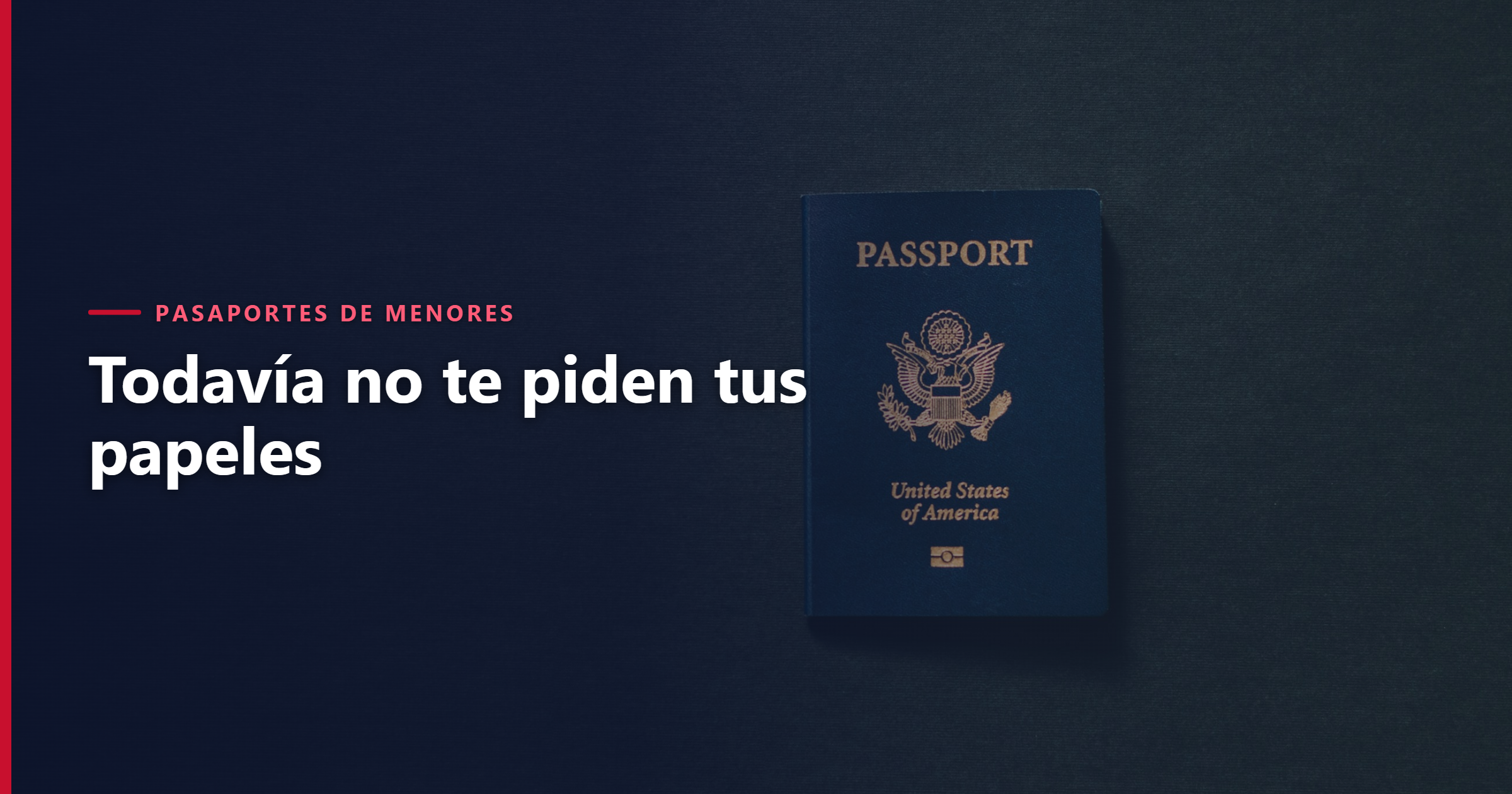
If your child was born in the United States, they are a U.S. citizen, and that citizenship does not depend on their parents’ immigration status. That starting point has not changed. What is under discussion is which papers you will have to show to get their passport.
At Campos Law Firm, we closely monitor developments in U.S. immigration policy to protect our clients’ rights and future. Below, we explain what is known, what is not in effect, and what is actually required today.
What is happening?
On September 1, 2026, Reuters reported, in an article by Kristina Cooke and Nate Raymond, that the State Department has a draft implementation guidance that would require parents or guardians to prove their own citizenship or immigration status when applying for a child’s passport.
According to that report, citizens would be asked for a valid U.S. passport or birth certificate; noncitizens, for Form I-94 or a permanent resident card.
Here is the nuance that matters more than the headline: it is a draft, it has not been finalized or published, and it has no effective date. In fact, Justice Department attorneys have argued in court that challenges are premature precisely because agencies have not yet issued public guidance.
The origin is two executive orders signed on August 6, 2026 — 14418, on the meaning of American citizenship, and 14419, on so-called birth tourism — published in the Federal Register on August 11. The first gives agencies 30 days to align their regulations, and that deadline explains the leaked draft.
State Department spokesperson Tommy Pigott told Reuters that the president has been unequivocal that the administration will protect the meaning and value of American citizenship, and that the passport process fully reflects that standard.
Is my child’s citizenship at risk?
Two things get confused constantly and are worth separating: the right to citizenship and the paperwork for the document.
On the right, the legal picture is clear and recent. The Fourteenth Amendment and the statute (8 U.S.C. § 1401) recognize the citizenship of anyone born in U.S. territory and subject to its jurisdiction. The Supreme Court confirmed this in 1898 in United States v. Wong Kim Ark, applying it expressly to children of resident foreign parents.
And on June 30, 2026, in Trump v. Barbara, the Supreme Court held unconstitutional the January 2025 executive order that sought to restrict birthright citizenship. Chief Justice John Roberts wrote for the majority that children born in the United States to parents unlawfully or temporarily present are subject to U.S. jurisdiction and are citizens at birth.
The August 2026 executive order attempts to open new categories of exclusion. On August 28, federal judge Deborah Boardman denied a temporary restraining order against it, but did not endorse it: she asked plaintiffs to amend their complaint and set a further hearing. The litigation remains open.
What is required today for a child’s passport?
Today, and until official guidance takes effect, proof of the parents’ immigration status is not required. What the State Department requires for a child under 16 is:
- Form DS-11, submitted in person.
- Proof of the child’s citizenship in original form: a U.S. birth certificate, Consular Report of Birth Abroad, Certificate of Citizenship, or a valid prior passport.
- Proof of the parental relationship, if the citizenship document does not establish it.
- Photo identification for both parents, typically a driver’s license, with front-and-back photocopies.
- Consent from both parents (22 C.F.R. § 51.28). If only one appears, the other’s notarized consent on Form DS-3053 is required, valid for 90 days, or proof of sole custody.
What can you do now?
- Do not postpone the application out of fear of a requirement that does not yet exist. If you have a pending application, get advice before deciding.
- Gather and safeguard the child’s documents: certified birth certificate, Social Security number, school and medical records.
- Consider a Certificate of Citizenship (Form N-600) with USCIS. It is independent, definitive proof of your child’s citizenship, accepted by the State Department. The fee is significant, but for mixed-status families it can be a second layer of security. Ask whether it makes sense in your case.
- If a citizen child’s passport is denied or delayed, do not let it sit: you can respond to the request for evidence, seek reconsideration, ask a congressional office for help, and ultimately file a declaratory action of nationality in federal court under 8 U.S.C. § 1503(a).
- Keep every piece of correspondence with the State Department, including envelopes and dates.
- Never submit false documents or claim a status you do not have. A false claim to U.S. citizenship creates permanent inadmissibility with virtually no waiver.
One historical precedent is worth keeping in mind. Between 2008 and 2009, in Castelano v. Rice, U.S. citizens born with midwives near the Texas border saw their passport applications stall after demands for additional proof. The case ended in a settlement requiring the government to re-adjudicate those applications. It is the exact precedent for what happens when documentary scrutiny falls disproportionately on Latino families.
Protect Your Family with Campos Law Firm
The citizenship of a child born here does not depend on their parents’ papers. What may become harder is the paperwork, and in mixed-status families any point of contact with a federal agency deserves careful preparation and advice.
At Campos Law Firm we review your family’s full situation and tell you what to file, in what order, and with what risks. Do not leave your immigration status to chance. Call us today at +1 (844) 922-6767 to schedule a free, confidential consultation in English or Spanish. Campos Law Firm: Legal Solutions in All Areas of Law.