
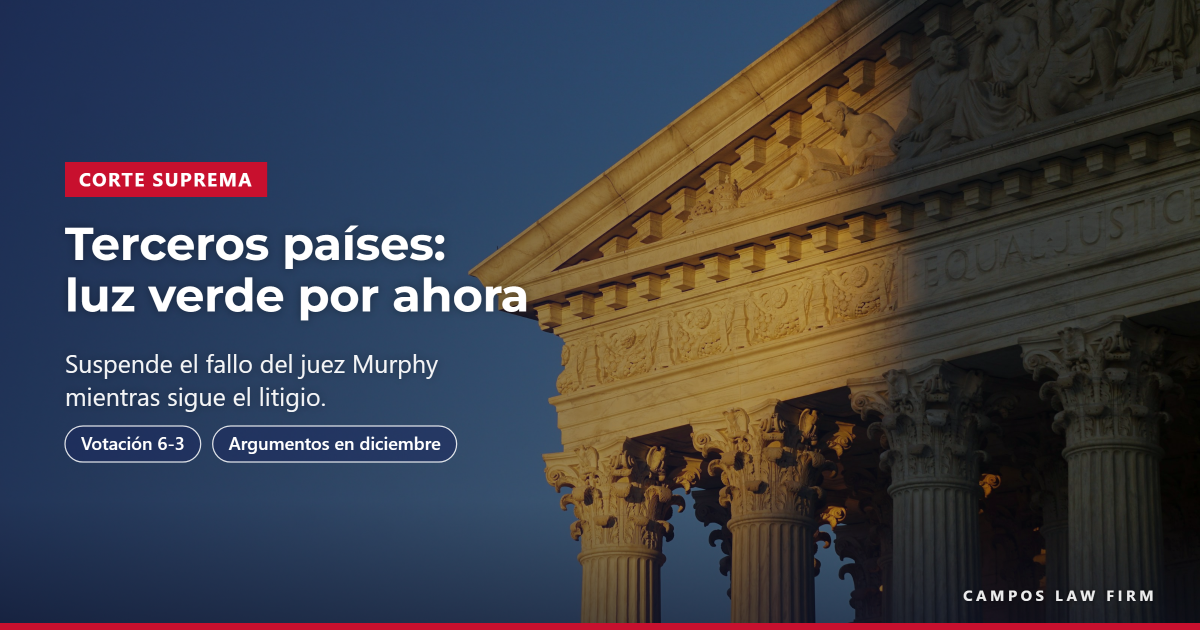
At Campos Law Firm, we closely monitor developments in U.S. immigration policy to protect our clients’ rights and future. On September 29, 2026, the U.S. Supreme Court granted the government’s emergency request and put on hold the ruling that had blocked third-country deportations, meaning removals to nations that are not the person’s country of origin.
The order does not decide whether the policy is lawful. It only lets the government keep using it while the case moves forward. Below, we explain what we know, what we don’t, and what you can do.
What Did the Supreme Court Decide?
The vote was 6-3. Justices Sonia Sotomayor, Elena Kagan, and Ketanji Brown Jackson dissented. “In matters of life and death, it is best to proceed with caution. In this case, the Government took the opposite approach,” Sotomayor wrote.
El caso es DHS v. D.V.D. The Court agreed to hear oral arguments in Diciembre de 2026 and will issue a final decision afterward. Until then, the stay remains in place.
This has happened before. In June 2025, the Court stayed an earlier preliminary order from the same trial court in this litigation, which allowed the program to expand.
What Had Judge Brian Murphy Ordered?
In February 2026, U.S. District Judge Brian Murphy in Massachusetts found that the policy failed to satisfy due process. He ordered the Department of Homeland Security (DHS) to give people clear notice before sending them to a third country and a meaningful chance to say they would face persecution or torture there.
On September 18, the U.S. Court of Appeals for the First Circuit largely upheld that ruling. A few days later it clarified its order, forcing the cancellation of a flight carrying about 70 personas from Alexandria, Louisiana, to Burundi, Rwanda, and the Central African Republic. The government then turned to the Supreme Court.
Según Reuters, more than 25,000 migrants have been sent to 29 countries under the policy since it was expanded in 2025. Most went to Mexico; others went to South Sudan, Uganda, Liberia, Equatorial Guinea, and the Central African Republic.
Who Could Be Affected?
Third-country removal usually applies to people who already have a resolución definitiva de expulsión and whose home country will not take them back, or when the government chooses another destination. It can also reach people who won protection from being returned to their home country, such as withholding of removal or protection under the Convention Against Torture. Those protections apply to a specific country, not to every country.
If you do not have a removal order, this decision does not change your case on its own. A pending asylum application, a green card case in process, or an open case in Immigration Court continues as before.
Can I Stop Being Sent to a Country That Is Not Mine?
There are no absolute answers, but there are tools. The law still prohibits sending anyone to a country where they would likely be tortured, and the stay does not erase that protection. What is in dispute is how much notice and what chance to respond people must get before a flight.
- Know your file: understanding whether you have a final order, its date, and what protections you hold is the first step.
- Speak up about fear right away: if you are told you will be sent to a third country and you fear for your life there, say so clearly and ask to speak with your attorney.
- No firmes nada que no entiendas: avoid signing departure or “voluntary return” papers you do not fully understand.
- Ten un plan familiar: keep your A-Number, copies of your documents, and your attorney’s contact information handy.
- Review legal options: in some cases, a motion to reopen or a request for a stay of removal may be available.
Protege tu situación migratoria con el bufete de abogados Campos
The Supreme Court’s order is temporary, but its effects are immediate for anyone with a removal order. Reviewing your case now, before any notice arrives, gives you more room to act. You can also read our earlier analysis of the Supreme Court and third-country deportations.
No dejes tu situación migratoria al azar. Llámanos hoy mismo al +1 (844) 922-6767 para concertar una consulta gratuita y confidencial en inglés o en español. Bufete de Abogados Campos: soluciones jurídicas en todas las áreas del derecho.


 English
  Spanish