
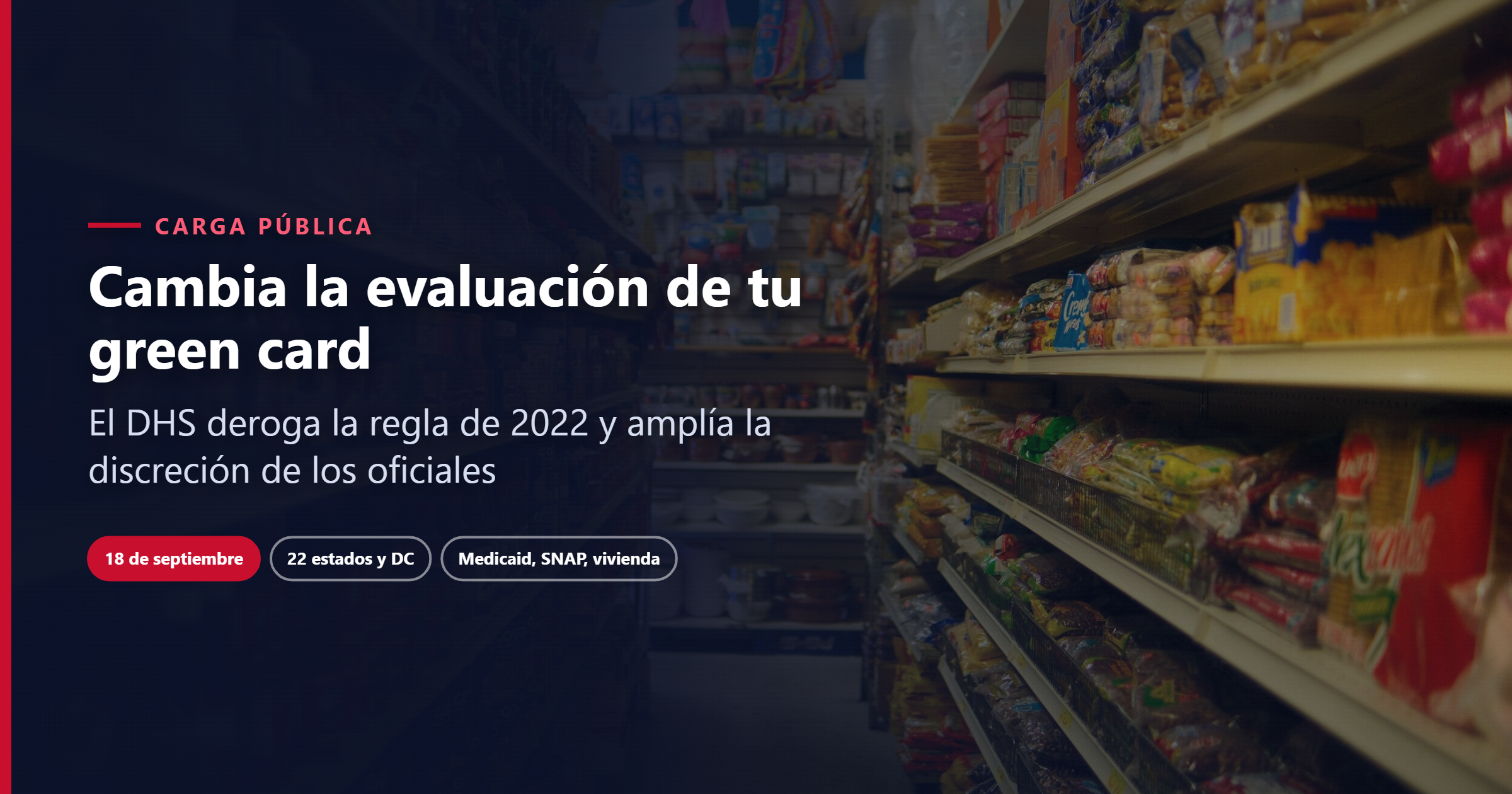
If you are applying for permanent residence and someone in your household receives Medicaid or food stamps, you have probably heard the rumor this week. It is worth separating what the rule says from what fear is already doing.
En el bufete de abogados Campos, seguimos de cerca la evolución de la política de inmigración de EE. UU. para proteger los derechos y el futuro de nuestros clientes. A continuación te explicamos lo que se sabe, lo que aún no se sabe y qué puedes hacer.
What exactly changes on September 18?
The Department of Homeland Security (DHS) published a final rule on July 20, 2026 that rescinds the 2022 public charge regulations, effective September 18, 2026.
The 2022 rule limited the analysis almost entirely to cash assistance for basic living expenses and government-funded long-term institutional care. By rescinding it, DHS removes those closed definitions and restores broad discretion for officers to weigh “the totality of the circumstances.”
In practice, benefits previously off the table — Medicaid, CHIP, SNAP food benefits and means-tested housing assistance — can now count as one factor among others. Officers must still weigh the five statutory factors: age, health, family status, financial resources, and education or skills.
One detail that matters: under the rule itself, only benefits received on or after the effective date are considered.
Who sued, and where?
El 14 de septiembre de 2026, two lawsuits were filed in the U.S. District Court for the Southern District of New York:
- A coalition of 22 states and the District of Columbia, led by New York Attorney General Letitia James alongside California and Illinois.
- A coalition of cities and counties: New York, Chicago, San Francisco and Seattle, plus Santa Clara and King counties.
The plaintiffs argue the rule is arbitrary and capricious, that it exceeds DHS’s statutory authority, and that it departs from the meaning Congress has long given to “public charge.”
Colorado Attorney General Phil Weiser put it this way: the rule “weaponizes the public charge test to harm legal immigrant children and families and cause fear, confusion and uncertainty about accessing benefits they are legally entitled to receive.”
That fear has support in the government’s own numbers: DHS’s regulatory impact analysis estimates roughly 950,000 legally eligible people will drop benefits out of fear, and about 588,000 applicants a year will fall under the expanded review.
Will I lose my green card if my U.S. citizen child uses Medicaid?
This is the question we hear most, and the nuanced answer is the most important part of this article.
The rule does not attribute to the applicant benefits received by other family members. If your child is a U.S. citizen and uses Medicaid, CHIP or the school lunch program, that is not counted as a benefit you received. Your household’s economic facts may still be relevant to assessing your resources, but that is a different thing.
Nor is it an automatic test. Public charge is a forward-looking, whole-picture analysis: the officer must assess whether a person is likely to depend on the government in the future, not punish a past benefit.
And some categories are not subject to public charge at all, because the exemption sits in the statute rather than in the rescinded regulation: refugees and asylees, Special Immigrant Juveniles, victims of trafficking and of certain crimes (T and U visas), and VAWA self-petitioners.
That said, without absolutes: every case is assessed individually, and officer discretion is now broader. That is why it is worth reviewing your file with an attorney before deciding anything.
What can you do before September 18?
- Do not cancel benefits out of panic: giving up health care or food for your U.S. citizen children carries a real cost and may change nothing in your case.
- Check which category you are in: if you are applying through refugee or asylee status, VAWA, T, U or SIJ, the public charge test does not apply to you.
- Organize your financial evidence: tax returns, employment letters, work history, health insurance, degrees and certifications.
- Mind the Affidavit of Support (I-864) if your case requires one: it is the document that weighs most in the resources analysis.
- Note who receives which benefit and since when: dates matter, because only benefits received from the effective date onward count.
- Follow the litigation before making big decisions: a court can halt the rule, and that has happened with earlier versions.
Protege tu situación migratoria con el bufete de abogados Campos
The deepest harm from a rule like this is not always in the denials: it is in the families who withdraw from programs they qualify for because nobody explained the scope to them clearly. In a country where every decision can change your future, having the right information is your best tool.
At Campos Law Firm we check whether public charge actually applies to your case, prepare the financial evidence that strengthens your filing, and let you know when the litigation shifts the landscape. We do not make unrealistic promises. We provide serious legal representation backed by preparation and integrity.
No dejes tu situación migratoria al azar. Llámanos hoy mismo al +1 (844) 922-6767 para concertar una consulta gratuita y confidencial en inglés o en español. Bufete de Abogados Campos: soluciones jurídicas en todas las áreas del derecho.

 English
  Spanish