
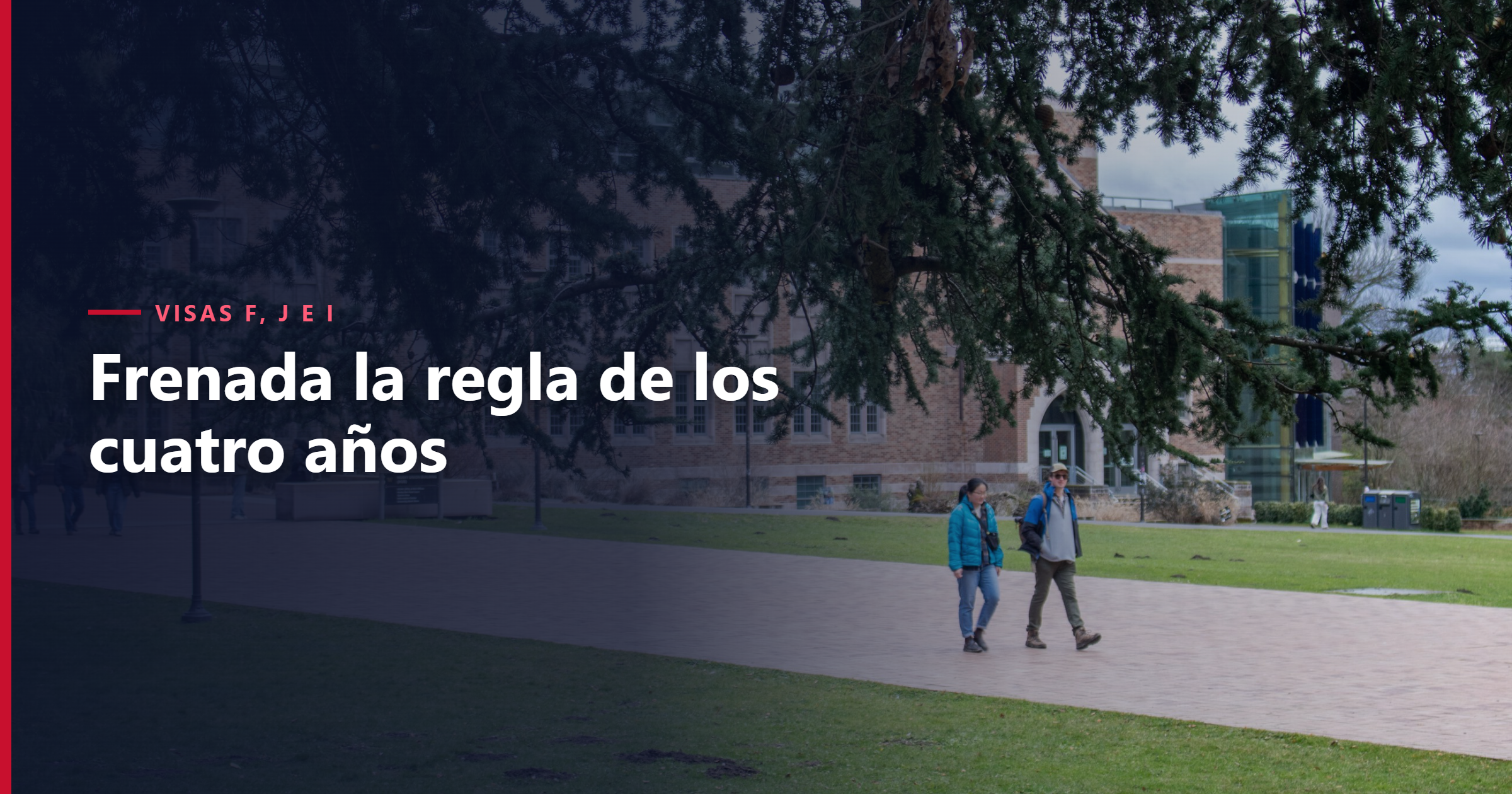
If you hold a student, exchange visitor or foreign media visa, you were supposed to wake up this week under new rules. You did not: a federal judge halted the change one day before it was to take effect.
En el bufete de abogados Campos, seguimos de cerca la evolución de la política de inmigración de EE. UU. para proteger los derechos y el futuro de nuestros clientes. A continuación te explicamos lo que se sabe, lo que aún no se sabe y qué puedes hacer.
¿Qué decidió el juez?
El 14 de septiembre de 2026, juez federal de distrito F. Dennis Saylor IV, of the District of Massachusetts, granted a nationwide preliminary injunction en Presidents’ Alliance et al. v. Department of Homeland Security.
The order postpones the rule’s effective date and bars the Department of Homeland Security (DHS) and Immigration and Customs Enforcement (ICE) from implementing it further. The rule had been published on July 17, 2026 and was set to govern from September 15.
The judge found that, at this stage, the plaintiffs are likely to succeed: the government failed to comply with the Administrative Procedure Act in issuing it. On the national security rationale DHS invoked, Saylor wrote: “The use of such labels does not, however, give DHS license to ignore its statutory obligations.”
The plaintiffs include the Presidents’ Alliance on Higher Education and Immigration, NAFSA and the American Federation of Teachers.
What would the rule have changed?
Today, someone admitted on an F or J visa enters for “duration of status” (D/S on the I-94): you may remain as long as you are fulfilling your program’s purpose, with no fixed expiration on the admission itself.
The blocked rule replaced that with fixed periods:
- Students (F) and exchange visitors (J): admission of up to four years, with new limits on changing educational objective, transferring schools or adding programs.
- Foreign media representatives (I): hasta 240 days, y 90 días for certain journalists holding Chinese passports.
- Periodic extensions: anyone needing more time would file an Extension of Stay application with U.S. Citizenship and Immigration Services (USCIS), including biometrics and proof of academic progress and financial resources.
For a six-year doctorate or a graduate program with extensions, that meant new filings, fees and waits every few years.
What does this mean today for your F, J or I visa?
Por ahora, nothing changes: duration of status remains in place.
- You do not need to file an extension simply because your program runs longer than four years.
- Transfer, program-change and practical training rules (CPT and OPT) stand as they were.
- Your I-20 or DS-2019 keeps its usual role: what maintains your status is meeting the program and full course load, not a fixed admission date.
A distinction worth making here, because it trips people up daily. A visa is the stamp a consulate issues, and it only lets you request entry. Status is your legal condition inside the country, set by Customs and Border Protection (CBP) on the I-94. A visa expiring while you study does no put you out of status; dropping below a full course load or working without authorization does.
Is this a final decision?
No — and this is not the moment to relax.
A medida cautelar freezes the situation while the case is litigated. The government may appeal, and the court still has to rule on the merits. A rule blocked for procedural defects can return later, corrected.
In the meantime, the sensible move is to prepare without panicking:
- Keep copies of everything: each period’s I-20 or DS-2019, your I-94, USCIS receipts, enrollment records and work authorizations.
- Talk to your international office (DSO or program sponsor) before any change: transfer, dropping courses, level change or medical leave.
- Watch the dates, not just the visa: the program end date on your I-20 and any practical training authorization.
- Do not travel without checking your paperwork: a missing travel signature on the I-20 can complicate reentry.
- Ask before making irreversible decisions: abandoning a program or accepting unauthorized employment carries consequences no court order undoes.
Protege tu situación migratoria con el bufete de abogados Campos
For thousands of families this rule was not a technicality: it was the difference between finishing a degree in peace and depending on a filing renewable every four years. The block brings relief, but the litigation is still open.
At Campos Law Firm we help students, researchers and professionals maintain status, plan transitions to other categories, and respond in time when the rules shift. We do not make unrealistic promises. We provide serious legal representation backed by preparation and integrity.
No dejes tu situación migratoria al azar. Llámanos hoy mismo al +1 (844) 922-6767 para concertar una consulta gratuita y confidencial en inglés o en español. Bufete de Abogados Campos: soluciones jurídicas en todas las áreas del derecho.
 English
  Spanish