
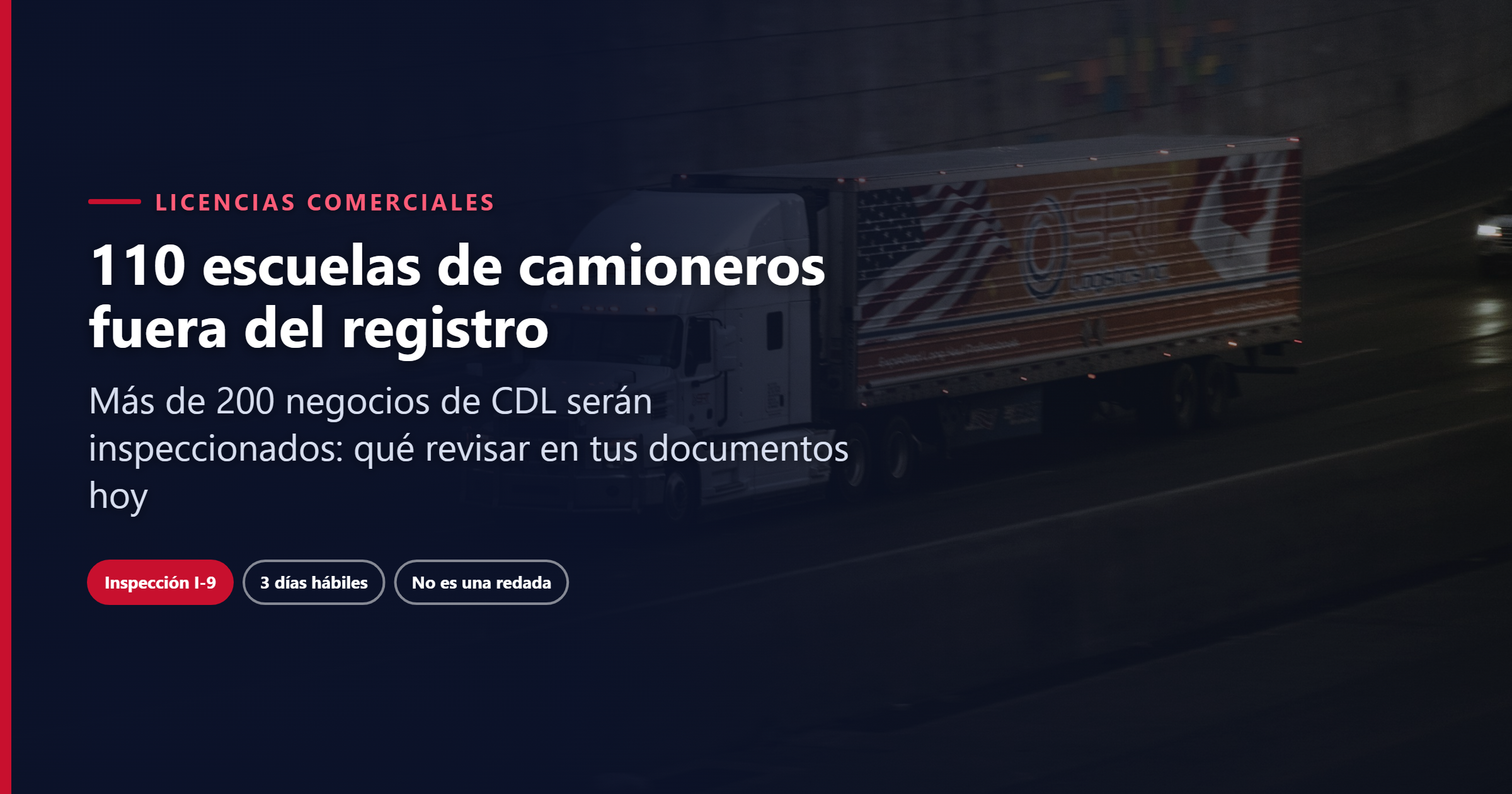
If you drive a truck, are about to get your commercial license, or run a trucking company, this news reaches you directly. Before you panic, though, one distinction almost nobody explains is worth fixing in your mind: an inspection is not a raid, and an investigation is not a finding of fraud.
At Campos Law Firm, we closely monitor developments in U.S. immigration policy to protect our clients’ rights and future. Below, we explain what was announced, how far it actually reaches, and what you can check today.
¿Qué está pasando?
El August 31, 2026, the Department of Transportation, together with the Department of Homeland Security (DHS), the Department of Justice, and eight U.S. Attorneys, announced an interagency crackdown on alleged fraud in the commercial driver’s license (CDL) industry. The initiative is called Joint Task Force Crossroads of America and centers on Illinois, Indiana, Michigan, and Ohio.
The figures published in the announcement itself:
- More than 110 training providers were removed on an emergency basis from the federal Training Provider Registry after being linked to more than 5,000 violations of the English language proficiency requirement.
- More than 200 CDL schools and related businesses will face a coordinated Homeland Security Investigations (HSI) operation, spread across 23 special agent in charge offices.
- More than 160 notices of proposed removal were issued against other providers in separate investigations.
- More than 80 Form I-9 notices of inspection have already gone out, along with over 1,000 leads on CDL businesses distributed to field offices.
The Department of Transportation links these providers to 239 deaths in commercial vehicle crashes. Attorney General Todd Blanche said that “the safety of American roadways affects everyone across the country.”
Do I lose my license if I trained at one of those schools?
Not automatically, and this is the question causing the most anxiety.
The regulation (49 C.F.R. § 380.723) provides that training conducted after the date of removal is invalid. In other words, invalidity runs forward. Someone who completed training before that date is not disqualified simply because their school left the registry.
Two honest warnings. First, the regulation (§ 380.721) allows retroactive invalidation where fraud or criminal conduct is involved, which is precisely the ground invoked here, though the agency has not declared it case by case. Second, a license can be canceled if the state agency determines the underlying certification was fraudulent.
If you have not yet taken your exam and your school was removed, you will need to retrain with a listed provider. It is worth checking today whether your provider is still on the federal registry.
What is an I-9 inspection, and how is it different from a raid?
This difference determines how you should respond.
An I-9 inspection es un administrative process under section 274A of the Immigration and Nationality Act. It begins with a written Notice of Inspection, and the employer has at least three business days to produce the forms. Other notices may follow: suspect documents, technical failures — with at least 10 business days to correct them — a warning notice, or a notice of intent to fine.
A raid is something else: no advance notice, and its instrument is a warrant signed by a judge. Two practical rules are worth knowing:
- Agents may enter areas open to the public, such as a lobby, but not closed areas — offices, shops, classrooms — without consent or a judge-signed warrant.
- An administrative immigration warrant (Form I-200 or I-205) is not enough to enter those private areas: it is signed by an ICE officer, not a judge, and names one specific person.
By the announcement’s own terms, the declared instrument of this operation is the notice of inspection — a largely administrative route — though with parallel criminal investigations into document fraud, identity theft, and labor exploitation.
Who is affected, and what can you do today?
- Verify your training provider: check whether it is still on the federal registry, and keep your certificate and the date you completed the course.
- Review your documents: license, Form I-94, work permit. Since 2026, the federal rule on commercial licenses for non-domiciled applicants narrowed eligibility to H-2A, H-2B, and E-2 status, leaving out work permit holders, asylees, asylum applicants, refugees, TN, and H-1B. If your CDL was issued under another category, get advice before renewing.
- Employers: audit your I-9s now, not when the notice arrives. Three business days is not long to organize a messy file.
- During an inspection or a visit: ask to see the document, check whether a judge signed it, do not consent to entry into private areas, and do not hand over more than what was requested.
- As a worker: you have the right to remain silent, to sign nothing, and to ask for an attorney. You are not required to answer about your place of birth or your status.
- Never use false documents or claim U.S. citizenship if you are not a citizen: a false claim to citizenship creates permanent inadmissibility with virtually no waiver.
Protect Your Work and Your Status with Campos Law Firm
An inspection is not an accusation, and having been on the roster of a removed school does not mean you committed fraud. But the window to react is short, and the mistakes made in those days — one document handed over too many, one hurried signature — can weigh for years afterward.
At Campos Law Firm we review your paperwork, your drivers’, or your company’s, and stand with you if a notice arrives. No dejes tu situación migratoria al azar. Llámanos hoy mismo al +1 (844) 922-6767 para concertar una consulta gratuita y confidencial en inglés o en español. Bufete de Abogados Campos: soluciones jurídicas en todas las áreas del derecho.

 English
  Spanish