
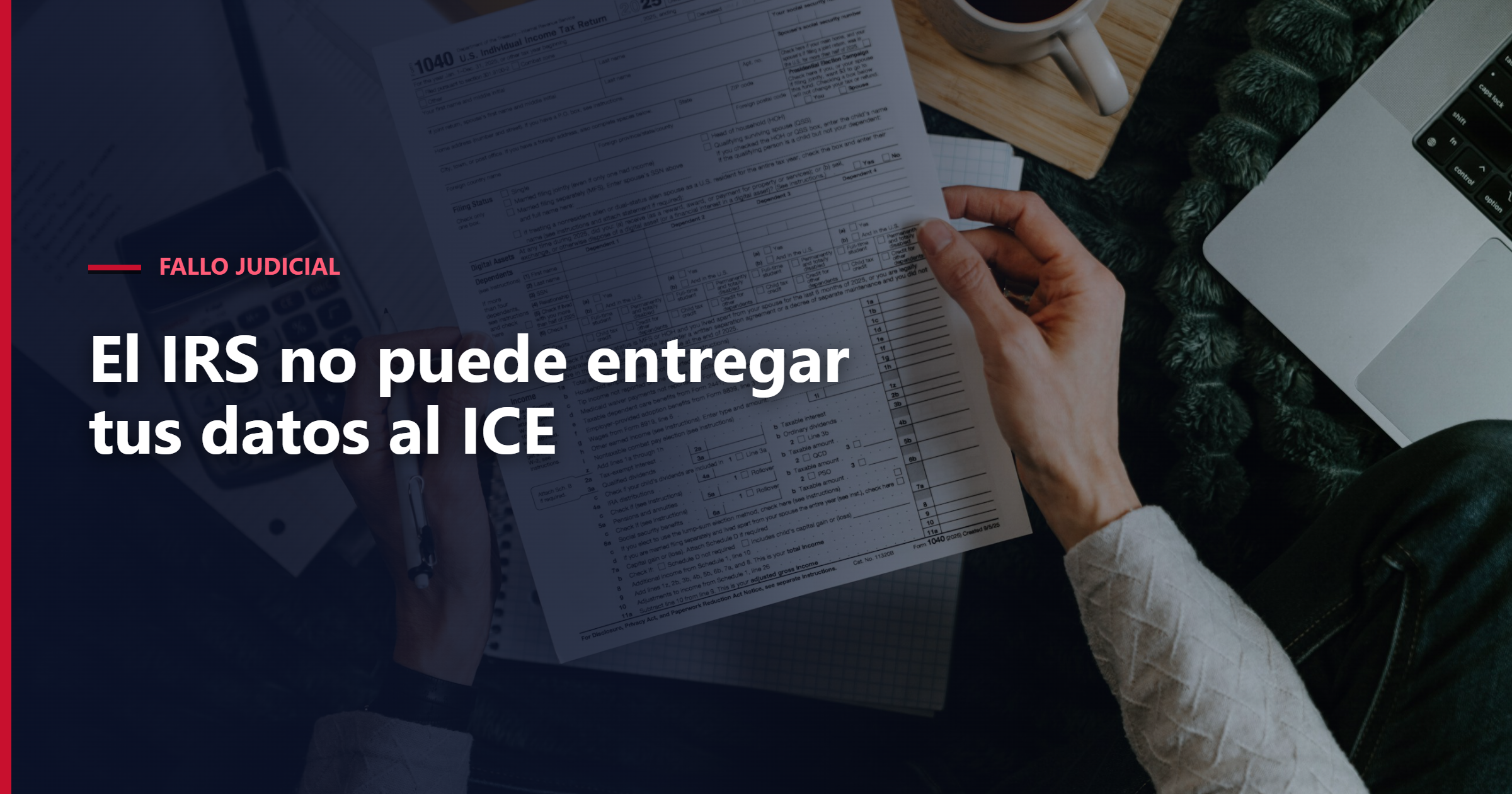
If you file taxes with an ITIN and you have spent months wondering whether that return could end up with ICE, this ruling affects you directly.
At Campos Law Firm, we closely monitor developments in U.S. immigration policy to protect our clients’ rights and future. Here is what the court decided, what it does not change, and what to do next.
¿Qué decidió el tribunal?
El 8 de septiembre de 2026, a three-judge panel of the U.S. Court of Appeals for the D.C. Circuit upheld the preliminary injunction blocking the data-sharing agreement between the Internal Revenue Service (IRS) and Immigration and Customs Enforcement (ICE).
The panel found that the IRS violated the federal taxpayer confidentiality law enacted after Watergate — now Section 6103 of the Internal Revenue Code — which allows disclosure to another agency only under strict conditions verified case by case.
Judge Cornelia Pillard wrote that the system “automates the review of millions of records without any individual review or any other means of ensuring compliance with the legal prerequisites to releasing each individual taxpayer’s information.”
How much data was shared, and who sued?
Under a memorandum of understanding signed in July 2025, the IRS processed ICE requests for the addresses of people it suspected of being in the country without authorization.
- 47,289 taxpayer addresses were actually disclosed, according to the record.
- The program targeted a far larger pool: roughly 1.28 million names.
- The system accepted five- or nine-digit numbers in address fields even when they were not real ZIP codes — a detail that shows how little review the process involved.
The plaintiffs are the Center for Taxpayer Rights y Main Street Alliance, represented by Democracy Forward. Its president, Skye Perryman, said the post-Watergate privacy protections “exist to prevent abuses of power just like this.”
Does this mean my tax return is fully protected?
It would be a mistake to read the ruling as complete protection. Here is the distinction that matters most.
- The order is preliminary, not final. It blocks the agreement while the case proceeds; it does not end the litigation or prevent the government from trying to redesign the mechanism.
- The statute does have exceptions. Section 6103(i) permits disclosure of taxpayer identity information to a federal agency in a criminal investigation, through a written request naming the person and the offense under investigation. What the court rejected was bulk, automated disclosure — not the exception itself.
- Tax data is not the only channel. The Department of Homeland Security (DHS) has other data sources, and this ruling does not reach them.
- Being out of status is not by itself a federal crime. Unlawful presence is a civil immigration violation, and that distinction is part of the underlying legal dispute.
Should I stop filing taxes?
That reaction is understandable, and it is also the riskiest one. In most cases, stopping does more harm than good.
- Many forms of immigration relief require a tax history. Cancellation of removal, adjustment of status and several discretionary applications ask you to show good moral character and tax compliance. A multi-year gap is hard to explain to an immigration judge.
- Not filing carries its own consequences: interest, penalties and, in serious cases, criminal exposure — regardless of your immigration status.
- The ITIN exists precisely so people can comply. It was created so those without a Social Security number could pay taxes.
- Update your address carefully. If you have a pending case, the address on file with USCIS or the immigration court determines whether you receive notices. Talk to an attorney before changing addresses across several systems at once.
- Keep your records. Returns, W-2s, pay stubs and IRS transcripts are useful evidence in almost any immigration case.
None of this replaces an individual review: every file has its own history, deadlines and risks.
Protege tu situación migratoria con el bufete de abogados Campos
A favorable appellate ruling is good news, but it does not answer the question each family actually has: what information exists about me, what cases are open, and what risks do I really face. Answering that takes a file review, not a headline.
En Campos Law Firm we review your immigration and tax history, identify the legal options available to you, and stand with you at every step. We do not make unrealistic promises. We provide serious legal representation backed by preparation and integrity.
No dejes tu situación migratoria al azar. Llámanos hoy mismo al +1 (844) 922-6767 para concertar una consulta gratuita y confidencial en inglés o en español. Bufete de Abogados Campos: soluciones jurídicas en todas las áreas del derecho.


 English
  Spanish