
If you or a family member were fitted with an electronic ankle monitor at an appointment with Immigration and Customs Enforcement (ICE), you are not alone, and you are not without options. Electronic monitoring has expanded sharply over the past year and a half, and most people wearing a device do not know that a formal process exists to ask that it be removed or reduced.
At Campos Law Firm, we closely monitor developments in U.S. immigration policy to protect our clients’ rights and future. Below, we explain what the data shows, what this program actually is, and what you can do.
¿Qué está pasando?
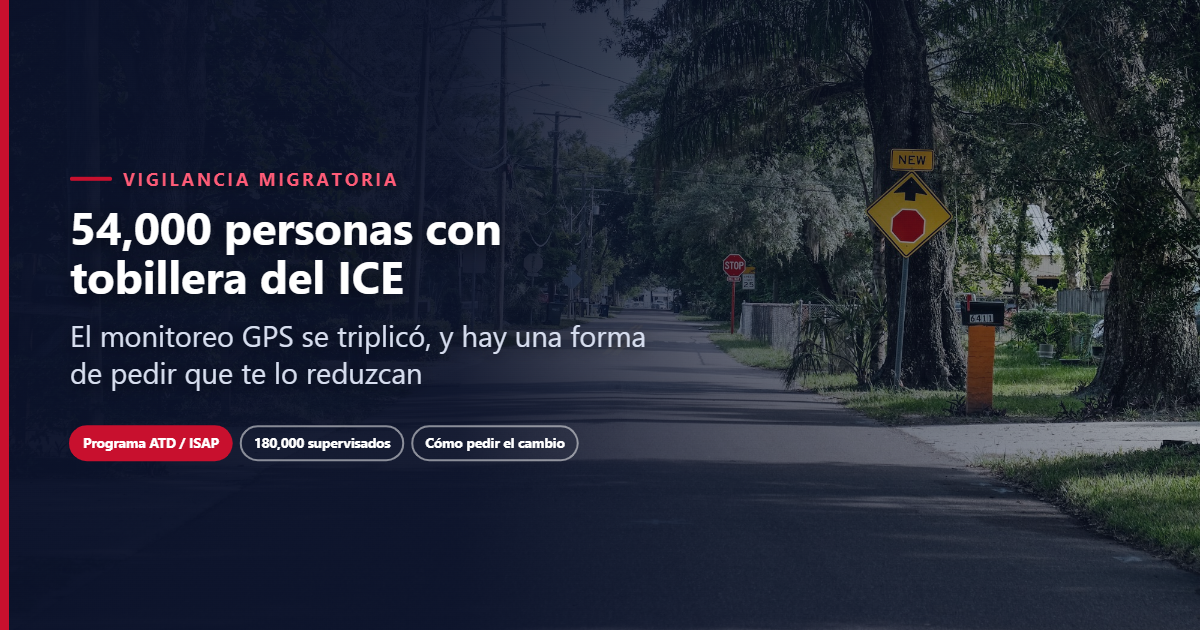
On August 27, 2026, Noticias Telemundo reported, based on ICE data, that about 54,000 people are currently wearing a GPS ankle monitor, up from just over 17,000 at the start of the current administration. In total, roughly 180,000 people are enrolled in some form of electronic supervision.
Independent figures confirm the trajectory. Researcher Austin Kocher, working from ICE’s own data, documented about 24,600 ankle monitors in mid-2025 and more than 40,000 by January 2026, the highest number in the agency’s recorded history at that point.
There is a specific instruction behind the increase. An internal ICE memorandum dated June 9, 2025, signed by acting assistant director Dawnisha M. Helland and obtained by The Washington Post, directs officers that when a person is not arrested at a reporting appointment, they should “escalate their supervision level to GPS ankle monitors whenever possible and increase reporting requirements.”
What is the ATD program, and what are its levels?
The program is called Alternatives to Detention (ATD) and runs through the Intensive Supervision Appearance Program (ISAP), operated by the private company BI Incorporated, a subsidiary of GEO Group. It has three levels:
- Telephonic reporting: the lightest form; a voiceprint is created at enrollment and matched at each check-in. It costs about $0.18 per day.
- SmartLINK: a smartphone app with facial recognition that captures a single GPS point at login and at check-ins. It is the most common level, roughly 70 percent of the total, at about $0.96 per day.
- Body-worn GPS: the ankle monitor, or the VeriWatch wrist device. The most restrictive and the most expensive, at roughly $2.74 and $4.50 per day.
It is worth saying plainly, because the program’s name misleads: ATD is not always an alternative to a detention that would otherwise happen. In practice, nearly everyone under monitoring had already been released. The monitoring is a condition of that release, not a substitute for jail.
One finding runs against intuition: a 2021 Cardozo School of Law study found a 98 percent appearance rate among people without a monitor, compared with 93 percent among those with one. There is no evidence the device improves compliance.
What is the legal basis, and what are the real effects?
It depends on the stage of your case, and the difference matters:
- If your case is still open before the Immigration Court, ICE detained you under section 236(a) of the Immigration and Nationality Act and released you on conditions, under 8 C.F.R. § 236.1(c)(8). Monitoring is one of those conditions.
- If you already have a final order of removal, what governs is an Order of Supervision (Form I-220B), under 8 C.F.R. § 241.5.
The effects documented by attorneys, law school clinics, and reporters go well beyond discomfort. People report swelling, irritation, and permanent scarring at the ankle; pain when walking and trouble sleeping; constant dependence on a charger; alerts they cannot interpret when they speak neither English nor Spanish; and a direct hit to employment. “The mere presence of the electronic bracelet is a barrier to employment,” immigration attorney Brian R. Duggan told Documented. Attorney Malak Shalabi put it this way: “It’s very dehumanizing for a lot of our clients.”
Can you ask to have it removed?
Yes. It is neither automatic nor guaranteed, but a process exists and many people never use it.
- Go to the right person: the request goes to the ICE deportation officer (ERO) assigned to your case. The BI case specialist you see at check-ins has no authority to change your level.
- Submit it in writing with your name, A-number, the stage of your case, your current level, and specific reasons. ICE must respond in writing, with an explanation, within two business days.
- Document what supports you: your record of attending check-ins and hearings, absence of a criminal record, family and community ties, and above all medical or mental health conditions, which tend to be the strongest argument.
- Keep evidence of device failures: faulty batteries and false alerts are common, and many alleged “violations” are technical failures. Documenting them as they happen is essential.
- If you are denied, escalate: a denial can move up the ICE supervisory chain to the Field Office Director.
- Watch the court deadline: an immigration judge may modify your release conditions only within 7 days of release (8 C.F.R. § 236.1(d)(1)). After that, the request goes to ICE, and a denial may be appealed to the Board of Immigration Appeals (BIA) within 10 days.
Specific protections also exist: ICE Directive 11032.4, dated July 1, 2021, prohibits GPS monitoring of people who are pregnant, postpartum, or nursing. A 2009 memorandum requires discontinuing the ankle device when a medical condition makes it inappropriate.
And one warning that deserves no softening: missing a reporting appointment can lead to an increase in your supervision level, to arrest, and to detention. If you have a problem with an appointment, say so beforehand, not afterward.
Protege tu situación migratoria con el bufete de abogados Campos
An ankle monitor does not define your case, but it shapes your daily life: your job, your movement, your health, and your peace of mind. And the route to changing your level depends on whether your case is still open or a final order already exists, something many people are not clear about in their own situation.
At Campos Law Firm, we review where your case stands, prepare the request to the right officer, and stand with you at every appointment. No dejes tu situación migratoria al azar. Llámanos hoy mismo al +1 (844) 922-6767 para concertar una consulta gratuita y confidencial en inglés o en español. Bufete de Abogados Campos: soluciones jurídicas en todas las áreas del derecho.


 English
  Spanish