
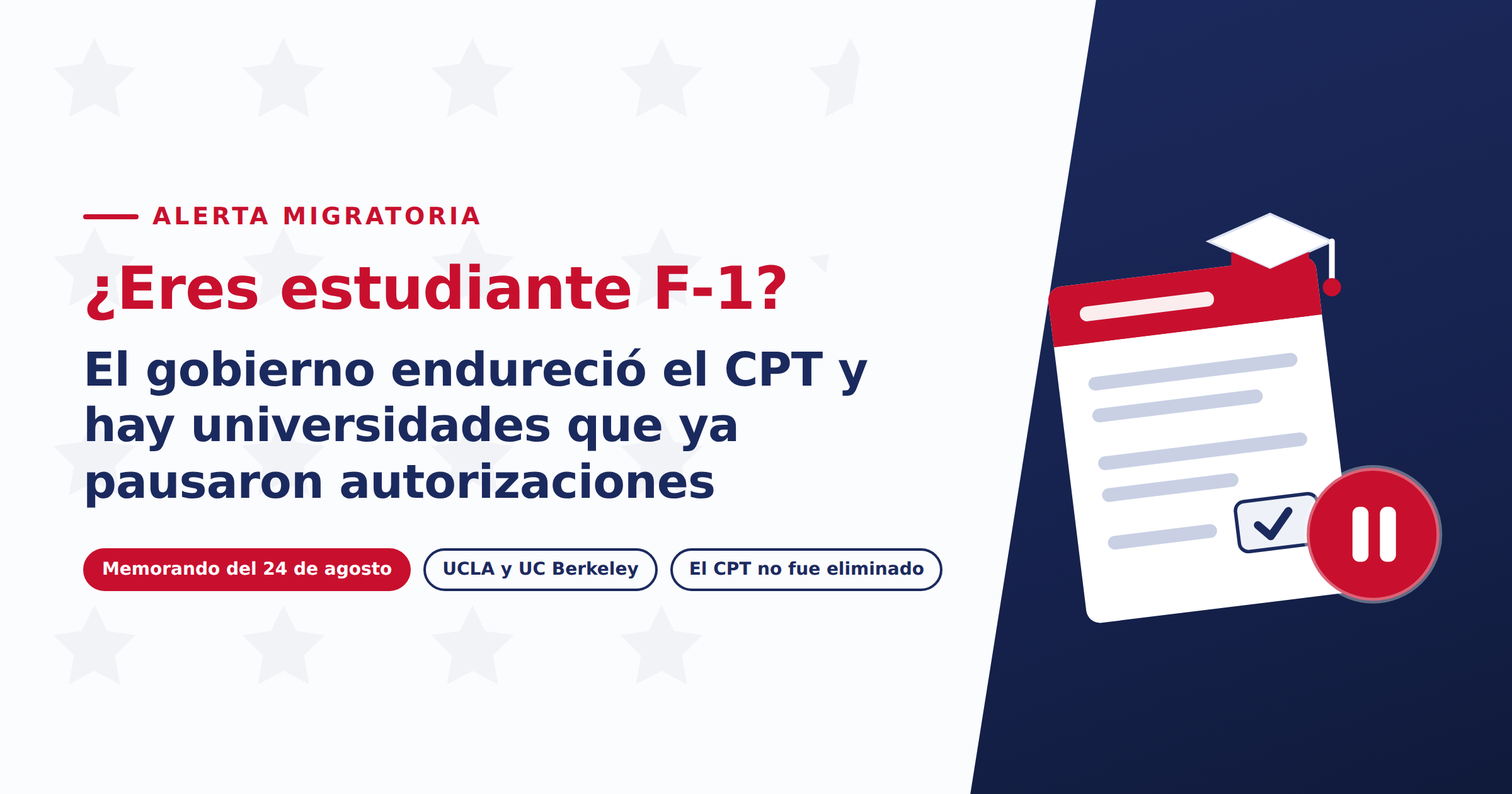
If you are an international student on an F-1 visa with a placement approved by your school, this affects you directly. The government has tightened oversight of Curricular Practical Training (CPT), and several universities have already paused authorizations while they review the federal instructions.
At Campos Law Firm, we closely monitor developments in U.S. immigration policy to protect our clients’ rights and future. Below is what is known, what has not changed, and what you can do now.
¿Qué está pasando?
According to Reuters, the administration sent universities across the country a federal memo dated August 24, 2026. It came from the Student and Exchange Visitor Program (SEVP), the Immigration and Customs Enforcement (ICE) office that certifies schools authorized to enroll foreign students.
The memo states that the agency has “observed a rise in Curricular Practical Training (CPT) authorizations that appear to violate regulatory requirements which permit CPT only where the training is an integral part of an established curriculum.”
The warning to institutions is explicit: “Failure to comply with SEVP regulations may result in an institution losing certification to enroll foreign students.”
Asked by Reuters, the Department of Homeland Security (DHS) said the regulations have not changed, while adding that “schools and employers should consider themselves on notice: under President Trump, abuse of this generous system will no longer be tolerated.”
What did UCLA and UC Berkeley say?
Both universities confirmed to Reuters that they are slowing parts of the process.
- UCLA: “UCLA has paused certain Curricular Practical Training authorizations while it reviews recent federal guidance and determines next steps.”
- UC Berkeley: its international office described the memo as “more narrow in focus, more direct, and includes content that is more restrictive in nature” than an earlier communication issued in mid-August, and said it was unlikely to process certain requests in the near term, while continuing to process CPT that is a degree requirement.
That detail matters: this is not a single document but a sequence. Earlier in August, SEVP had already circulated notices reminding designated school officials (DSOs) of their liability when authorizing CPT, applying a stricter reading of what “integral part of an established curriculum” means — the training must be essential to completing the degree, directly related to the student’s major, and formally recorded academically, not authorized solely for employment purposes.
Does this eliminate CPT or affect my F-1 status?
No. CPT has not been eliminated, and the regulations are unchanged. What changed is the level of scrutiny and, with it, how universities behave. It also does not affect Optional Practical Training (OPT), a separate authorization issued by U.S. Citizenship and Immigration Services (USCIS).
Even so, it is worth understanding how CPT and status relate, because they are not the same thing. CPT is a work authorization approved by a DSO in the SEVIS system and recorded on your Form I-20, always for one specific employer and one specific period. Your F-1 status depends on staying enrolled full time and meeting your program’s conditions.
The risk runs the other way: working without valid CPT authorization is unauthorized employment, which can amount to a status violation with consequences for future visa or residency applications. So when an authorization is paused, the right move is never to start or keep working “while it gets sorted out.”
Two points that are easy to miss:
- One full year of full-time CPT eliminates your eligibility for OPT. Before accepting a full-time placement, check how much you have already used.
- If a school lost SEVP certification, its students are not automatically deported, but they face a difficult transfer or reinstatement scenario that calls for immediate legal advice.
As Attorney Alejandra Campos, founder of Campos Law Firm, reminds students, decisions should not be based on headlines: it is one thing for the government to announce closer scrutiny, and quite another for your specific authorization to be at risk.
¿Qué puedes hacer ahora?
- Do not start or continue working without an endorsed I-20. Confirm your CPT is approved in SEVIS, with the correct employer and dates, before day one.
- Contact your DSO in writing. Ask whether your authorization is paused, on what basis, and what academic documentation supports that the placement is part of your program.
- Keep academic evidence: your curriculum, the associated course or credits, the job description and its connection to your major, and every notice from the school.
- Review your CPT history: how many months of full-time CPT you have used and how that affects future OPT.
- Tell your employer early if the offer depends on CPT, rather than gambling on a start date.
- Habla con un abogado especializado en inmigración before deciding to change programs, schools, or status.
Protege tu situación migratoria con el bufete de abogados Campos
The memo does not eliminate CPT or rewrite the regulations, but it shifts pressure onto universities, and they are responding with pauses and stricter standards. In practice, a technical error in your authorization can turn into a status problem that follows you for years.
Every case depends on your program, your authorization history, and the exact dates on your I-20. If you are an F-1 student whose CPT is on hold, or you are unsure whether your placement meets the new standards, Campos Law Firm is here to help you review your situation and protect your student status. From immigrants, for immigrants.
No dejes tu situación migratoria al azar. Llámanos hoy mismo al +1 (844) 922-6767 para concertar una consulta gratuita y confidencial en inglés o en español. Bufete de Abogados Campos: soluciones jurídicas en todas las áreas del derecho.

 English
  Spanish